The Critics' Corner on THEY WERE EXPENDABLE
"The most thrilling and electrifying passages in the film are those
which show the torpedo-boat action - the midgets closing boldly on
their prey, slamming their 'fish' out of the raked tubes then wheeling
around in their white wakes, Mr. Ford and his watchful photographers
have caught battle action at the full, even to the dying appearance of
spent cartridge cases on the decks. But the drama and essence of the
story are most movingly refined in those scenes which compose the
pattern of bravery and pathos implicit in the tale. Mr. Ford, and
apparently his scriptwriter, Frank Wead, have a deep and true regard
for men who stick to their business for no other purpose than to do
their jobs. To hold on with dignity and courage, to improvise when
resources fail and to face the inevitable without flinching - those
are the things which they have shown us how men do. Mr. Ford has made
another picture which, in spirit, recalls his 'Lost Patrol.' It is
nostalgic, warm with sentiment and full of fight in every foot." -
Bosley Crowther, The New York Times, December 26, 1945.
"Produced and photographed excellently, it's highly interesting if too
long. Regardless of any actual or supposed reaction against war
films, this one is virtually certain to go over big. It has as a
box-office aspect in the fact that the book on which it's based was a
bestseller. Also, it's the first pic for Robert Montgomery since he
was mustered out of the Navy, with which he served as a
lieutenant-commander...The battle scenes in which the P-Ts go after
Jap cruisers and supply ships were exceptionally well directed and
photographed...Running time of 135 minutes could have been cut way
down." Char., Variety, November 21, 1945.
"For what seems at least half of the dogged, devoted length of They
Were Expendable all you have to watch is men getting on or off PT
boats, and other men watching them do so. But this is made so
beautiful and so real that I could not feel one foot of the film was
wasted. The rest of the time the picture is showing nothing much
newer, with no particular depth of feeling, much less idea; but,
again, the whole thing is so beautifully directed and photographed, in
such an abundance of vigorous open air and good raw sunlight, that I
thoroughly enjoyed and admired it. Visually, and in detail, and in
nearly everything he does with people, I think it is John Ford's
finest movie." James Agee, The Nation, January 5,
1946.
"Ford...has framed sequence after sequence with such consummate skill
and knowledge that one is given a key to recent conflict as well as a
fiercely moving account of that conflict. [The film] is way up in the
top brackets of movie making...The actors have obviously had something
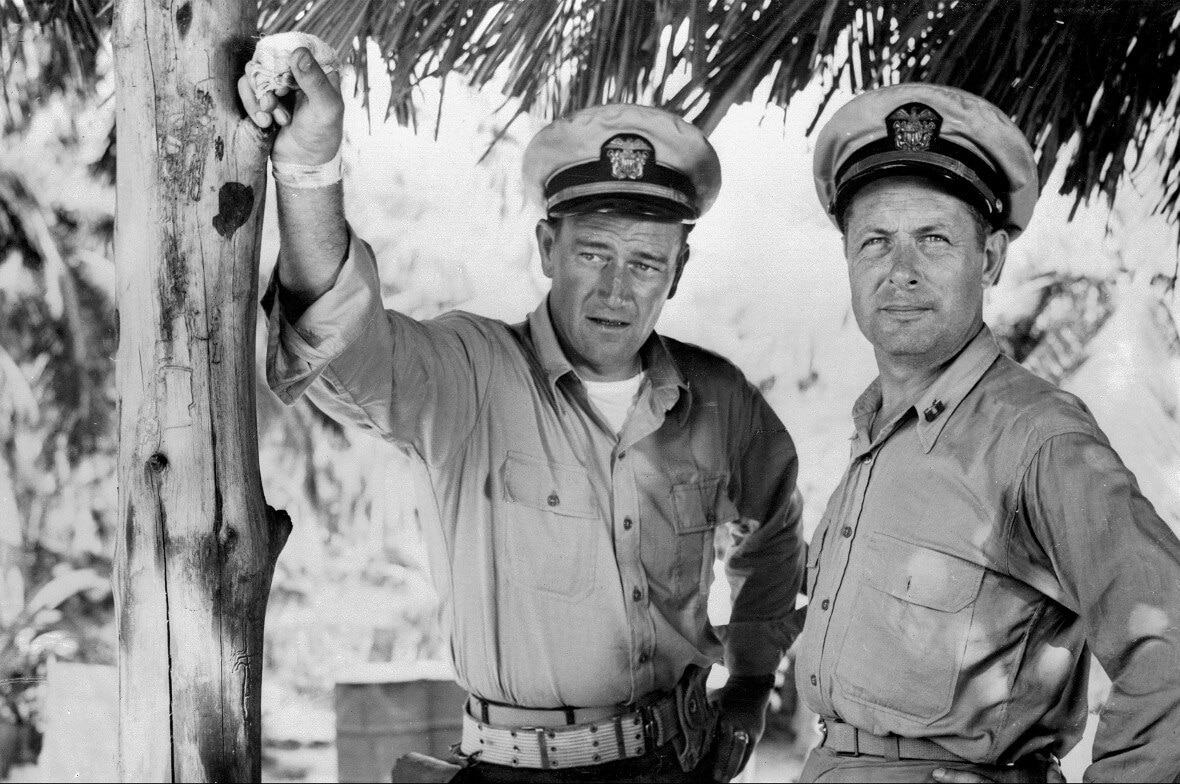
to do with this. Montgomery is especially striking as the commander
of the expendable little squadron¿ He plays with a quiet authority
which always defines a scene in its human aspects. John Wayne is
excellent as another skipper and so are too many performers to list
here..." Howard Barnes, New York Herald Tribune, December,
1945.
"...the film is not flag-waving propaganda or hero worship. It does
have an almost reverential attitude toward the armed services...At the
same time, though, Ford is aiming for a degree of realism that films
made earlier in the war lacked...If John Wayne and Donna Reed have the
most emotional dramatic moments, the film rests on Robert Montgomery's
understated work. When the film was made, Montgomery had just left the
Navy. Perhaps that experience gives him the aura of quiet conviction
that provides the balance to Wayne's louder, more bellicose character.
Ford works with the difference between the two throughout, but brings
it to the surface only in the final scene, where he plays against all
of the audience's heroic expectations. It's an unusual conclusion to
an unusually complex film." - Mike Mayo, Videohound's War Movies:
Classic Conflict on Film.
"The tugs of docudrama, emotionalism and sheer timing produced a major
work of surprisingly downbeat romanticism...A curious movie, whose
premises Ford would obsessively rework in his subsequent cavalry
pictures, with the luxury of historical distance." - Paul Taylor,
TimeOut Film Guide.
Awards and Honors:
The film received only two Academy Award Nominations in lesser
categories: Best Special Effects and Best Sound Recording.
by John Miller
The Critics Corner (5/28) - THEY WERE EXPENDABLE
by John Miller | February 17, 2005
SIGN UP FOR OUR NEWSLETTERS

CONNECT WITH TCM