SYNOPSIS
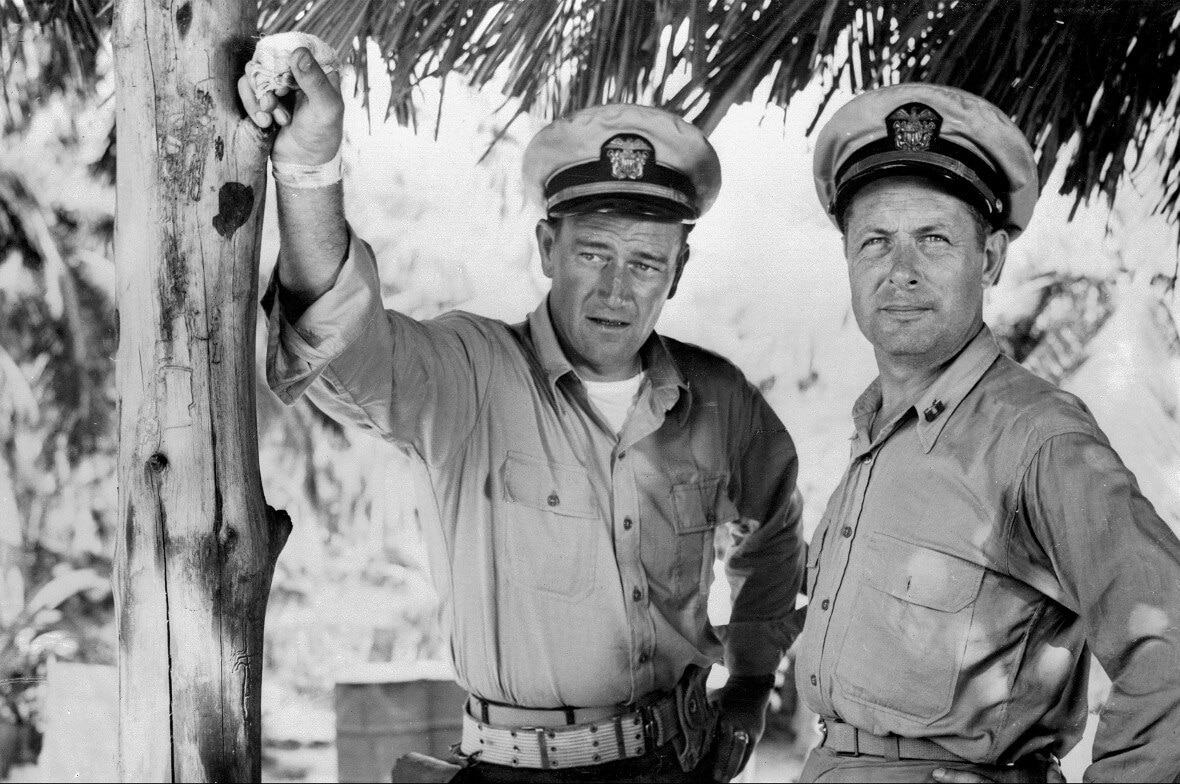
They Were Expendable is based on the real-life heroics of PT Boat squadron leader John Bulkeley, and the defense of the Philippines from December 1941 through April 1942. During World War II, Lt. Brickley and Lt. Ryan put on a demonstration of PT Boat speed and maneuverability in combat for the top Navy brass. The Lieutenant and his commanding officer are frustrated that the PT boat squadron is assigned unimportant duties, even after Pearl Harbor and a Japanese attack on their base in Manila Bay. Lt. Ryan is wounded in the skirmish and sent to sick bay in Corregidor, where he recovers under the care of an attractive nurse, Lt. Davys. Despite a strong mutual attraction, the couple must face an inevitable separation due to their orders and the advancing Japanese troops.
Director: John Ford
Producers: John Ford, Cliff Reid
Screenplay: Frank Wead
Based on the book by William L. White
Cinematography: Joseph H. August
Costume Design: Yvonne Wood
Film Editing: Douglass Biggs, Frank E. Hull
Art Direction: Malcolm Brown, Cedric Gibbons
Original Music: Earl K. Brent, Herbert Stothart
Makeup: Jack Dawn
Cast: Robert Montgomery (Lt. John Brickley), John Wayne (Lt. J.G. "Rusty" Ryan), Donna Reed (Lt. Sandy Davys), Cameron Mitchell (Ensign George Cross), Jack Holt (General Martin), Ward Bond (Boots Mulcahey), Marshall Thompson (Ens. Snake Gardner).
BW-135m.
Why WERE EXPENDABLE is Essential
They Were Expendable was conceived by MGM and the Navy in 1942 as a vehicle for wartime propaganda, but by the time he directed it in 1945, John Ford had experienced war first-hand. As a result, he brought a solemn sense of purpose to the story of a PT Boat squadron leader and the defenders of the Philippines. The resulting film is a somber, poetic study of courage, loneliness, and sacrifice. In addition to Ford, a number of the men in the cast and crew had just returned from combat, lending the film a palpable authenticity. The performances are first-rate, the photography by Joseph August is crisp and immediate, but it is clearly John Ford's picture ¿ his eloquent authority colors every frame of the film. They Were Expendable is not only a great war movie, it shares with other Ford pictures like The Grapes of Wrath (1940) the universal themes of dignity, loyalty, and strength during grief.
As its title suggests, They Were Expendable does not try to push the same buttons as most war movies made during wartime. There are no stirring patriotic speeches about God and Country, no overt references to the home front and those waiting and praying for the soldier's safe return, and no depictions of the enemy as sub-human and godless. In fact, in They Were Expendable we never see a Japanese soldier - just the distanced enemy ships and a healthy respect for the power of their advance. Ford keeps the film focused on the men of the squadron and their duty and responsibility. If the result is a film that plays as somber and downbeat, Ford was unapologetic. As he told Peter Bogdanovich, "I despise happy endings - with a kiss at the finish - I've never done that. Of course, they were glorious in defeat in the Philippines - they kept on fighting."
Filming started February 1, 1945, Ford's 51st birthday. The location was Key Biscayne, Florida, which was a substitute for the actual Philippines. The Navy supplied actual PT boats for the filming and Navy officers would stop by occasionally to watch the filming. Robert Montgomery was able to draw on his activity as an actual PT commander at Guadalcanal and Normandy and Ford poured a lot of himself into the film as well. John Wayne said Ford "was awfully intense on that picture and working with more concentration than I had ever seen. I think he was really out to achieve something."
Near the end of filming, Ford broke his leg when he fell 20 feet off a scaffold. During his absence Robert Montgomery directed the remaining scenes, even though Ford had publicly upbraided him earlier for trying to suggest a different way to handle a scene. Montgomery wasn't the only future director observing Ford at work. John Wayne already had ideas for a film about the Alamo and was learning film technique from Ford, and future director Blake Edwards was an extra, playing a crewman aboard one of the boats. The postproduction work on They Were Expendable was performed while Ford was away in Washington and didn't sit well with him at all; in particular, he objected to some of the heavy music added (though you can still hear Ford's signature tune, "Red River Valley").
The acting in the film is naturalistic and convincing. That Robert Montgomery's technique is invisible should come as no surprise, as he had already spent years in the Navy as a PT boat commander. James Agee called his performance "sober, light, [and] sure... the one perfection to turn up in movies during the year." John Wayne, Ward Bond, and other Ford stalwarts also turn in solid work, occasionally providing welcome moments of humor and camaraderie. Donna Reed brings great humanity to a role in which she is not only required to be the quasi-love interest, but also personify civility and femininity in the desolate locale.
They Were Expendable features some exciting and well-staged action sequences in which the speed and agility of the PT boats are convincingly displayed. Ford does not alter his shooting style for these scenes, whether it's a night raid or an airplane attack drenched in sunlight; Joseph August's photography is sharp and precise, Ford's attention is unblinking, and there is beauty even in the sprays of water erupting around the darting boats. The compositions are just as thoughtfully shot for every other type of scene - from a touching formal dinner party in a jungle hut, to the squadron visiting a dying skipper in a blackened Corregidor hospital corridor, to an impromptu funeral service in a remote island chapel - one powerful and poignant visual follows another.
Although it depicted events that had occurred only a few years earlier, They Were Expendable has immediacy and a documentary feel brought about by Ford's fresh exposure to the war. It was released on December 7, 1945, but with the war dying down, it was not as big a hit as expected. It did receive two Oscar® nominations for Best Sound and Best Special Effects. It also became entangled in two lawsuits. Commander Robert Kelly (the basis for John Wayne's character) sued MGM for libel and was awarded $3,000. Lieutenant Beulah Greenwalt (played by Donna Reed) said the portrayal of her in a fictitious romance was damaging and an invasion of privacy; she was awarded $290,000. Despite these setbacks, They Were Expendable is now recognized as one of the best war films and a high point in the careers of everybody involved with it.
by John Miller & Lang Thompson
The Essentials (5/28) - THEY WERE EXPENDABLE
by John Miller & Lang Thompson | February 17, 2005
SIGN UP FOR OUR NEWSLETTERS

CONNECT WITH TCM