Behind the Camera on GASLIGHT
Director George Cukor suggested Bergman study the patients at a
mental hospital to learn about nervous breakdowns. She did,
focusing on one woman in particular, whose habits and physical
quirks became part of the character.
Bergman usually succeeded in getting her way during film
productions, but she did lose on one important detail. The
actress hated to begin shooting with a passionate love scene
before she got to know her leading man better. But the first
scene captured on film had her leaping out of a railway carriage
and racing into Boyer's arms. It was an awkward moment for her,
all the more so because Boyer was a few inches shorter than her
and had to stand on a box for the scene. "I had to rush up and
be careful not to kick the box, and go into my act," Bergman
said in her autobiography My Story (Delacorte, 1980), written
with Alan Burgess. "It was easier for us to die of laughter than
look like lovers."
Bergman had great respect for Charles Boyer, however. In her
autobiography, she called him the most intelligent actor she
ever worked with and one of the nicest. "He was widely read and
well educated, and so different," she wrote.
Boyer's height presented more than one problem during the
shooting. He had to perch on a box again when he next appeared
with Bergman in Arch of Triumph (1948). And at 5'8",
Angela Lansbury, his co-star in Gaslight, was as tall as
Bergman. Cukor made her wear platform shoes to increase her
height and accentuate her sinister persona in scenes where she
had to threaten Bergman. That only made Boyer's shortness (and
need for a box) more evident.
One of the happy results of Gaslight was that it launched
Angela Lansbury's long and acclaimed acting career. In Peter
Bogdanovich's book of interviews, Who the Devil Made It
(Ballantine Books), Cukor recalled the casting of Lansbury:
"...there was a very good part of a rather sluttish housemaid.
We looked around, we saw some English girls, and they weren't
really very fresh or quite right for it. And playwright John Van
Druten, who wrote the script, said: 'You know, Moyna MacGill' -
who was a very well known English actress - 'is here with her
three children. She was a refugee during the war and I know she
has a daughter - I think she may be fourteen; I have no idea how
old she is.' Then he found out and said, 'Yes, she is sixteen or
seventeen.' At the moment they were working at Bullocks making
Christmas packages and this girl came up who had never acted
before, and she read the thing and I thought she was awfully
good....Anyway, she did get the job. Now: the very first day on
the set, she was absolutely at home - she had never acted. She
wasn't as accomplished as she is now but she was an actress and
she had the talent for changing herself physically without
appearing to. And she had this rather sullen, bad-tempered face
- rather impertinent face - it just came from the inside. And
there was this full-blown character. Then what makes her
interesting is that right after that she played in The
Picture of Dorian Gray (1945) - directed by a friend of
mine, Albert Lewin - in which she played the most exquisite and
fragile heroine. That could have been awfully saccharine and she
did it with great delicacy and feeling - and looked quite
different."
Lansbury made such an impression in her debut she was nominated
for a Best Supporting Actress Academy Award and cast in another
film that same year as Elizabeth Taylor's older sister in
National Velvet. Many years later when she was watching
the film again, Lansbury commented with astonishment, "My God,
how did I have all that assurance?"
George Cukor was known in the industry as a "woman's director,"
and many of his best-known movies up to that point had been
stylish and breezy comedies: Dinner at Eight (1933),
Holiday (1938), The Women (1939), The Philadelphia
Story (1940). But he also knew his way around period dramas:
Little Women (1933), David Copperfield (1935),
Camille (1937). Still, many were surprised and impressed
by the skill with which he created the tense and moody
atmosphere of Gaslight. "I really think the style comes
out of the story," he told film historian Gavin Lambert late in
his career. "If you're going to do a story about a murder in a
Victorian house, you make it claustrophobic, you make it clouded
and gas lit. You research the period, not just to reproduce
things physically but for the emotions it stirs up in you. ... I
always say the text dictates the whole style to me, which may
not be to the director's advantage, because it means his touch
is not immediately recognizable."
Cukor said he didn't like to talk about the part with actors too
much because "you lose the magic" and that he never rehearsed
the emotions of a scene, only the mechanics, so the actors could
make fresh choices when the cameras rolled. But he also admitted
that he had a tendency to "lead" the actors, in his own special
way. While directing Bergman, he kept retelling her the plot to
bring her up to the emotional point of the scene and keep her
intensity up between takes. Finally one day, she told him
politely, "I'm not a dumb Swede, you've told me that before."
Cukor stopped telling her anything, the result of which, he
said, was that the producer watching later rushes told him the
actors appeared to be "acting as thought they're under water."
So, Cukor resumed his storytelling method, a practice Bergman
soon grew to appreciate.
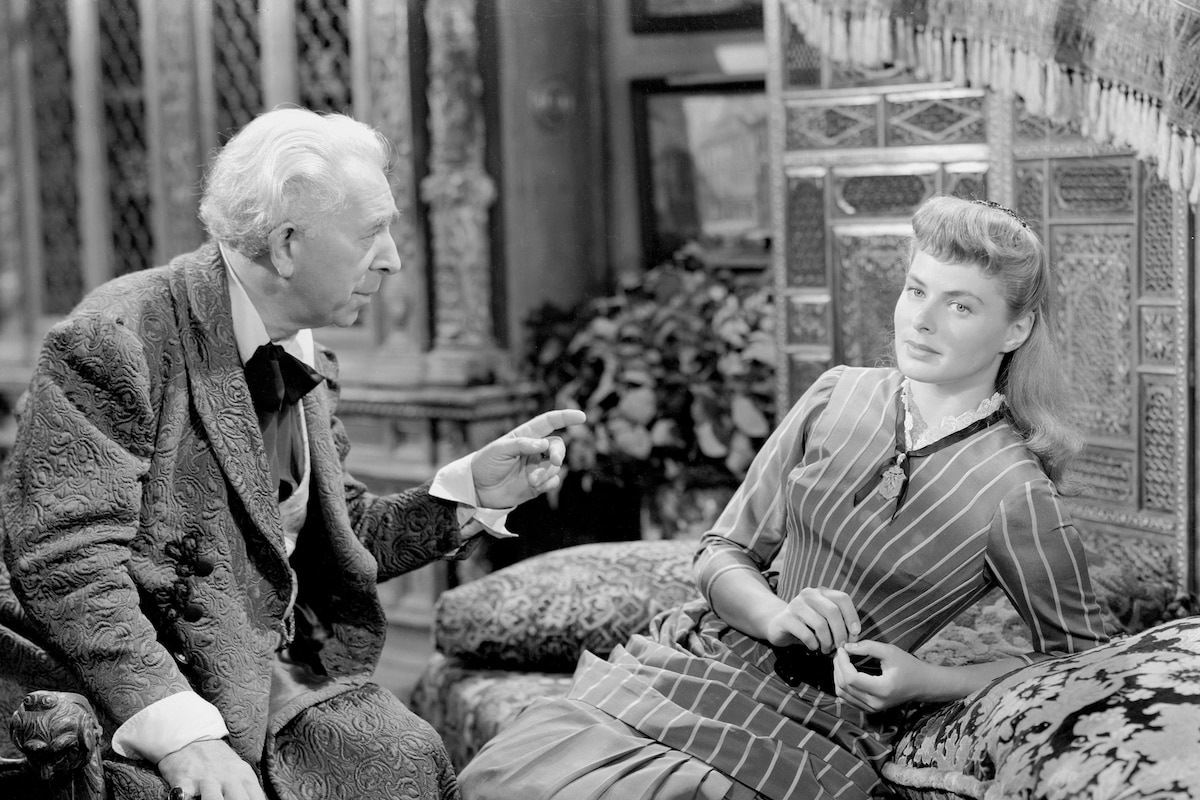
Years after the release of Gaslight, Cukor pointed out
that his direction and the performances of the cast weren't the
only factors that made the film a success. He also credited the
rich production resources of MGM for access to all the items
needed to create the film's Victorian home in minute detail, an
important factor in a story that involved objects from the house
being deliberately misplaced and "stolen" to convince Bergman's
character she was going mad. Cukor told Lambert about Paul
Huldschinsky, a German refugee whose family had owned newspapers
and whose wife had once owned railroads in their native country.
At the time of the film's production, Huldschinsky was working
in a rather obscure job as a set dresser at Metro, primarily
doing gas stations and other rather pedestrian assignments. The
studio wanted to put one of their more established and
well-known dressers on the project, but Cukor insisted on
Huldschinsky and was rewarded for his support by an intricate
and lushly detailed set that earned an Oscar®.
By Rob Nixon
Behind the Camera (5/21) - GASLIGHT
by Rob Nixon | February 17, 2005
SIGN UP FOR OUR NEWSLETTERS

CONNECT WITH TCM