Behind the Camera on ARSENIC AND OLD LACE
Although he planned to do the entire production on a single set, Capra had to make exceptions for the scenes added to the story in the script adaptation: the baseball game, the marriage license office, and the sanitarium. For the most part though, Capra and cinematographer Sol Polito confined themselves to the set designed by art director Max Parker, following Capra's sketches. The house was constructed so they could shoot both interiors and exteriors in the same place.
Low-key lighting was used throughout, to give the film its spooky Halloween tone.
To add to the funny-creepy mood, Capra ordered a backdrop with wispy clouds in front of a full moon and countless bags of autumn leaves blown around the exterior house and cemetery sets by three wind machines.
The city backdrop was achieved with two-dimensional models of the Manhattan skyline and, in front of that, a foreshortened three-quarter-angle miniature of the Brooklyn Bridge. The tall buildings were covered with a scrim to make them appear farther off, and a glow was projected around the distant city. In front of the bridge were Brooklyn buildings, with a glow of lights in the windows, and still closer, the cemetery next to the Brewster home. From the front tombstone to the Manhattan skyline the 3-D perspective effect was done in 40 feet of studio space.
Capra planned the shoot for two cameras with one always attached to a Chapman 20-foot boom for crane and dolly shots and the other designed as "wild," to be set up anywhere.
Capra cut corners wherever he could and worked swiftly and cheaply to bring the picture in on budget and within its short shooting schedule. He later said production manager Steve Trilling asked him if he was "going back to your Poverty Row quickies" where he had started his career. Capra said, "Yes, for a refresher course."
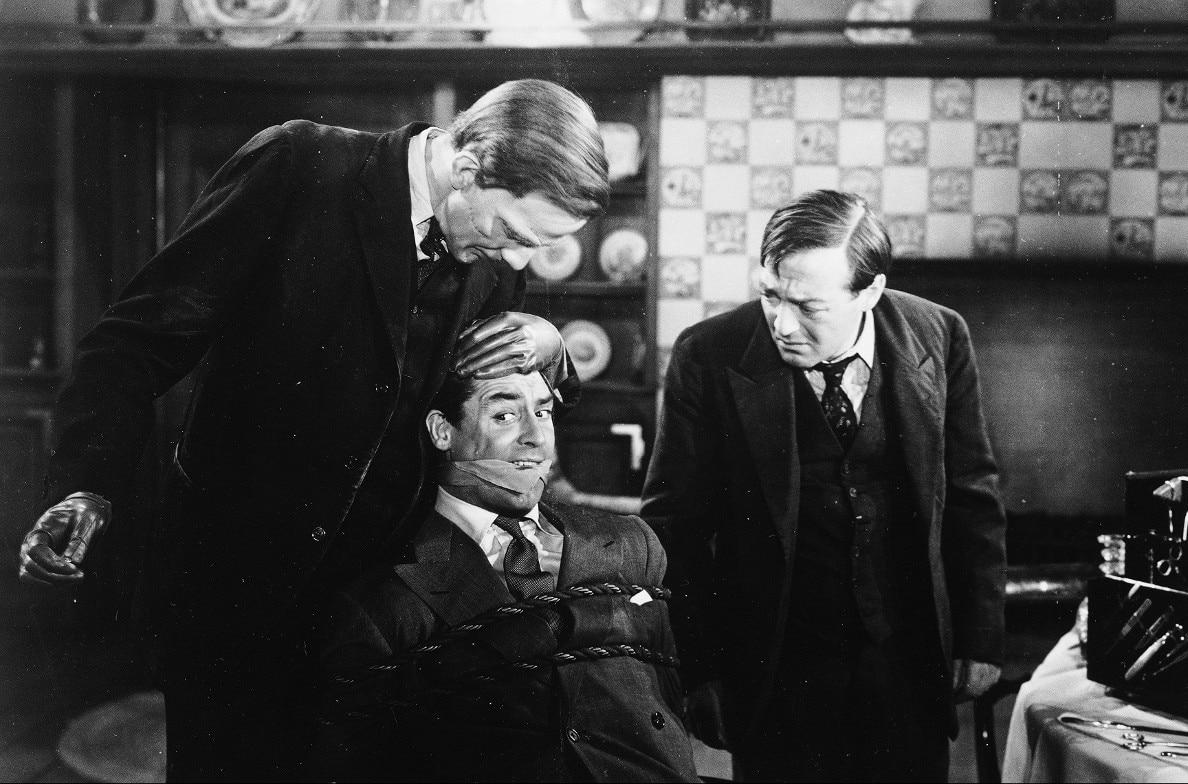
Capra pushed his actors to the broadest comedy takes, a fact that did not sit well with Grant. As a result, his (and Carson's) performances were singled out by reviewers for going dangerously over the top, while Massey and the stage performers managed to look rather restrained by comparison. Grant hated working this way, although in his more generous moments he credited Capra with helping him to get the comic effect he was unable to do on his own (it may have been his subtle way of blaming the director). Actor Gregory Peck later gave his assessment of the direction: " Capra was a very strong, determined, hands-on director, and he had Cary doing a lot of squirrelly things. When a director imposes on an actor or persuades or cajoles the actor to do something that doesn't feel right, that's not good direction." Julius Epstein also thought Grant mugged too much. He later said Capra intended to go back and rein in the broadest scenes, but near the end of principal photography, the Japanese attacked the U.S. at Pearl Harbor and Capra was eager to move on to his military assignment, so retakes were never done.
The film actually took closer to eight weeks to shoot, not the four Capra had planned, and the $400,000 initially budgeted was eventually set at just over a million, a far more realistic figure considering the salaries for Grant and Capra alone.
Because he had joined the Army shortly after the U.S. entered World War II, Capra asked for a six-week leave of absence to finish, edit and ready Arsenic and Old Lace for a January 30, 1942 preview.
by Rob Nixon
Behind the Camera (5/14) - ARSENIC AND OLD LACE
by Rob Nixon | February 17, 2005
SIGN UP FOR OUR NEWSLETTERS

CONNECT WITH TCM