SYNOPSIS
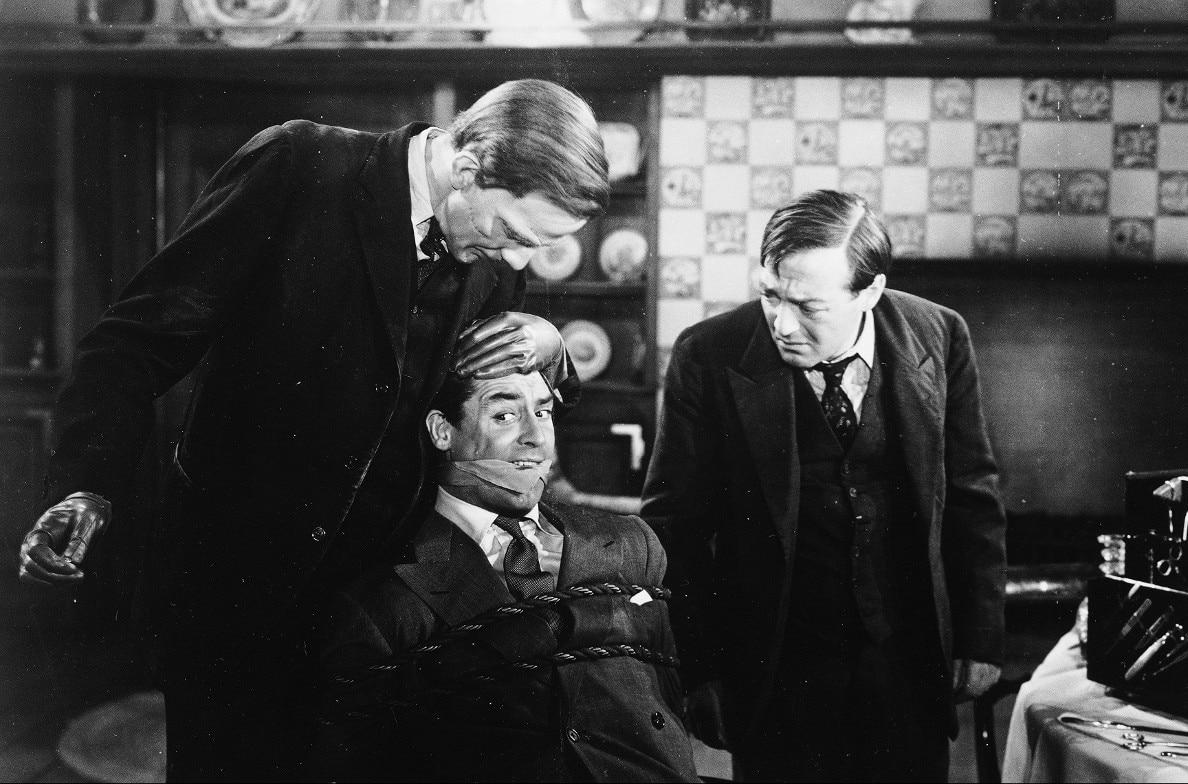
Drama critic and notorious anti-marriage columnist Mortimer Brewster sneaks off on Halloween and weds Brooklyn girl Elaine Harper despite objections from her father, a preacher. He soon finds a runaway wedding is the least of his concerns. Back at the Brooklyn home where he and his two brothers were raised by their kindly spinster aunts, Martha and Abby, Mortimer discovers a dead body in the window seat. Thinking at first it's the work of his off-kilter sibling Teddy, who believes himself to be Theodore Roosevelt, Mortimer is stunned when he learns his sweet elderly aunts have been poisoning sad, lonely old men for years. The two sisters consider their murderous acts mercy killings and can't understand Mortimer's panic. Matters are complicated further by the arrival of Mortimer's other brother, the long-lost Jonathan, who as a child tied Mortimer to the bedpost and shoved needles under his fingernails. Jonathan, a cold-blooded murderer with as many corpses to his credit as his aunts, arrives with his creepy little partner in crime, Dr. Einstein, a plastic surgeon who while intoxicated transformed Jonathan into the spitting image of Boris Karloff. In comparison, Mortimer appears to be the craziest of the bunch, running around desperately trying to cover for his aunts, protect his confused bride, commit one brother and have the other arrested.
Director/Producer: Frank Capra
Screenplay: Julius J. Epstein, Philip G. Epstein, based on the play by Joseph Kesselring
Cinematography: Sol Polito
Editing: Daniel Mandell
Art Direction: Max Parker
Music: Max Steiner
Cast: Cary Grant (Mortimer Brewster), Priscilla Lane (Elaine Harper Brewster), Josephine Hull (Abby Brewster), Jean Adair (Martha Brewster), Raymond Massey (Jonathan Brewster), Peter Lorre (Dr. Einstein).
BW-119m. Closed captioning. Descriptive video.
Why ARSENIC AND OLD LACE is Essential
By the early 1940s, director Frank Capra was in a position to produce and direct practically anything he wanted. He already possessed more Academy Awards than any other director - for It Happened One Night (1934), Mr. Deeds Goes to Town (1936), and You Can't Take It with You (1938) - and his movies were very popular with audiences. In such films as Mr. Smith Goes to Washington (1939) and Meet John Doe (1941), Capra had built a solid reputation for his unique blend of gentle humor, social commentary, and a fondness for the common man and old-fashioned American values that had come to be labeled "Capra-corn." But in 1941 he was looking for a project that provided complete escapism - a purely unpretentious entertainment. "No great document to save the world, no worries about whether John Doe should or should not jump; just good old fashioned theater," he said. He found it one night at Broadway's Fulton Theater, where Joseph Kesselring's Arsenic and Old Lace was playing to a full house.
This was just the kind of rollicking good time Capra had in mind, a black comedy that moved at a breakneck pace and featured characters who were not who they appeared to be: not the timid elderly ladies who slipped lonely old gentlemen elderberry wine laced with arsenic, strychnine, and cyanide; not their delusional nephew who dug basement graves for their victims thinking he was Teddy Roosevelt constructing the Panama Canal; not the murderer who was a dead ringer for Boris Karloff (played on stage, in a delicious theatrical twist, by Karloff himself); not even the cop on the beat, who fancied himself a playwright, or the one supposedly sane family member, a newlywed who had made a reputation writing diatribes against marriage. Capra was determined to bring it to the screen, intent on making what he called "an anything goes, rip-roaring comedy about murder." Opening the story up only slightly for the screen, he preserved and even heightened the play's zany pace, letting "the scene stealers run wild" in his cast, creating a box office bonanza for Warner Brothers and "a mugger's ball" for his actors. In some ways, Arsenic and Old Lace works as a comically grotesque vision of the American family and shares many similarities with the macabre humor of cartoonist Charles Addams.
The film version was produced in 1941, but Warner Bros. delayed its release for three years until the stage version finished its run. Frank Capra, famous for films such as It Happened One Night and It's a Wonderful Life (1946), was chosen by executive producer Jack Warner to direct the film. Because of the Production Code in Hollywood, a few scenes and dialogue present in the stage version had to be changed or omitted for the film. Mortimer's famous line in the play, "Darling, I'm a bastard!" was changed to "I'm a son of a sea cook!" The film ends with the cab driver's declaration, "I'm not a cab driver. I'm a coffee pot", rather than retaining the final scene from the play. The latter showed the two aunts giving an unhappy, lonely old man a glass of elderberry wine laced with their special blend of poison. But the Production Code only allowed acts such as murder to be shown if the perpetrators were punished by the end of the film.
According to authors Charles Higham and Roy Moseley in their biography, Cary Grant: The Lonely Heart, Arsenic and Old Lace was written to Grant's specifications for the screen, which included shooting the film in sequence. Even so, he was often irritable during production, complaining constantly about the set, the props, and the wardrobe of the cast members. At one point he admitted he would rather have starred in a film version of Noel Coward's play, Blithe Spirit. Of course, tensions on the set weren't helped any after Japan staged its surprise attack on Pearl Harbor on Sunday, December 7. The crisis halted production briefly and caused the film to run over budget.
Not everyone involved in the making of Arsenic and Old Lace was thrilled with the over-the-top results. Grant, a brilliant comic actor and no stranger to wacky screen hi-jinks, found Capra's style in this picture too excessive. "I tried to explain to him that I couldn't do that kind of comedy - all those double takes. I'd have been better as one of the old aunts!" he later said, explaining why it was his least favorite of all his films. Grant also believed the movie would have been better served by the original actor from the stage, Allyn Joslyn, or even James Stewart, and that its great success was probably due mostly to the play's reputation. True, the play continues to be one of the most popular, translated into dozens of languages and still performed regularly at community theaters everywhere. But although Grant thought he was overplaying and considered his performance "dreadful" and embarrassing (a sentiment echoed by some critics), the movie-going public didn't seem to mind. According to Variety, audiences at New York's Strand Theater punctuated the screening with both screams and laughter, drowning out some of the dialogue. And not too long ago, actor Robert Wagner contradicted Grant's own assessment of his work: "Cary was the best ham in the world. He had a wonderful sense of the joy of the moment. Cary took risks. Look at the things he did in Arsenic and Old Lace." Even those critics and film analysts who consider this movie insignificant in Capra's body of work tend to admit it's great fun. The movie continues to be as popular with viewers today as it was for those at the Strand more than 60 years ago.
by Rob Nixon, Sara Heiman & Jeff Stafford
The Essentials (5/14) - ARSENIC AND OLD LACE
by Rob Nixon | February 17, 2005
SIGN UP FOR OUR NEWSLETTERS

CONNECT WITH TCM