SYNOPSIS
Lucky Garnett is a member of a magic-and-dance troupe, and is
also a compulsive gambler. He is tricked by his friends into
missing his wedding ceremony, and the furious father of the bride
tells him to clear out and not return until he has $25,000, proof
that he's not a worthless layabout. Lucky travels to New York to
make his fortune and bumps into Penny, a dance school instructor.
Instantly smitten, he enrolls in her class and pretends to be a
club-footed clod. The tactic backfires and gets Penny fired from
her job. Lucky then proves to Penny he's a professional dancer
after all and the couple proceed to audition in different clubs
around town. Despite a rocky beginning, Penny begins to warm to
Lucky's romantic overtures but she's also got another admirer,
the bandleader Ricardo. On the sidelines, offering advice and
wisecracks along the way are Lucky's friend Pop from the old
dance troupe, and Penny's acerbic older friend, Mabel.
Producer: Pandro S. Berman
Director: George Stevens
Screenplay: Howard Lindsay, Allan Scott
Story: Erwin Gelsey - "Portrait of John Garnett"
Music: Jerome Kern
Lyrics: Dorothy Fields
Dance Director: Hermes Pan
Music Director: Nathaniel Shilkret
Orchestrations: Robert Russell Bennett
Cinematography: David Abel
Film Editing: Henry Berman
Art Direction: Van Nest Polglase
Gowns: Bernard Newman
Costume Design: John W. Harkrider
Photographic Effects: Vernon L. Walker
Sound Editor: George Marsh
Sound Recordist: Hugh McDowell, Jr.
Cast: Fred Astaire (John "Lucky" Garnett), Ginger Rogers
(Penelope "Penny" Carroll), Victor Moore (Everett "Pop"
Cardetti), Helen Broderick (Mabel Anderson), Eric Blore (Gordon),
Betty Furness (Margaret Watson), Georges Metaxa (Ricardo Romero),
Landers Stevens (Mr. Watson).
BW-104m.
WHY SWING TIME IS ESSENTIAL
George Stevens's Swing Time (1936) is the sixth pairing of
Fred Astaire and Ginger Rogers. Its story is simplistic (even
for a 1930s-era musical), it is slowly developed (28 minutes go
by before the first full dance sequence), and its title is a
misnomer (there is not much in the way of genuine swing music in
the film). In spite of all this, Swing Time is one of the
great musicals of the 1930s, and many people's favorite of the
Astaire-Rogers series.
The successful aspects of the film far outnumber the few
weaknesses. The score by Jerome Kern and Dorothy Fields is
outstanding. It yielded three songs which were hits of the day
and have remained standards: "The Way You Look Tonight," "A Fine
Romance" and "Pick Yourself Up." The songs are integrated into
the story in very inventive and surprising ways. The dance
numbers are also very carefully thought out to advance the story
- specifically the romantic missteps, misunderstandings and
misgivings of the leads. Routines brilliantly build on previous
ones, containing slight returns of earlier-seen steps, they
subtly echo the previous stages of the romantic relationship.
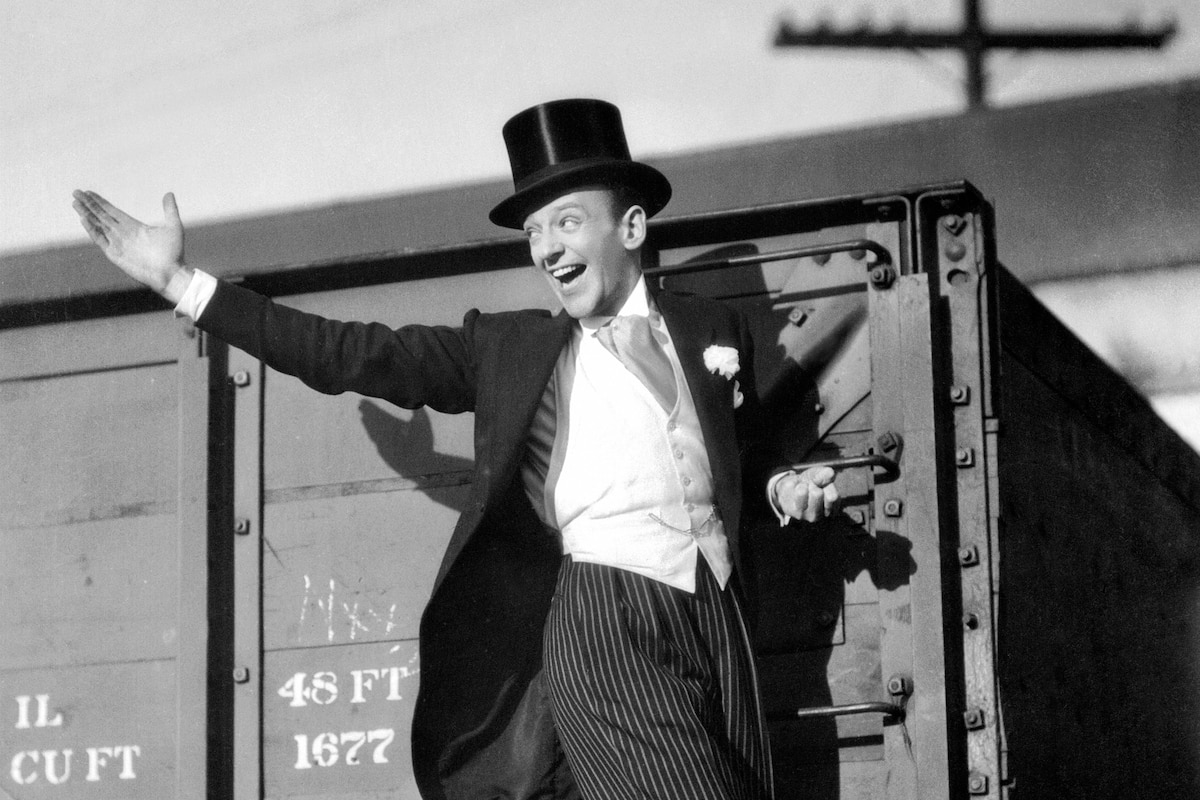
Astaire, working with choreographer Hermes Pan, was inspired to
create new and innovative dances, including the first trick
photography used in an Astaire routine (the "Bojangles of Harlem"
number). Swing Time was also the only Astaire-Rogers movie
directed by the great George Stevens, a perfectionist known for
shooting countless retakes until he got the scene he wanted. The
main beneficiary of his shooting methods was Ginger Rogers, who
gives a wonderfully nuanced performance in Swing Time,
triumphing over the trite script while creating the haughty yet
sympathetic character that the roller-coaster romantic plot
demanded.
Swing Time is graced by a brilliant Jerome Kern-Dorothy
Fields song score. Of the tunes introduced in the film, none is
more timeless than the Oscar®-winner, "The Way You Look
Tonight." Of Kern's music, Fields later said, "the first time
Jerry played that melody for me I had to leave the room because I
started to cry. The release absolutely killed me. I couldn't
stop, it was so beautiful." To this Fields added a tender but
conversational lyric:
Someday,
When I'm awfully low
And the world is cold,
I will feel a glow just thinking of you
And the way you look tonight.
The result is nothing less than one of the greatest of all
romantic ballads. An indication of the charm of Swing
Time is the setting in which this song is introduced - Ginger
Rogers is not in a shimmering gown, but in a bathrobe with
shampoo in her hair!
As wonderful as the songs were, and as cleverly as they were
integrated into the film, they would not have had nearly the
impact if not for the astonishing dance sequences. Even at the
time, Kern's music was considered slightly old-fashioned, so much
of the credit for adapting the music for the screen goes to the
film's arranger Robert Russell Bennett, and by some accounts, to
Fred Astaire's rehearsal pianist, Hal Borne. The music was
clearly shaped for showcase dance numbers, and it is in this area
that the film excels as few other films ever have, thanks to the
otherworldly talents of Fred Astaire and Ginger Rogers. There
are three show-stopping duet dances with Astaire and Rogers in
the film, and a brilliant solo number by Astaire. Astaire,
naturally, is justly regarded as one of the greatest dancers ever
caught on film, just as Rogers is regarded as his most beguiling
partner. And Swing Time captures for all time some of
their greatest routines, which continue to amaze even after
repeated viewings.
by John Miller
The Essentials (4/30) - SWING TIME
by John Miller | February 16, 2005
SIGN UP FOR OUR NEWSLETTERS

CONNECT WITH TCM