Trivia & Other Fun Stuff
Jean Renoir was the son of the famous and highly influential French painter Pierre-Auguste Renoir (1841-1919). The director wrote a loving biography of the elder artist, Renoir, My Father, published in 1962.
Besides such notable French productions as Boudu sauve des eaux (1932), Le crime de Monsieur Lange (1936), La Bete humaine (1938), and La Regle du jeu (1939) - generally considered his greatest film - Renoir also worked in Hollywood during and shortly after World War II. He directed seven films between 1941 and 1947, among them Swamp Water (1941), The Southerner (1945), and the thriller The Woman on the Beach (1947).
"Excepting All Quiet on the Western Front [1930], I had not seen a
single film giving a true picture of the men who did the fighting,"
said director Jean Renoir who made every effort to bring that
perspective to his film The Grand Illusion (1937).
"Introducing his film to the American public in 1948, Renoir wrote, "I hear Hitler yelling on the radio, demanding the partition of Czechoslovakia. We are on the brink of another 'Grand Illusion.' I made this film because I am a pacifist. To me, a true pacifist is a Frenchman, a German, an American. The day will come when men of good faith will find a common meeting ground. Cynics will say that my words at this point in time are naive. But why not?" - Jean Renoir (from Dictionary of Films by Georges Saduol)
Renoir was given an honorary Academy Award in 1975 for his body of work. He was also nominated as Best Director for The Southerner, a film that won him the National Board of Review directing award. The National Society of Film Critics also gave him a special award the same year as his honorary Oscar©.
Jean Gabin is generally considered France's greatest star. His career ran from 1928 through 1976 (the year of his death) and included such international classics as Pepe le Moko (1937), Le Quai des brumes (1938), Le Jour se leve (1939), Le Plaisir (1952), and Les Miserables (1958). He made three other films with Renoir: Les Bas-fonds (1936), La Bete humaine, and French Cancan (1955).
It was also generally well received abroad. The movie was a huge success in the U.S. and received much wider distribution throughout the country than other foreign films of the time. It played 15 weeks at a major first-run house (as opposed to an "art cinema") in New York.
It would probably have won the grand prize at the Venice Film Festival in 1937 if a democratic, pacifist film were not an unlikely choice for what was then called the Mussolini Award, after Italy's fascist dictator. Instead, jurors created a special "best artistic ensemble" prize for it. Nevertheless, it was banned in Italy as well as Germany, where Nazi Propaganda Minister Joseph Goebbels declared Renoir "Cinematographic Enemy Number One" and had the prints seized (although a negative turned up in Germany years later, allowing Renoir to re-release the film in its original form in the late 50s). Goebbels also called Von Stroheim's performance of a German military man "a caricature" and insisted "No German officer is like that."
This was one of four French films banned in 1937 by Yugoslav censors.
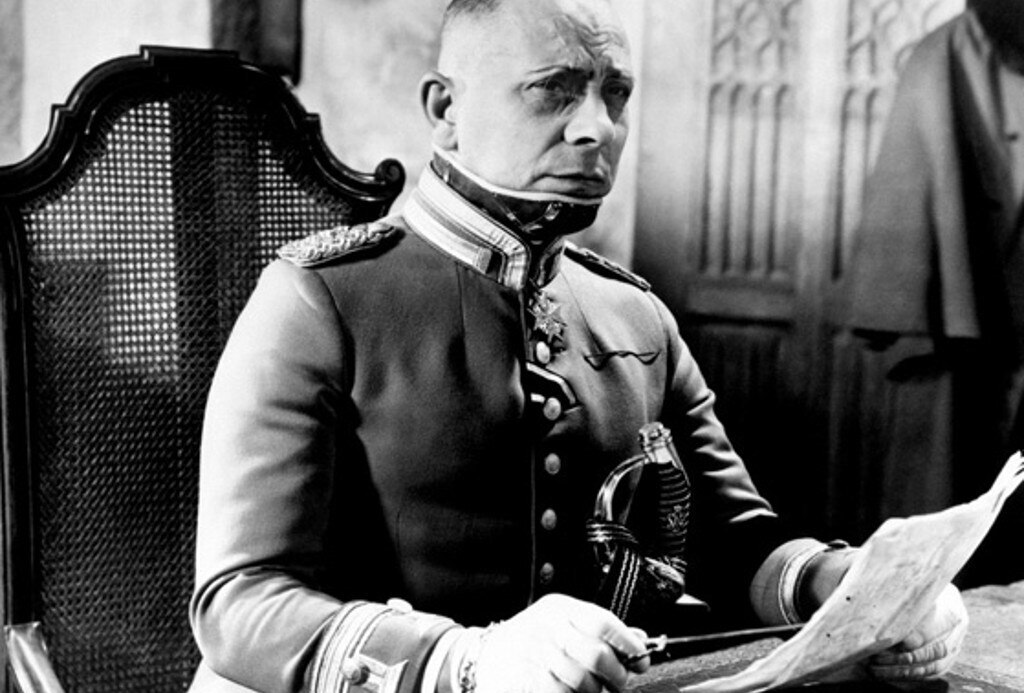
Erich von Stroheim claimed to be a German aristocrat with a distinguished military career. Some mystery still surrounds his background, but by most accounts he was, in fact, the son of an Austrian Jewish hatmaker and spent only three months in the Austro-Hungarian army.
Von Stroheim had a notable acting career in the U.S. during the silent era as "the man you love to hate," a moniker owing much to his roles as evil Germans in World War I films. After the war he played leads in a number of notable pictures. He was also a brilliant director whose masterpiece, Greed (1924), was taken over by the studio and cut from its original four-hour length to just over two hours (the director's cut has since been essentially restored). He was fired by producer-star Gloria Swanson from his last silent film, Queen Kelly (1929), effectively ending his directing career. He continued working as a writer and acted in many films over the next nearly 30 years, though rarely with the success or acclaim of either his silent work or his performance in The Grand Illusion. He is perhaps best remembered today as Max, the ex-director, now butler to a forgotten silent film star played by Swanson in Sunset Boulevard (1950).
Several members of this picture's cast worked frequently with Renoir, including Marcel Dalio, Jean Daste, and Gaston Modot. Dalio, who plays the Jewish character, Rosenthal, was himself a Jew, born in Paris to Romanian immigrants. At the outbreak of the war, his pictures appeared on posters depicting "the typical Jew," and he was forced to flee Europe. He subsequently had small roles, usually as the stereotypical Frenchman, in dozens of Hollywood films, including Casablanca (1942) and The Song of Bernadette (1943). Although he returned to European films after the war, he also continued to work in the U.S. in such movies as Gentlemen Prefer Blondes (1953), Can-Can (1960), and Catch-22 (1970). He also played Captain Renaud in a short-lived TV series based on Casablanca.
Dita Parlo, who plays Elsa, the German widow, in this picture, and Jean Daste (the teacher), appeared as the lovers in Jean Vigo's poetic love story L'Atalante (1934).
Screenwriter Charles Spaak's daughters, Catherine and Agnes, both became actresses with notable European careers. Of the two, Catherine is probably better known to American audiences for her work in Jacques Becker's Le Trou (1960), The Empty Canvas (1963) co-starring Bette Davis, and the Dario Argento giallo, The Cat 'O Nine Tails (1971).
Assistant director Jacques Becker, who worked frequently with close friend Renoir in the 1930s, appears as the English officer who begins singing "La Marseillaise" in this film. Becker was himself a POW during World War II. After the war, he became a director of several films, most notably the prison escape drama Le Trou.
One of the editors on this film was Renoir's companion, Marguerite Renoir. (Although she had taken his name, they were not yet married at the time). She had begun working with him on La Chienne (1931), at the time he separated from his wife, actress Catherine Hessling. Jean and Marguerite married in 1944, although his 1943 divorce from Hessling was not officially recognized in Europe.
Renoir's nephew Claude was the camera operator on The Grand Illusion. He went on to become a noted cinematographer, working on a number of his uncle's pictures, including the luminous color work of The River (1951). He also contributed to international productions in a wide range of styles, such as Barbarella (1968), French Connection II (1975), and The Spy Who Loved Me (1977).
Charles Spaak was, along with Jacques Prevert, arguably the most influential French screenwriter of his time, contributing heavily to the "poetic realism" of films by Renoir, Julien Duvivier, and Jacques Feyder.
Art Director Eugene Lourie was a leader in his field in the 1930s. He followed Renoir to the U.S. during the war and worked on not only the director's pictures but those of other filmmakers, including Chaplin's Limelight (1952), Samuel Fuller's Shock Corridor (1963) and The Naked Kiss (1964), and Clint Eastwood's Bronco Billy (1980). He also played a small part in Breathless (1983), a remake of the 1960 Jean-Luc Godard film.
Famous Quotes from GRAND ILLUSION:
SIGN IN MILITARY BAR: Alcohol kills! Alcohol drives people mad. The squadron leader drinks it!
MARECHAL (Jean Gabin): (being searched by prison guard) I've nothing. If I'd known I was coming I'd have brought a little money with me.
MARECHAL: The theater's too deep for me. I prefer bicycling.
SERVANT: May I bring it to your attention, sir, we only have two pair of white gloves left.
VON RAUFFENSTEIN (Erich von Stroheim): We can't get any more now. Try to make these last out the war.
VON RAUFFENSTEIN: (in French to Marechal) I suppose you know the Maxim machine gun?
MARECHAL: (pointing to where he was wounded) Very well, sir. Personally, I prefer the restaurant.
VON RAUFFENSTEIN: (in English to Boeldieu) Maxims. That reminds me. I used to know a girl there in 1913. Her name was Fifi.
BOELDIEU (Pierre Fresnay): So did I.
MARECHAL: It's usually the clap that gets the posh people, right, Boeldieu?
BOELDIEU: It used to be a privilege of class but it, like everything else, has been lost to the masses.
ROSENTHAL (Marcel Dalio): Each would die of his class disease if there weren't war to mix microbes.
VON RAUFFENSTEIN: The end of the war will be the end of the Boeldieus and the Rauffensteins.
VON RAUFFENSTEIN: A Marechal and a Rosenthal, officers?
BOELDIEU: They're very good soldiers.
VON RAUFFENSTEIN: Happy gifts of the French Revolution.
BOELDIEU: I think we can do nothing to stop the march of time.
ROSENTHAL: I'm very proud of my rich family. When I invite you to my table, it's easy to show it.
BOELDIEU: I didn't know a bullet in the stomach hurt so much.
VON RAUFFENSTEIN: I aimed at your legs.
BOELDIEU (to von Rauffenstein): For a common man, it's terrible to die in a war. For me and you, it's a good solution.
ROSENTHAL: Frontiers are an invention of men. Nature doesn't give a hoot.
ROSENTHAL: Have you been eating your buttons?
MARECHAL: Can't you see they're missing?
MARECHAL: (to a cow) You were born in Wirtemberg, I was born in Paris, but that doesn't stop us from being pals. You're a poor cow, I'm a poor soldier. We do our best, true?
MARECHAL: We have to finish the war. Let's hope it's the last.
ROSENTHAL: An illusion. Back to reality.
Compiled by Rob Nixon
Trivia (4/16) - GRAND ILLUSION
by Rob Nixon | February 16, 2005
SIGN UP FOR OUR NEWSLETTERS

CONNECT WITH TCM