Pop Culture 101 - GRAND ILLUSION
The Grand Illusion (1937) did not divide France's political factions as much as Renoir's other works did (or as La Regle du jeu/Rules of the Games, 1939, would). It was highly praised by France's leftists. Right-wing newspapers in France were reserved in their praise for the film but amazed to note that an artist whose left-wing politics they considered detestable and dangerous had made a film with grand national themes that appealed to audiences of all political persuasions. However, they then went so far as to suggest Renoir must have stolen his ideas from a writer more in line with their beliefs.
We know a great deal about the genesis of the script because after the movie's premiere, Renoir was accused of plagiarism by Jean des Vallieres, author of Kavalier Scharnhorst, a 1931 book about his experiences in and escapes from a German fortress the author claimed, among other things, was too similar to the setting of the film. Renoir answered each of Vallieres' accusations in minute detail, noting all the sources from which he and Spaak had drawn and the fact that so many of the stories shared enough close similarities to make a charge of plagiarism ludicrous. He admitted to having glanced at Kavalier Scharnhorst, again on the recommendation of the League of Escapees, but only to confirm certain aspects of the already-completed story. Renoir rejected much of the book because of its "hateful" tone, "written in a spirit of mean and narrow-minded nationalism" in stark contrast to his aim to make a film of deep humanism "which, by its being totally national, would be absolutely international." Renoir went on to further assert that much of the push behind the plagiarism charge came from the right-wing press, who had always hated him and his work. He said they were "only too happy...to prove that an author classified as left-wing can't produce a national subject without stealing it from them."
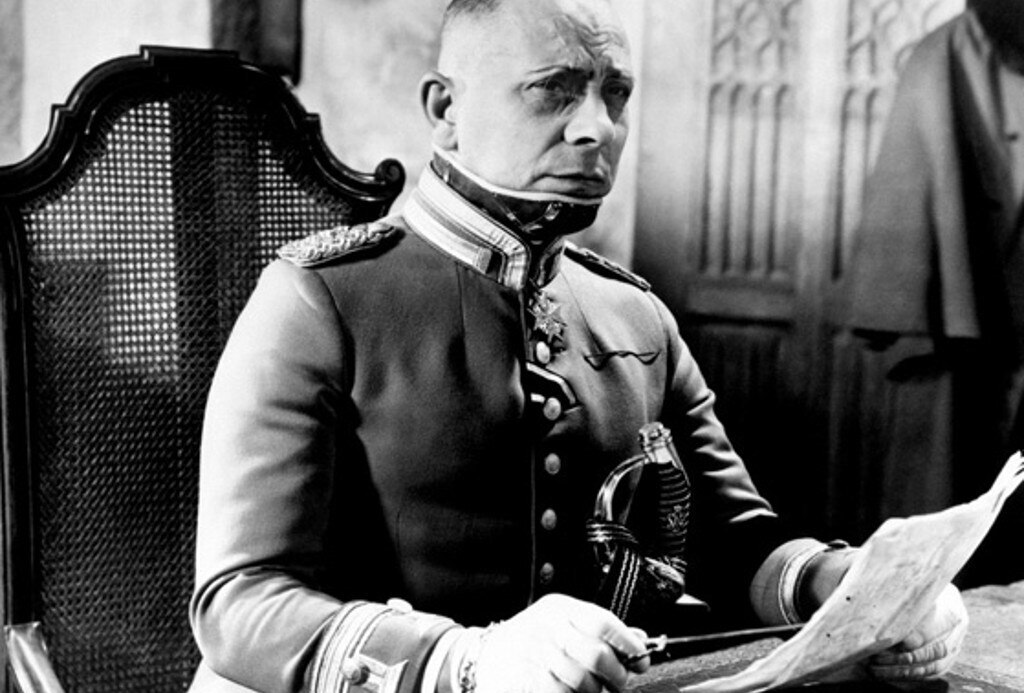
Jean Renoir said that prior to making his first film, he was heavily influenced by repeated viewings of Foolish Wives (1922), directed by Erich von Stroheim, who was cast in The Grand Illusion and greatly influenced the development of the character he played.
The Grand Illusion has been issued in other versions since its 1937 premiere. Although the concerns were baseless, several cuts were made in a 1946 French reissue to avoid criticism that the original was too kind to Germans and even that it displayed anti-Semitism.
At the end of a screening at UCLA in 1951, Renoir marched angrily to the stage to address the audience. The cause of his irritation was a change in the subtitles. When Gabin and Dalio part at the end of the film, Gabin says affectionately, "Au revoir, sale Juif," which translates as "So long, filthy Jew," a mocking reference to their earlier antagonism and an irony in light of their bond. The subtitle in the American version, however, read, "Goodbye, old pal."
In the early 1950s, Renoir tried very hard to get his hands on a copy of the original version of The Grand Illusion. In 1957, he wrote a friend about a man in Los Angeles who claimed to have one but who told Renoir it was lost. "I am sure he is renting it out to clubs and schools on the sly, and pockets the money," Renoir wrote. Another exhibitor who had a print promised to return it to Renoir after one last showing at his cinema. He later claimed to have given it to the director, although Renoir insisted that never happened.
The various prints of The Grand Illusion that were circulating, many of them butchered, led Renoir and screenwriter Charles Spaak to buy back the commercial rights with the intention of showing it in its original form. They finally found a negative that had been seized by the Germans and recovered by Americans in Munich. Renoir asked Von Stroheim to re-record some lines in the key scene where he shoots Boeldieu. The actor gamely agreed, even though he was dying of spinal cancer and requested a sound recording expert be brought to his bedside. Von Stroheim did not live long enough to see the triumphant reissue of the movie in its original form in 1958.
The character of the aristocratic Boeldieu seems to reference other Renoir works. The name itself can be seen as a variant of Bois le Dieu (God of the Woods), a favorite archetype of the director's. The figure appears in one form or another in such Renoir films as La Fille de l'eau (1925) and Le Dejeuner sur l'herbe (1959). The faun-like creature is associated with the playing of the flute, which Boeldieu does in The Grand Illusion to help the other prisoners escape, echoing a scene from Boudu sauve des eaux/Boudu Saved from Drowning (1932).
Similarities have been noted between this film and Renoir's masterpiece La Regle du jeu (1939). Both have similar four-part structures with a climactic scene at the end of part two and the major climactic moment at the end of the third part, followed by a quieter, more intimate final section in which the action moves outdoors into the countryside.
The singing of the French national anthem, "La Marseillaise," as a gesture of defiance toward the Germans was also used in Casablanca (1942).
The digging of the escape tunnel, down to the details of how it is done (the prisoners hide the excavated dirt in their pants and shake it out on the parade ground during exercise), was used in the World War II POW movie The Great Escape (1963).
Although The Grand Illusion was never remade, one of his last works, Le Caporal epingle/The Elusive Corporal (1962) was a comedy that returned to similar setting, themes and characters (French soldiers attempting to escape German POW camps, this time in World War II). Other Renoir works, however, have been given new versions: La Chienne (1931) was redone by Fritz Lang as Scarlet Street (1945); Boudu sauve des eaux became Down and Out in Beverly Hills (1986); La B¿te humaine (1938) was the basis for Lang's film noir Human Desire (1954); and La Regle du jeu is said to have inspired Scenes from the Class Struggle in Beverly Hills (1989).
After seeing Dita Parlo as the German widow in this picture, Orson Welles wanted to cast her in his planned (but never made) film version of Joseph Conrad's novel Heart of Darkness. But shortly after the outbreak of World War II, Parlo (who was born in a then German region that is now part of Poland) was arrested as an alien and deported to Germany. She returned to France and resumed her career in 1950.
by Rob Nixon
Pop Culture (4/16) - GRAND ILLUSION
by Rob Nixon | February 16, 2005
SIGN UP FOR OUR NEWSLETTERS

CONNECT WITH TCM