Behind the Camera on GRAND ILLUSION
Before the producers agreed to finance The Grand Illusion (1937), they questioned every expense including a stipulation in the script for the use of genuine silver dinner service. Renoir had to agree to make do with silver plate.
Renoir also had to abandon the idea of filming numerous planned shots of planes, airfields, and aerial combat (in the final film, we simply see characters leaving a room to go off on a flying mission, and later entering a room after being shot down and captured). The producers said they could not acquire the necessary planes but were also relieved to avoid a major expense. Renoir was furious at first but later considered it a fortunate accident, realizing his film worked much better without this footage.
Principal photography on The Grand Illusion began in winter 1936. Because shooting in Nazi Germany was out of the question, exteriors were done in the Alsace, the easternmost region of France, which retains a rather German character (and had been under German rule on and off, most recently from the late 19th century until World War I). The prisoners' quarters were actually military barracks that had been constructed by the German Kaiser Wilhelm II, who also built the chateau that doubled for the final fortress prison.
Somewhere between early scripting and production, the character of Dolette developed into the wealthy Jewish character Rosenthal, which gave Renoir the opportunity of not only joining race and ethnicity to the examination of class themes but, with Rosenthal written as a middle-class character, of adding nuance to the dichotomy between the working-class Marechal and the aristocratic De Boeldieu. The character was made more complex with the help of producer Pinkovitch, who was Jewish and frequently offered suggestions for building the role into a plum part for Jewish actor Marcel Dalio.
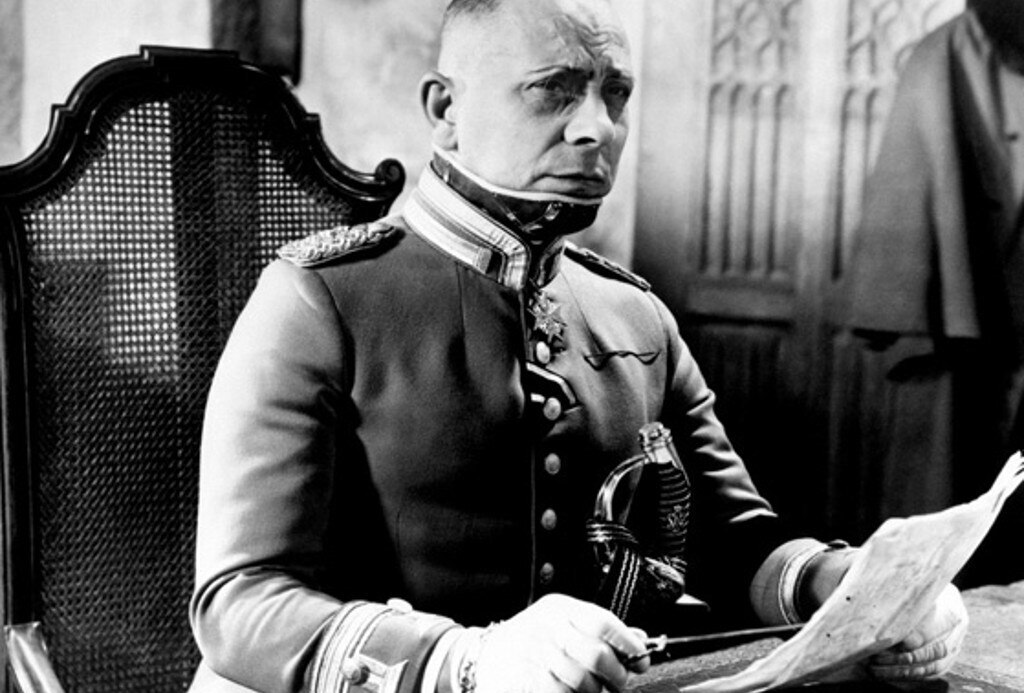
The biggest shift in the story came about after Erich von Stroheim was cast. The actor-director-writer had recently returned to Europe in an effort to salvage his fading career. Various stories exist about how he came to be cast and what role he was originally offered, but what is clear is that Von Stroheim suggested he play both the gracious, aristocratic captor who first receives Marechal and Boeldieu as prisoners and the commandant of the fortress prison where they end up. Struggling through language barriers (each spoke different degrees of French, German and English), a collaboration between director and actor grew, combining both roles into one and enriching Von Rauffenstein from a sketchy character in the script into one who played a pivotal part in the film's themes of class differences, bonds stretching across borders, and the death-knell of the old aristocracy.
Von Stroheim, who had influenced Renoir as a young filmmaker, was encouraged to write whole segments of his own dialogue. He helped create a relationship with the other aristocratic character, De Boeldieu, making it more complex and full and adding greatly to the exploration of the film's themes. He was also in synch with the director in their intention not to make the character a retread of the stereotypical "Horrible Hun" that Stroheim had played in American war films produced in World War I.
Von Stroheim also gave Von Rauffenstein his physical dimensions, creating a backstory in which, between the character's first and second appearances, he has been shot down and now exists in a painful and rigid orthopedic apparatus due to a broken back and constantly wears white gloves to conceal burns. An orthopedist had to be found in Colmar, a city near where they were shooting, to create the device in just a few days.
Von Stroheim's contributions extended to the look of the officer's uniform and the decor of his fortress chambers: the Gothic bed, the solitary geranium in the window that came to figure so prominently in his relationship with Boeldieu. Renoir did not accept all his suggestions; he nixed the idea of covering the chambers in black crepe. But by and large, theirs was a very productive collaboration that gave new shape and meaning to the film.
The working relationship between Von Stroheim and the crew was not always smooth. He quarreled furiously with technical adviser Carl Koch over the uniform worn by the army nurse. Fueled by too much wine, the argument escalated into vicious insults and the throwing of wine glasses before the two men were calmed.
Von Stroheim also clashed with Renoir in the early days of shooting, and the director later said the actor "behaved intolerably." They had one argument over whether or not there should be prostitutes in the German quarters, a detail Von Stroheim thought would lend greater authenticity but which Renoir rejected as a childish cliche. The dispute so distressed Renoir he burst into tears, which caused Von Stroheim to do the same. They fell into each other's arms, and Renoir said that rather than quarrel with an artist he so greatly admired, he would give up directing the film altogether. Von Stroheim promised from that point on to follow Renoir's instructions to the letter, and he kept his word. Looking back on the production, the actor said, "I have never found a more sympathetic, understanding and artistic director and friend than Jean Renoir."
Renoir had no problems at all with Jean Gabin. "There you have a true film actor - with a capital F," he later said. "I've filmed many people in my life, and I have never met such a cinematic power; he's a cinematic force, it's fantastic, it's incredible. It must come from his great honesty. He's certainly the most honest man I've ever met in my life."
On The Grand Illusion and all his films, Renoir worked very collaboratively with everyone, readily accepting suggestions from cast and crew and frequently improvising scenes to achieve a great sense of spontaneity.
Being an actor himself, Renoir also knew how to get the best performances from his cast. When Boeldieu creates a diversion to allow his fellow inmates to escape, Renoir told Von Stroheim to shout to him in English, "I beg you, man to man, come back," in a way that would sound like a man pleading with his mistress.
Renoir achieved not only authenticity but an effective element in the theme of class and national boundaries by having the characters speak in their own languages (with subtitles). This was further heightened by the use of occasional English in dialogue between De Boeldieu and Von Rauffenstein, setting them apart from the other characters in their education and sophistication.
In certain interior scenes, Renoir was able to keep his camera moving by having movable partial sets constructed in the courtyard of the actual barracks used on location. He did this to avoid destroying the continuity of a scene through editing. This also allowed him to shoot his actors "indoors" while showing the bustle of the camp outside the window.
Although they were fully behind the production, the producers got nervous as shooting progressed and told Renoir they had grave doubts about continuing with the production. So he halted photography long enough to edit some scenes that had already been shot, hoping to change their mind, and luckily, he succeeded.
The script changed so much during shooting, Renoir found himself at a loss for how to end the picture. He finally decided on the last scene when exterior work was almost completed.
by Rob Nixon
Behind the Camera (4/16) - GRAND ILLUSION
by Rob Nixon | February 16, 2005
SIGN UP FOR OUR NEWSLETTERS

CONNECT WITH TCM