The Big Idea Behind GRAND ILLUSION
Renoir said the idea for doing The Grand Illusion (1937) came about in 1934 when he reconnected with an old friend, Pinsard, who had become the commander of an air base near where Renoir was shooting Toni (1935). He recalled that Pinsard had several stories of escaping from German POW camps during World War I and thought they might make an interesting film. He got Pinsard to retell his tales, wrote them down, talked with other men who had been war prisoners, and recalled incidents from his own experiences in the cavalry and as a reconnaissance pilot. During that time, Renoir had also been a captive for three weeks during the Battle of the Marne. From all this he fashioned a scenario entitled "Les Evasions de Capitaine Marechal," but he wasn't satisfied with it and put it aside while he went on to make other movies. "I am no good with a new idea," Renoir later explained. "I have to carry it for years."
Later, Renoir raised the idea with Charles Spaak, his collaborator on the screen adaptation of Gorky's The Lower Depths/Les Bas-fonds (1936). Spaak added information he gathered from his brother, the Belgian Minister of Foreign Affairs, who also spent time in POW camps during the war. They also worked in material from the memoirs of several other participants in the Great War, even German flying ace Von Richthofen (the famous Red Baron). They had much of their work verified by the League of Escapees, a group of men who had escaped from POW camps in the war and who recommended to the film's creators to use the book My Ten Escapes by Lt. Bastin to verify details. They also had the assistance of Carl Koch, a former lieutenant in the German Army, who supplied many details about the German military and continued to serve as technical adviser throughout the shooting and editing of the film.
Renoir said his collaboration with Spaak was "smooth and without incident. The ties of our friendship were reinforced by our common faith in the equality and fraternity of men." Although much of the script changed after Spaak's contribution, he has been credited with bringing a strong dramatic structure and character delineation to the project. Spaak did not take part in the filming itself. When he saw the final cut, the story had changed so much he claimed not to recognize it and suggested he should not even get credit for it, but Renoir left his name in the titles as co-writer.
Spaak and Renoir were happy with where the story had gone, and showed it to Jean Gabin, then France's major star, who was working with them on Le Bas-fonds. Gabin liked the script (and the role of Marechal offered to him) and got behind it completely. , "If it weren't for Gabin, I could never have made La Grande Illusion," Renoir later admitted. Gabin took it first to the producer of Les Bas-fonds, who was unable to get backers. Then Gabin and Renoir beat down the doors of every producer - French, American, Italian - they could contact, but they all refused, citing lack of interest in war stories and insisting the issues raised by the film were "too delicate." The latter objection was probably due to the fact that relations with Germany were beginning to reach a crucial conflict point. Finally they found people outside the film industry to produce it, a man named Albert Pinkovitch and the financier he worked for, Frank Rollmer, who was interested in working in motion pictures. They made the picture, Renoir said, simply because they were not in the business. "All the professionals were sure it couldn't be a success," he explained.
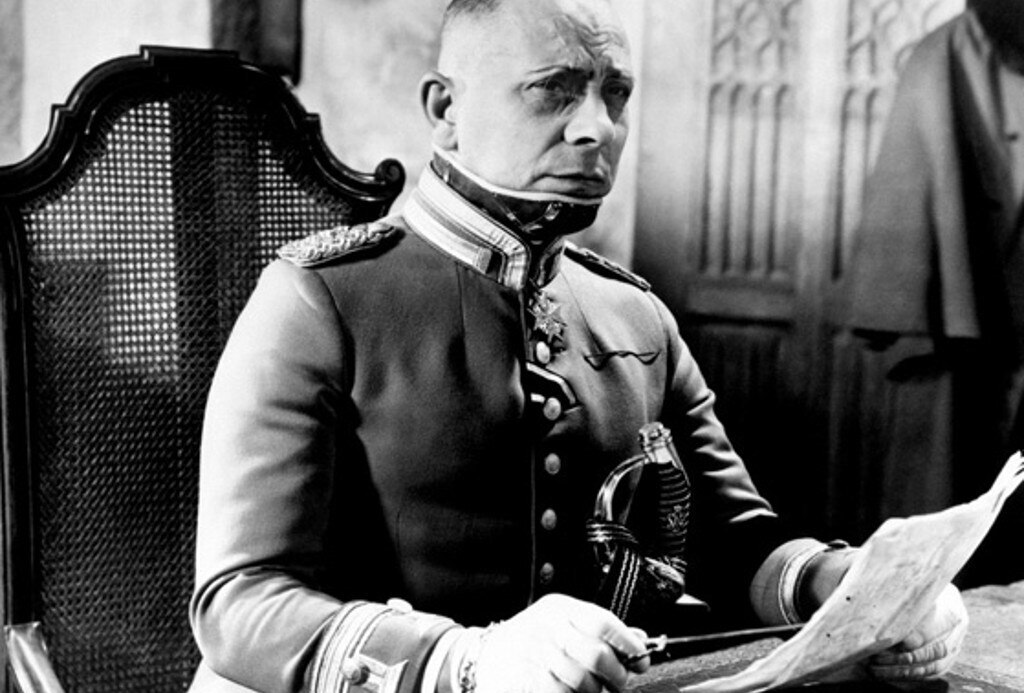
The script of The Grand Illusion underwent several changes along the way. A significant part of the evolution occurred during production itself; Renoir liked to leave room for improvisation and actor contributions, and once Erich von Stroheim was cast, large sections of the story were given a new focus. But an important reason for the changes at this stage was that Renoir came to realize he was no longer interested in simply making a movie about POW escapes. For one thing, he wanted an approach that was different from the typical war movie, with its "dreary clichés" and "us vs. them" mindset. "Excepting All Quite on the Western Front [1930], I had not seen a single film giving a true picture of the men who did the fighting," he explained. "Either the drama never got out of the mud, which was an exaggeration, or else the war was made into a kind of operetta with cardboard heroes."
Renoir also had no wish to depict the suffering of the infantry. His chief aim was the same as he had been pursuing since starting to make films - to express the common humanity of all people and the way they intersect and interact in unusual social or historical situations. What had started as an adventure story became, he said, "simply a cry, the affirmation of a conviction. I had the desire to show that even in wartime the combatants can remain men."
A scene in an early treatment of The Grand Illusion but not included in the final shooting script helped clarify the meaning of the title. Marechal and a fellow prisoner, Dolette (who later evolved into the Jewish character Rosenthal), escape and reach safety in Switzerland. They agree to celebrate the first Christmas Eve after the war together at the famous Maxim's restaurant in Paris. The final shot in this version was to have been set in post-war Paris at Maxim's, crowded with Christmas revelers except for an empty table awaiting the two men who never show up. In light of a world heading toward another cataclysmic war, it was a more downbeat ending that suggested that the bond between these two men could not outlast the war. Instead, Renoir opted for a more hopeful resolution, one that opted for pacifism while emphasizing the humanity of every character.
by Rob Nixon
The Big Idea (4/16) - GRAND ILLUSION
by Rob Nixon | February 16, 2005
SIGN UP FOR OUR NEWSLETTERS

CONNECT WITH TCM