SYNOPSIS
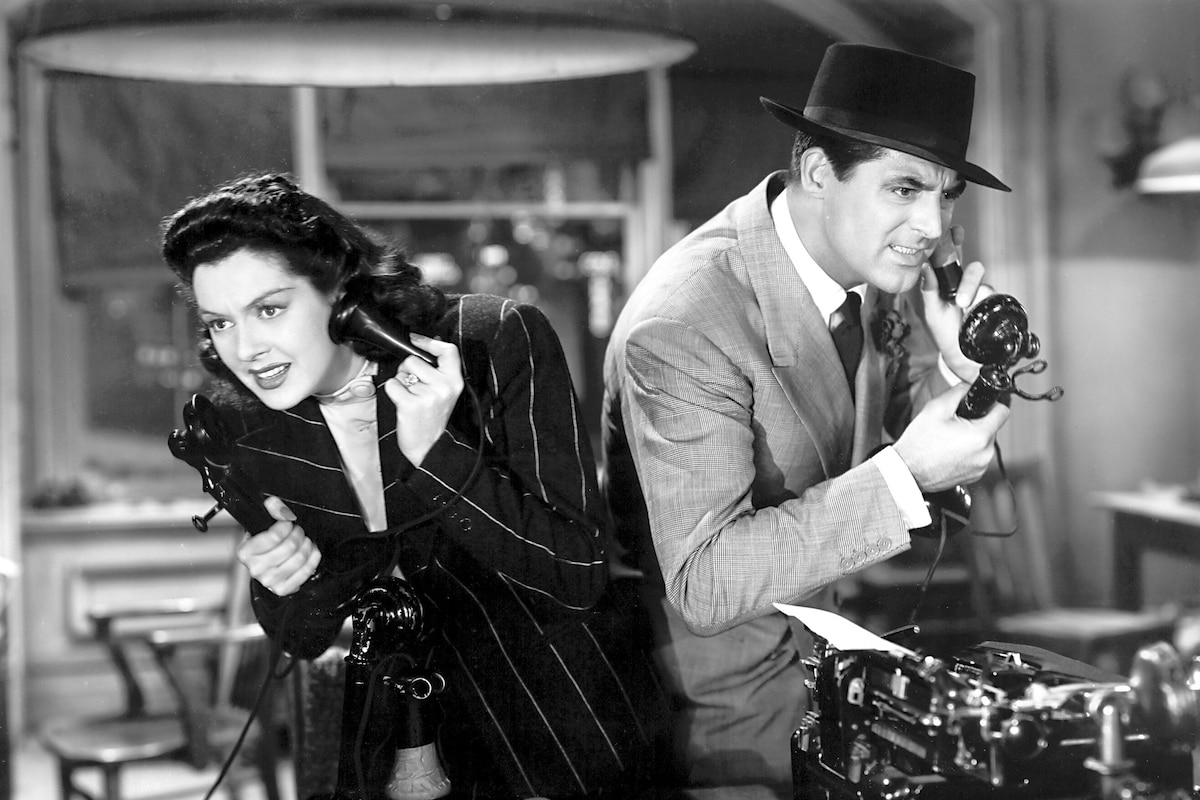
Romance and career collide when ace news reporter Hildy Johnson tries to leave her job and her editor/ex-husband Walter Burns, for a quiet life of wedded bliss. On her way out the door, Burns convinces her to tackle one last assignment -- a controversial execution scheduled for the next morning -- which is certain to be the greatest story of her career. Burns tries to keep Hildy busy while he thinks up ways to stop her impending marriage to the dull but respectable Bruce Baldwin. Meanwhile, Hildy finds herself aiding an escaped prisoner and uncovering a major political scandal.
CAST AND CREW
Producer-Director: Howard Hawks
Screenplay: Charles Lederer
Based on the play The Front Page by Ben Hecht and Charles MacArthur
Cinematography: Joseph Walker
Editing: Gene Havlick
Art Direction: Lionel Banks
Music: M.W. Stoloff
Cast: Cary Grant (Walter Burns), Rosalind Russell (Hildy Johnson), Ralph Bellamy (Bruce Baldwin), Gene Lockhart (Sheriff Hartwell), Helen Mack (Molly Malloy), Porter Hall (Murphy), Ernest Truex (Bensinger), Cliff Edwards (Endicott), Clarence Kolb (Mayor), Roscoe Karns (McCue), Frank Jenks (Wilson) Regis Toomey (Sanders), Abner Biberman (Diamond Louie), John Qualen (Earl Williams), Alma Kruger (Mrs. Baldwin) Billy Gilbert (Joe Pettibone)
BW-92m.
Why HIS GIRL FRIDAY is Essential
One of the greatest newspaper films ever made was born by accident. Director Howard Hawks was trying to prove that Ben Hecht and Charles MacArthur's play, The Front Page, still had some of the best modern dialogue ever written, but he didn't have two men to read a scene between editor Walter Burns and ace reporter Hildy Johnson. He gave Hildy's lines to his secretary, then announced, "It's even better this way." He got Hecht's blessing on the altered version, and the two started working on the script in 1939. But their work was going nowhere until Hecht's protégé, Charles Lederer, suggested the story would be more focused if Walter and Hildy had been married and divorced previously. Eventually, Hecht had to leave for another project, so Lederer finished the script and took sole credit with Hecht's blessing. Initially, he called the film The Bigger They Are before settling on the more romantic title His Girl Friday (1940).
Hawks' first choice for the divorced editor was the leading man from his last three films, Cary Grant. After a few years as a suave leading man, Grant had risen to stardom as a wise-cracking divorcee in The Awful Truth (1937). He'd almost quit the film, however, over director Leo McCarey's habit of throwing out the script and having the actors ad-lib scenes. By the time he went to work for Hawks, another master of improvisation, he was a master at winging it. Hawks got Grant to play against type as the milquetoast harassed by Katharine Hepburn in Bringing Up Baby (1938), then cast him as a he-man flyer in Only Angels Have Wings (1939). For His Girl Friday Grant played a rougher version of his usual sophisticated image, no great stretch for a man who grew up in the slums of London. He even added lines about himself, including a joking reference to "Archie Leach," his real name, and a reference to a man hiding in a desk as a "Mock Turtle," the character he had played in the 1933 version of Alice in Wonderland.
The female lead in His Girl Friday was one of the juiciest roles ever written for a woman and one of the few female characters from Hollywood's golden age to be treated as an equal to her male lead. Yet Hawks ran into a lot of trouble casting it. His first choice was Carole Lombard, who had become a star in his screwball farce, Twentieth Century (1934). By 1940, however, she was too expensive and the studio, Columbia, couldn't afford her. The script then went to Katharine Hepburn, Irene Dunne, Claudette Colbert, Jean Arthur, Margaret Sullavan and Ginger Rogers, all of whom turned it down.
Rosalind Russell jumped at the role. It fit perfectly with her move into fast-paced comedy that had started with The Women (1939). She knew she wasn't Hawks' first choice, however, and after a few days on the set felt he was treating her like an also-ran. "You don't want me, do you?" she asked him. "Well, you're stuck with me, so you might as well make the most of it." He obviously did as she turned in a performance that won her acclaim as one of the movies' funniest women. She also got a bonus when Grant introduced her to producer Frederick Brisson, whom she would marry a year later.
Although the final screenplay for His Girl Friday was a hefty 191 pages, the film clocks in at only 92 minutes (screenplays tend to run between one and one-and-a-half pages per minute). The reason was Hawks' insistence on using overlapping dialogue and rapid delivery throughout the film. As he would tell Peter Bogdanovich in an interview published in Who the Devil Made It (Alfred A. Knopf: New York, 1997): "I had noticed that when people talk, they talk over one another, especially people who talk fast or who are arguing or describing something. So we wrote the dialog in a way that made the beginnings and ends of sentences unnecessary; they were there for overlapping." Since the film was made before the arrival of multi-track sound recording, he had to have the sound mixer on the set turn the various overhead mikes on and off to follow the dialogue. Some scenes required as many as 35 switches.
His Girl Friday is one of three films often hailed as the ultimate screwball comedy. The other two are Bringing Up Baby, which also paired director Howard Hawks with Cary Grant, and The Awful Truth, starring Grant.
by Frank Miller
The Essentials-His Girl Friday
by Frank Miller | February 16, 2005
SIGN UP FOR OUR NEWSLETTERS

CONNECT WITH TCM