The Big Idea Behind NORTH BY NORTHWEST
North By Northwest made its way from script to screen in a rather roundabout way. Alfred Hitchcock and screenwriter Ernest Lehman were under contract to MGM to adapt The Wreck of the Mary Deare, based on Hammond Innes's maritime mystery novel. But Lehman had more than a few issues regarding his involvement in the project, and he approached Hitchcock with a strong suggestion that he quit the project. Unperturbed, Hitchcock said, "Don't be silly, Ernie. We get along so well together, we'll simply do something else." Lehman liked the idea, but still fretted on what to tell the MGM brass. Hitchcock smiled and said, "We won't tell them anything." For weeks, Hitchcock and his young screenwriter talked about food, fine wines, the latest scandals and everything but their still-undecided film. Finally, they got around to actually earning the money MGM was paying them every week, but neither one of the filmmakers could agree on a story idea, until Lehman simply said, "I want to do a Hitchcock picture to end all Hitchcock pictures, Hitch." The director was receptive to that idea and wistfully added, "I've always wanted to do a chase sequence across the faces of Mount Rushmore." Thus, the seed for North By Northwest was planted. So while Hitchcock was filming Vertigo (1958) the two would get together and thrash out the script and further plans for a film that was then called In a Northwesterly Direction. (Oddly enough it was also briefly titled Breathless which a year later would be the English title of the debut feature from Jean-Luc Godard, a rabid Hitchcock fan.) The resulting screenplay was tight, balanced and intricate; Hitchcock later told Francois Truffaut that, "In this picture nothing was left to chance." The script also made liberal use of the MacGuffin, Hitchcock's name for a device that keeps the story in motion even though in itself it's practically meaningless. The key MacGuffin in North By Northwest is the secret information sought by James Mason's sinister operation even though we never learn why it matters. This was Hitchcock's personal favorite, one he said had "been boiled down to its purest expression: nothing at all!" By the way, Hitchcock and Lehman never did make The Wreck of the Mary Deare. Michael Anderson ended up directing that one with Gary Cooper and Charlton Heston.
North By Northwest may have been inspired by a famous international espionage case called "The Galindez Affair." Jesus de Galindez was a Spaniard living in exile in New York City in 1956. While earning a living as a teacher at Columbia University, he was preparing a doctoral dissertation on the repressive Trujillo government in the Dominican Republic. Agents from the Trujillo government tried to bribe Galindez in order to prevent the dissertation from being published, but to no avail. On the evening of March 12, 1956, Galindez entered a Manhattan subway and disappeared without a trace. "The Galindez Affair" soon became an item of international interest, even being referred to on several occasions by President Eisenhower in press conferences. After several months though, no new leads appeared in the newspapers and the story ended without a resolution.
It is possible that Hitchcock and Lehman modeled the slightly sinister Leo G. Carroll character, head of the American Intelligence Agency, on John Foster Dulles (Secretary of State from 1953-1959) and his brother, Allen W. Dulles (head of the CIA from 1953-1961). The physical resemblance between Carroll's professor character and the two Dulles brothers is rather startling.
Lehman knew he wanted his hero to be an innocent man, possibly a sports announcer, a newspaperman, an advertising executive, or even a Frank Sinatra-type entertainer, but he couldn't figure out how the hero gets into trouble. Hitchcock ended his dilemma by recalling a story idea a New York newspaperman had once given him at a cocktail party - an idea about some government agency creating a nonexistent decoy agent to throw the villains off the trail of a real government agent. It did not take Lehman and Hitchcock long to concoct a similar phantom agent for their plot purposes.
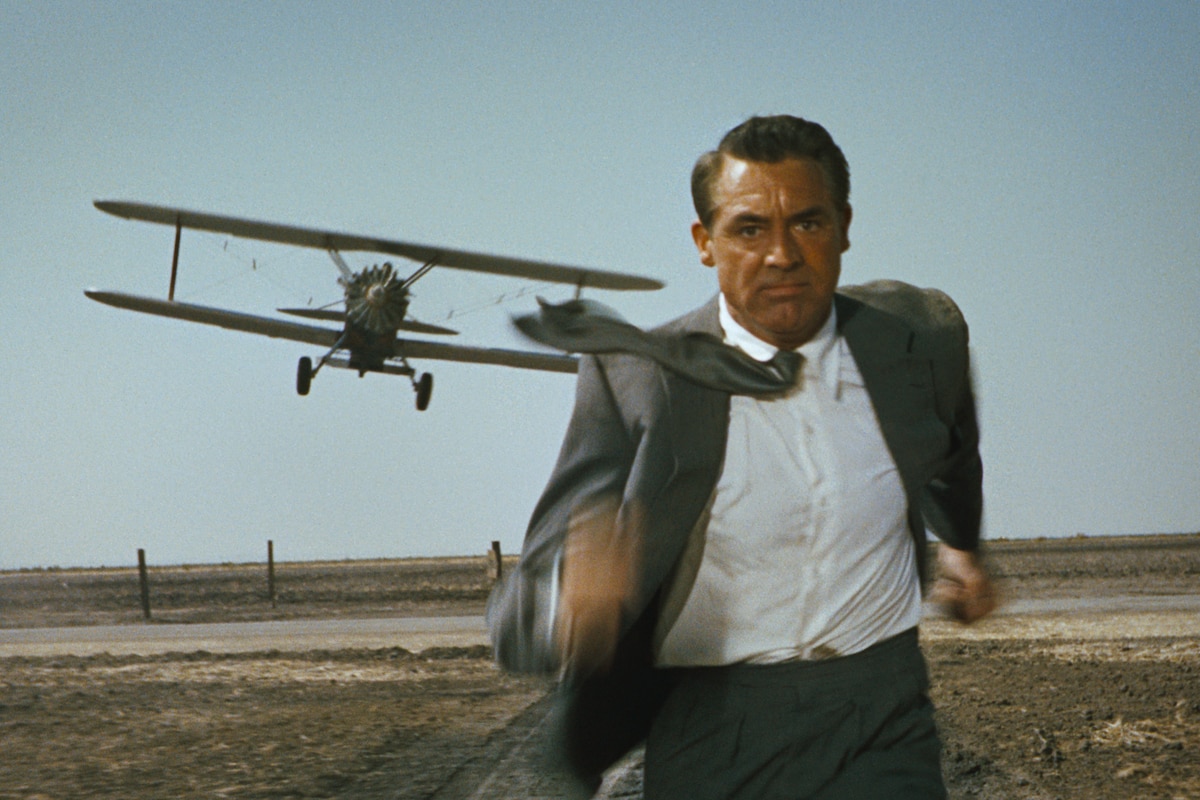
Alfred Hitchcock, in a celebrated interview with French film critic and director Francois Truffaut, discussed the inspiration behind the famous crop duster attack. Hitchcock said: "I'll tell you how the idea came about. I found I was faced with the old cliché situation: the man who is put on the spot, probably to be shot. Now, how is this usually done? A dark night at a narrow intersection of the city. The waiting victim standing in a pool of light under the street lamp. The cobbles are washed with the recent rains. A close-up of a black cat slinking along against the wall of a house. A shot of a window, with a furtive face pulling back the curtain to look out. The slow approach of a black limousine, et cetera, et cetera. Now, what was the antithesis of a scene like this? No darkness, no pool of light, no mysterious figures in windows. Just nothing. Just bright sunshine and a blank, open countryside with barely a house or tree in which any lurking menaces could hide."
By Scott McGee & Lang Thompson
The Big Idea (4/2 & 9/17) - NORTH BY NORTHWEST
by Scott McGee & Lang Thompson | February 16, 2005
SIGN UP FOR OUR NEWSLETTERS

CONNECT WITH TCM