SYNOPSIS
Roger Thornhill (Cary Grant), a successful New York advertising executive, is implicated in a murder at the United Nations and is forced to flee. He is soon captured by a spy ring who are convinced he is George Kaplan, a U.S. agent who is in possession of a top-secret microfilm. After a bungled attempt on his life by his captors, Thornhill goes to the police but they don't believe his story. In an attempt to discover who the real George Kaplan is, Thornhill embarks on his own cross-country investigation, while being pursued by both spies and government agents. The only person who appears willing to help him is a cool, mysterious blonde (Eva Marie Saint) he meets along the way.
Director: Alfred Hitchcock
Producers: Alfred Hitchcock, Herbert Coleman
Screenplay: Ernest Lehman
Cinematography: Robert Burks
Music: Bernard Herrmann
Art Direction: William A. Horning, Merrill Pye
Cast: Cary Grant (Roger O. Thornhill/George Kaplan), Eva Marie Saint (Eve Kendall), James Mason (Phillip Vandamm), Jessie Royce Landis (Clara Thornhill), Leo G. Carroll (The Professor), Martin Landau (Leonard), Philip Ober (Lester Townsend).
C-136m. Letterboxed. Closed captioning. Descriptive Video.
Why NORTH BY NORTHWEST is Essential
Alfred Hitchcock's North By Northwest (1959) is one of those rare films that expertly encapsulates all the favorite plot devices and themes that have marked a film director's entire career. It has an ordinary man thrust into extraordinary circumstances, a glamorous but enigmatic blonde, an array of sophisticated and diabolically cunning villains, and the expected cameo appearance by the director. The plot is also a distillation of the best espionage film cliches while displaying an ingrained fear of the police and American institutions like the U.S. government. North By Northwest is exactly what screenwriter Ernest Lehman intended; "the Hitchcock picture to end all Hitchcock pictures."
At the time of the film's release, Hitchcock was at the peak of his popularity with American audiences, mainly due to his weekly presence in American homes via the hit television series, Alfred Hitchcock Presents. He capitalized on this popularity by delivering a motion picture brimming with his trademark suspense, humor, and glamour that are still the measuring stick for chase thrillers.
The studio, however, wasn't quite so appreciative. They wanted to cut the film thinking that at 136 minutes it was too long. But Hitchcock's contract prevented that, and he insisted that some of what they were trying to cut was in fact vital to the film.
James Stewart, a veteran of four Hitchcock pictures, lobbied hard for the lead role in North By Northwest. But Hitchcock, while he admired his friend and frequent lead actor, did not envision Stewart as the dashing Roger Thornhill in North By Northwest. Hitchcock was able to stall Stewart long enough until the actor was forced to start work on Bell, Book and Candle (1958) for Columbia Pictures. Besides, Hitchcock didn't have the heart to tell Stewart that he had Grant in mind all along.
Cary Grant earned a nice chunk of change for his part in North By Northwest. On top of his base salary of $450,000, Grant also earned the same profit percentage as Alfred Hitchcock, plus an extra $5,000 per day beginning seven weeks after the contract was signed and continuing until the production was complete. Those seven weeks expired before shooting even began, so Grant's bank account swelled by the end of principal photography. It was Grant's fourth and final Hitchcock film and the actor brought his usual debonair charm and a genuine sense of confusion and bewilderment to the part. During shooting Grant said to Hitchcock, "It's a terrible script. We've already done a third of the picture and I still can't make head or tail of it." The comment greatly amused Hitchcock because, far from being a flaw, it perfectly reflected what Grant's character was feeling as well.
For the female lead, MGM tried to force Hitchcock to accept Cyd Charisse, who was under contract at the time. The idea of the attractive and talented actress as the duplicitous Eve Kendall seemed plausible, but Hitchcock wasn't interested. Meanwhile, Cary Grant wanted Italian sensation Sophia Loren, whom he had become quite smitten with while working on a previous film together, Houseboat (1958). Hitchcock surprised everyone by insisting on Eva Marie Saint. Starting with her Oscar®-winning role in On the Waterfront (1954), Saint had developed a "plain Jane" image in her choice of screen characters. Why Hitchcock thought she could sufficiently portray a sexy female spy baffled many. But Hitchcock loved the challenge of molding Saint into his idea of the mysterious blonde heroine. Just as Scottie Ferguson (James Stewart) molded Judy Barton's (Kim Novak) appearance in Vertigo (1958), Hitchcock personally supervised every aspect of Eva Marie Saint's transformation into Eve Kendall. "I watched every hair on her head," Hitchcock said about the wardrobe and pre-production tests. MGM commissioned two sets of wardrobe for Saint, both of which Hitchcock rejected because the clothes made Saint look like a "waif." Instead, Hitchcock took Saint on a shopping spree to Bergdorf Goodman's in New York City and bought the character's wardrobe right off the rack. By the way, see if you can read Saint's lips during her line "I never discuss love on an empty stomach" since the audio was supposedly dubbed over the original line "I never make love on an empty stomach."
Veteran scene-stealer Jessie Royce Landis landed the showy role of Cary Grant's mother. Her casting is peculiarly amusing in light of her age: she was less than a year younger than Grant. Some sources incorrectly list her as two years older than Grant.
While the story covers a wide span of the United States, filming was mostly brief location shots and extensive studio work. Hitchcock and cast started in New York in August 1958. A hidden camera was used to film Grant entering the United Nations building but they weren't able to film in the real UN lobby because it had been used somewhat inappropriately in an earlier film and all movies were forbidden there. Instead they filmed on a studio set that had been recreated as accurately as possible. (Hitchcock had gone through the real lobby with a still photographer while pretending to be a tourist and getting numerous snapshots.) The director ran into a similar problem at Mount Rushmore. The Department of Interior-which operates the monument-not only wouldn't allow filming on the actual sculpture but they also wouldn't give permission for actors to crawl over a reproduction either. A compromise was reached where the actors went between the faces instead of over them, but except for a few exteriors the whole Mount Rushmore scene was filmed at the MGM studios. (Perhaps it's a good thing that Hitchcock gave up his plan to have one of the characters erupt in a sneezing fit while hiding in a statue nose.)
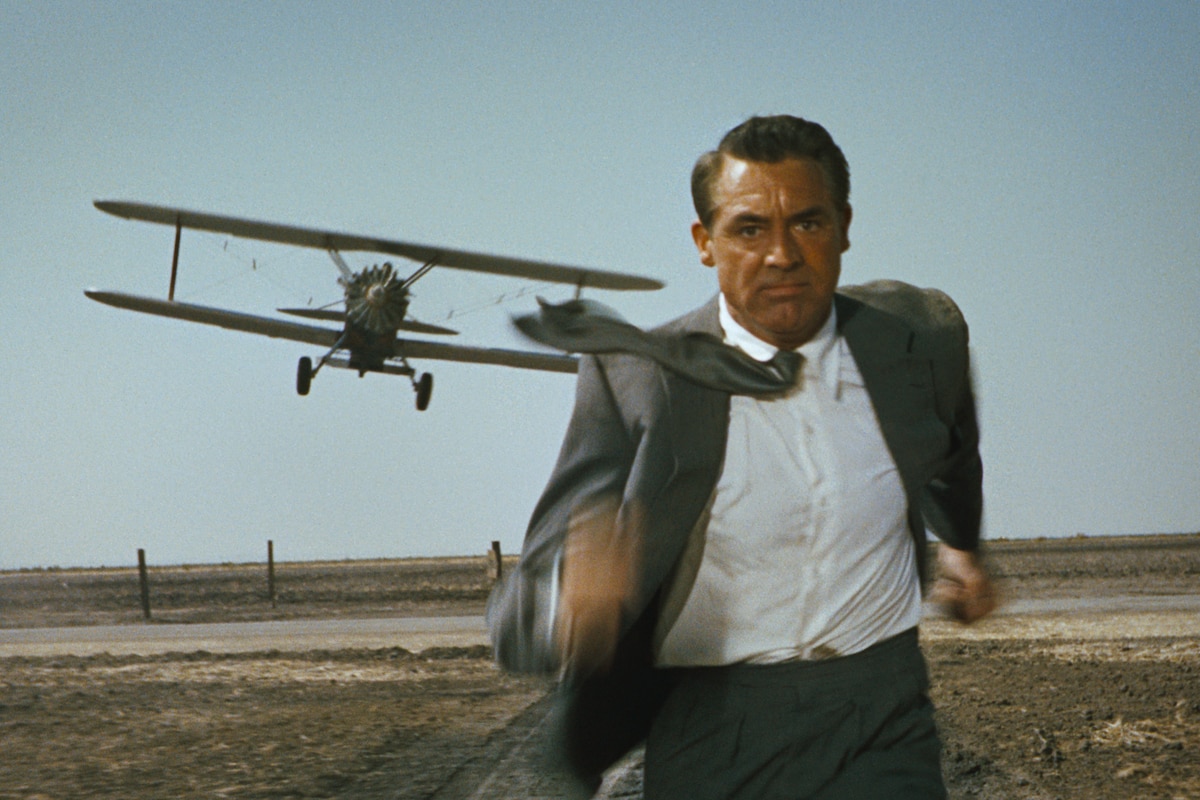
The famous scene of Cary Grant being chased through a cornfield by a crop duster is an example of Hitchcock at his best. It came about because he had noticed that when most directors try to make a suspenseful scene they use tight alleyways, shadows barely visible through the gloom and the slow building tension of the approaching menace. So Hitchcock did exactly the opposite: full daylight, completely open space and a very fast machine. Similarly, most directors gradually shorten each individual shot in such a scene as a way of increasing the tension, but Hitchcock kept his shots fairly uniform so that a viewer gets a better idea of how far and where Grant is running. The finished scene lasts around seven minutes with no dialogue and is as remarkable as the shower scene he devised for Psycho a year later.
The studio, however, wasn't quite so appreciative. They wanted to cut the film thinking that at 136 minutes it was too long. But Hitchcock's contract prevented that, and he insisted that some of what they were trying to cut was in fact vital to the film.
On release, North By Northwest proved Hitchcock knew what he was doing, when it turned out to be a big hit, breaking records at Radio City Music Hall and going on to become the sixth highest grossing film for 1959 (tied with Anatomy of a Murder) which made up for the commercial disappointment of Vertigo. The New York Times and National Board of Review chose it as one of the ten best films of the year. There were three Oscar® nominations for Best Editing, Best Art Direction and for Ernest Lehman for Best Original Screenplay. (Years later, Lehman would work with Hitchcock on Family Plot (1976), one of Hitchcock's biggest commercial successes, and another script that was never filmed.)
By Scott McGee, Jeff Stafford & Lang Thompson
North by Northwest - The Essentials
by Scott Mc | February 16, 2005
SIGN UP FOR OUR NEWSLETTERS

CONNECT WITH TCM