Like another of Fred Astaire's biggest hits, Top Hat (1935), The Band Wagon opens with the titles shown over his trademark top hat and walking stick.
Although far from the long-past-his-prime entertainer he portrayed in the film, Fred Astaire was coming off a box-office flop, The Belle of New York (1952), when he started work on The Band Wagon.
One parallel to Astaire's career that did not remain in the script was a movie exhibitor's reference to Tony Hunter as "box-office poison." Astaire had been among several stars -- including Katharine Hepburn, Greta Garbo and Joan Crawford -- stuck with that label in the late '30s and was quite sensitive about it.
Freed had always planned to use Ava Gardner in a cameo as the glamorous film star whose arrival at Grand Central Station upstages Astaire's. Studio head Dore Schary was never a Gardner fan and instructed the studio's publicists to announce that swimming star Esther Williams would play the role. Freed insisted on Gardner, however, and she ended up doing the scene.
The scene in which Lester and Lily Marton (Oscar Levant and Nanette Fabray) greet Astaire at the train station as the Tony Hunter Fan Club was based on a real event in writer Adolph Green's life. He was returning to New York after an out-of-town failure when his writing partner, Betty Comden, greeted him with a sign reading "Adolph Green Fan Club."
Early in the film, Astaire leaves his friends to go find the New Amsterdam Theatre. That was the theatre at which he had performed in the original The Band Wagon in 1931. In fact, Green first saw him perform in that show.
For the "Shine on My Shoes" number, Fred Astaire wanted to dance with the bootblack. They found the real thing in Leroy Daniels, a dancing shoeshine man working in downtown Los Angeles. He also inspired the 1950 hit "Chattanooga Shoe Shine Boy," recorded by Bing Crosby and country-western star Red Foley. Daniels would make only a handful of films, ending his career as a bootblack in 1985's Avenging Angel. He also had a recurring role on the hit sitcom Sanford and Son.
Director Vincente Minnelli wanted to button the end of "Shine on My Shoes" by having an arcade machine erupt with noise and color. Smith designed a combination calliope and rocket launcher for a cost of $8,800.
Jack Buchanan had introduced Astaire's first song in the film, "By Myself," in the stage show Between the Devil.
In England, where he was a star, Buchanan received co-star billing alongside Astaire. In other areas, he was billed as a featured player.
During previews, the mostly young audience gave Buchanan, whom most had never heard of, their highest approval rating, 78 percent. Astaire came in at 66 percent, lower than Cyd Charisse (71 percent) and Nanette Fabray (71 percent). The only principal player given a lower rating was Oscar Levant (46 percent).
Astaire and Charisse had not worked together since Ziegfeld Follies (1946), in which she had danced around him -- but not with him.
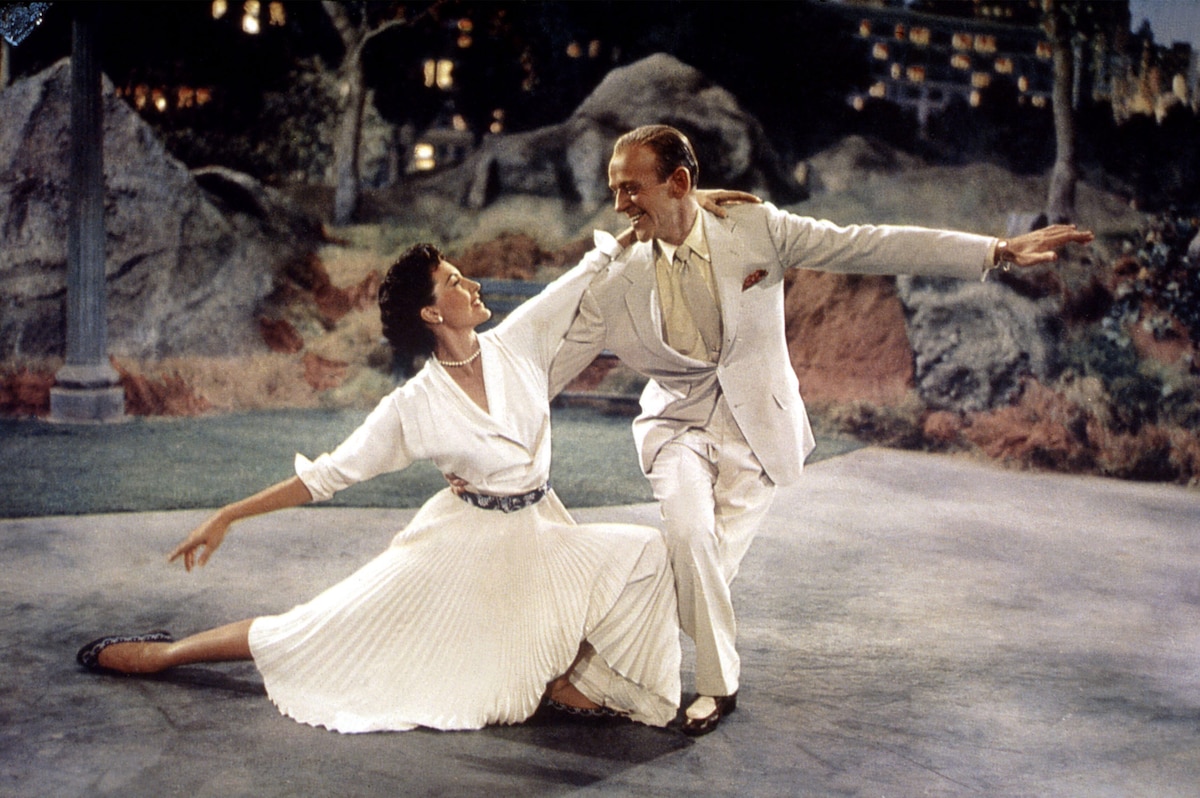
The simple dress Charisse wore for "Dancing in the Dark" was a copy of a dress costume designer Mary Ann Nyberg had bought in Arizona for $25. Since the dress was no longer being made, it had to be copied in the studio costume department, where it took $1,000 to get it right.
After his fight with Fabray, Levant goes to a bar across the street from the theatre. In the background is a poster for Every Night at Seven, the musical the brother-and-sister act played by Astaire and Jane Powell take to London in Royal Wedding (1951).
In the original script, Astaire's temper tantrum was written, "I am not Nijinsky. I am not Marlon Brando -- I'm just Mrs. Hunter's little boy, Tony -- an entertainer." When the legal department asked Brando for permission to use his name he refused, taking offense at the suggestion that he wasn't an entertainer. They changed it to "song-and-dance man."
As one of the visuals representing the show's disastrous opening in New Haven, Minnelli used a favorite painting of his, Arnold Boecklin's "The Isle of the Dead." It had also inspired a 1945 horror film from producer Val Lewton.
The song "I Guess I'll Have to Change My Plan" was originally about a man contemplating a love affair and included the line, "Why did I buy those blue pajamas, Before the big affair began." It was even nicknamed "The Blue Pajama Song" when Clifton Webb performed it in The Little Show in 1929. In 1953, however, the Production Code wouldn't allow any celebration of an illicit affair, so the lyrics were made more innocuous.
Although Michael Kidd was the film's choreographer, Astaire staged his own duet with Jack Buchanan to "I Guess I'll Have to Change My Plan."
Oliver Smith modeled his design for "I Guess I'll Have to Change my Plan" on the work of modern painter Paul Klee. This triggered another battle with the MGM art department.
The three clues Astaire investigates in the "Girl Hunt Ballet" were inspired by Rudyard Kipling's 1897 poem "The Vampire": "A fool there was, and he gave his share/For a rag, a bone and a hank of hair."
The sets for the "Girl Hunt Ballet" include posters for the movie The Proud Land. That was the name of the big-budget film that destroyed the leading character's career as a producer in The Bad and the Beautiful (1952), Minnelli's previous film.
As part of the ceremonies when Astaire received the American Film Institute's Lifetime Achievement Award in 1981, Charisse repeated her closing speech from the film, a tribute to Tony Hunter as a showman and the man her character loves.
James Mitchell, who plays Charisse's boyfriend and the show-within-a-show's original choreographer, was himself a dancer, most notably as the dancing Curly in Oklahoma. Two decades later, he would debut as corrupt tycoon Palmer Cortlandt on the daytime drama All My Children.
by Frank Miller
Famous Quotes from THE BAND WAGON
"I can stand anything but pain." - Levant as Lester Marton, in a reflection of the actor's own hypochondria.
"Kids, you're geniuses! It's brilliant, contemporary, perceptive -- this show is a modern version of Faust!" - Jack Buchanan as Jeffrey Cordova, taking over the show.
"Just like Faust, this man is tempted by the devil. And his compromise, his sellout, must end in eternal damnation."
"That'll leave them laughing." - Buchanan and Levant.
"There is no difference between the magic rhythms of Bill Shakespeare's immortal verse, and the magic rhythms of Bill Robinson's immortal feet." - Buchanan leading into "That's Entertainment."
"We're not fighting! We're in complete agreement! We hate each other!" - Nanette Fabray at Lily Marton settling an argument with Levant.
"Tony, you're showing me one-eighth of the iceberg, and I want to see eight-eighths. Now, go out there and give it to me." - Buchanan directing Fred Astaire as Tony Hunter.
"Did you ever try spreading ideals on a cracker?" - Astaire (and others), delivering one of the show-within-the-show's worst lines.
"I am not Nijinsky. I am not Marlon Brando -- I'm just Mrs. Hunter's little boy, Tony --a song-and-dance man!" - Astaire blowing up at Buchanan.
"I've learned one thing in the theater and it's this -- one man has to be at the helm and the rest take orders." - Astaire taking over the show-within-the-show.
"She came at me in sections. More curves than a scenic highway. She was bad, she was dangerous. I wouldn't trust her any farther than I could throw her. She was selling hard, but I wasn't buying." - Astaire's narration of "The Girl Hunt Ballet."
"The show's going to run a long time. As far as I'm concerned, it's going to run forever." - Cyd Charisse as Gaby Gerard, pledging her devotion to Astaire at the film's end.
Compiled by Frank Miller
Trivia - The Band Wagon - Trivia & Fun Facts About THE BAND WAGON
by Frank Miller | February 16, 2005
SIGN UP FOR OUR NEWSLETTERS

CONNECT WITH TCM