The Big Idea Behind THE BAND WAGON
After the success of An American in Paris (1951), built around the songs of George Gershwin, and Singin' in the Rain (1952), which used several of his own songs, MGM producer Arthur Freed set out to produce another song catalogue musical. This time he drew on the work of composer Arthur Schwartz and lyricist Howard Dietz, the latter head of publicity for MGM's parent company, Loew's Inc. Among their hits included in the film were "Dancing in the Dark," "By Myself" and "I Guess I'll Have to Change my Plan."
Initially, Dietz had turned down the chance to work with Schwartz. The lyricist had made his Broadway debut in 1924 working with the great Jerome Kern on Dear Sir. Schwartz was unknown at the time -- a lawyer planning to quit his firm to focus on music. When he wrote Dietz saying he'd like to try working with him, Dietz told him he didn't want to work with an unknown. The lyricist's next two shows were flops, however, so he was lucky to get a job writing songs with Schwartz for 1929's The Little Show. Their collaboration was so successful they would go on to write over 400 songs together.
The project's original title, taken from a Dietz-Schwartz hit that would end up in the movie, was I Love Louisa.
To create a movie around the songs, Freed set up a team including director Vincente Minnelli, writers Betty Comden and Adolph Green, composer/arranger Roger Edens, dancing star Fred Astaire, choreographer Michael Kidd, designer and stage producer Oliver Smith, and musician, wit and sometime actor Oscar Levant. The picture would mark the third for Kidd (he had done uncredited work at Warner Bros. in the '30s and re-staged the musical numbers for Where's Charley? in 1952) and the first for Smith, both well established on Broadway.
The Band Wagon (1953) was the first musical for Minnelli since An American in Paris, 18 months earlier. Much of his time between the two pictures was spent on a musical version of Huckleberry Finn that ended up being canceled. He also directed one of his biggest dramatic hits, the Hollywood tell-all The Bad and the Beautiful (1952).
Astaire was no stranger to Dietz and Schwartz's songs. The last show in which he had co-starred with his sister, Adele, was the songwriters' 1931 hit The Band Wagon. Minnelli had made his debut as a Broadway director with one of their shows, At Home Abroad in 1935.
Smith had been brought to MGM by Gene Kelly, who wanted to work with him on a proposed dance film called Invitation to the Dance. Sensing the film would be a disaster at the box office (he was right), Smith begged Freed to assign him to another film.
Creating a plot to connect all the songs proved a special problem because all of the Dietz and Schwartz songs had been written for musical revues. After weeks of listening to the songs and the theatrical reminiscences of their colleagues, Comden and Green came up with what seemed like the only logical choice, a movie about putting on a Broadway musical. Like Astaire, the leading man was a musical star in the middle of his career, conflicted about whether to continue working or retire. Other reflections of the star were his fear of dancing with a woman taller than him, his concern about his age and his problems working with ballet dancers. They even referred to the character's trademark costume as "perhaps the most famous top hat and stick of our generation." At first they were concerned that Astaire would think it hit too close to home -- to raise the stakes they had made the character a has-been -- but he loved the idea.
To carry the film's comedy, they created a married writing-performing team. Although Comden and Green were married to others, the roles were clearly modeled on themselves. Minnelli, however, thought the couple was based on Ruth Gordon and Garson Kanin, while Smith thought they were Oscar Levant and his wife, June.
Another key role was Jeffrey Cordova, a pretentious actor-director who would take on the musical and almost ruin it. Their inspiration for the character was Orson Welles and José Ferrer, who had recently wowed Broadway by staging four shows while appearing in a fifth.
The first actor approached to play Jeffrey Cordova was Clifton Webb, who had starred in The Little Show. Having risen from the supporting ranks to leading man status despite his advanced years and lack of sex appeal, Webb refused to take the secondary role. He suggested they talk to Jack Buchanan, an English song and dance man often dubbed "the British Fred Astaire." Before testing him, Freed also considered Vincent Price and Edward G. Robinson.
To play the married songwriters, Freed cast Levant, who had never played a married man on screen before, and Broadway star Nanette Fabray. Fabray had headlined Love Life and Arms and the Girl, two shows choreographed by Michael Kidd.
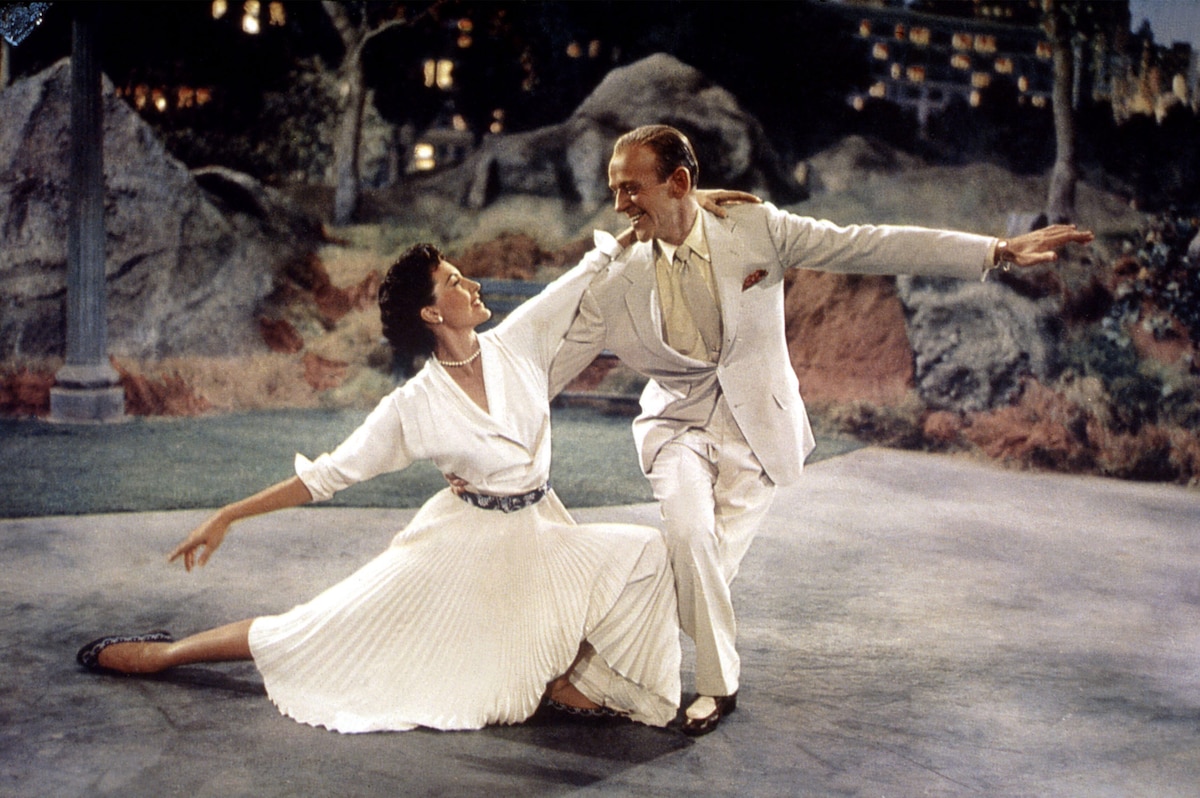
Cyd Charisse had been at MGM since 1944 without making the transition to stardom. She had been the original choice to play Astaire's first dancing partner in Easter Parade (1948), but a broken leg ended that and brought Ann Miller to the studio as her replacement. Then pregnancy had cost her the female lead in An American in Paris, a role that made Leslie Caron a star. In 1952, however, she scored a hit as Gene Kelly's sultry dancing partner in the "Broadway Rhythm Ballet" in Singin' in the Rain. As a result, Freed cast her as Astaire's dancing partner in their new film. Before accepting her, Astaire, like his character in the film, checked to make sure she wasn't taller than he.
Edens chose the songs to be included in the evolving screenplay, but Freed felt they needed something more. Inspired by Cordova's pep talk about the importance of entertainment in the theatre, he asked Dietz and Schwartz to write a new song for the film that would be another "There's No Business Like Show Business" (the show business anthem written by Irving Berlin for Annie Get Your Gun, 1950). The team went off and wrote the song in half an hour.
Freed decided that I Love Louisa no longer fit the script they were developing. Instead, he proposed The Band Wagon, the title of Astaire's previous Dietz and Schwartz show. Since 20th Century-Fox had bought the film rights (using the score only in their 1949 Dancing in the Dark), he had to buy the title from them for $10,000.
The film's musical climax, "The Girl Hunt Ballet," was just a note in the script. Comden and Green expected to create a plot for the ballet later, but Edens felt they should turn to the songwriters for that. Dietz and Schwartz wrote a song called "The Private Eye," but it didn't work in rehearsals. Then Eden saw a Life magazine spread about hard-boiled writer Mickey Spillane and decided to do a send-up of his work. Dietz wrote some musical themes for him, and Edens turned them into the ballet's score. Minnelli then asked Alan Jay Lerner, who had written the script for An American in Paris (1951) and would later write Gigi(1958) and the Broadway smash My Fair Lady, to write the narration. He did it for no screen credit or money, just for the fun of it. He was credited on the soundtrack album, however, triggering a complaint from Minnelli, who felt that he deserved the author's credit. His name replaced Lerner's when the recording was reissued on 45 rpm, which triggered a protest from Comden and Green. Freed dismissed the latter out of hand.
by Frank Miller
The Big Idea - The Band Wagon
by Frank Miller | February 16, 2005
SIGN UP FOR OUR NEWSLETTERS

CONNECT WITH TCM