SYNOPSIS
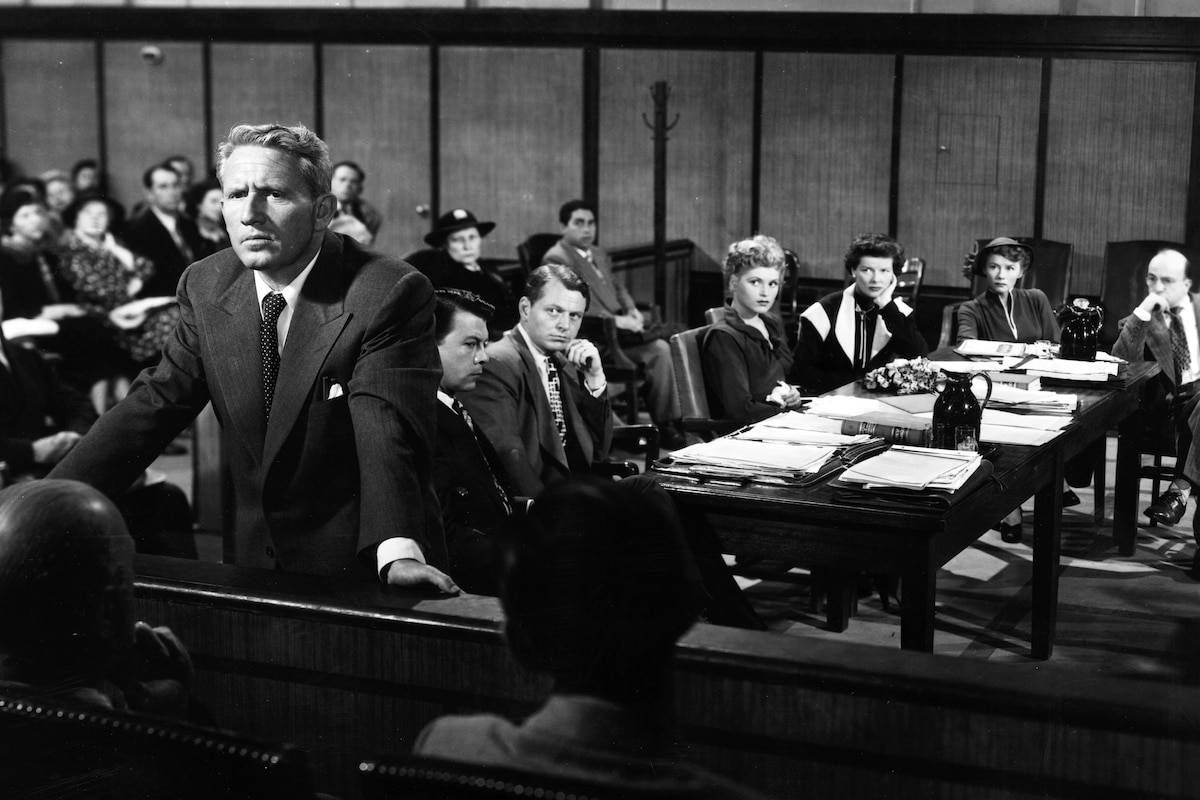
Attorneys Adam and Amanda Bonner are blissfully happy in their privileged world of professional achievement and creature comforts until they wind up on opposite sides of a controversial trial. Housewife Doris Attinger takes a shot at her philandering husband and is brought to trial for attempted murder. Amanda argues that a man doing the same to his cheating wife would be applauded for defending his home so she takes Doris's case pro bono, only to end up facing her assistant district attorney husband in the courtroom. As the battle over sexual equality spills over into their personal lives, the stage is set for a hilarious battle of the sexes between two formidable opponents.
Director: George Cukor
Producer: Lawrence Weingarten
Screenplay: Ruth Gordon, Garson Kanin
Cinematography: George J. Folsey
Editing: George Boemler
Art Direction: Cedric Gibbons, William Ferrari
Music: Miklos Rozsa
Cast: Spencer Tracy (Adam Bonner), Katharine Hepburn (Amanda Bonner), Judy Holliday (Doris Attinger), Tom Ewell (Warren Attinger), David Wayne (Kip Lurie), Jean Hagen (Beryl Caighn), Hope Emerson (Olympia La Pere), Clarence Kolb (Judge Reiser), Polly Moran (Mrs. McGrath), Paula Raymond (Emerald), Tommy Noonan (Reporter), Madge Blake (Mrs. Bonner), Marvin Kaplan (Court Stenographer), Anna Q. Nilsson (Mrs. Poynter).
BW-102m. Closed captioning.
Why ADAM'S RIB is Essential
With its story of married attorneys sparring in court and at home over the sexual double standard, Adam's Rib was years ahead of its time in dealing with feminist issues. Critic and historian Robin Wood would call it "perhaps the most explicitly feminist of all Hepburn movies" (International Dictionary of Actors and Actresses).
Other historians have hailed the film as a logical extension of the screwball comedies of the '30s and '40s. For them, the battle over sexual stereotyping grew out of the career vs. marriage conflicts of such earlier films as His Girl Friday (1940) and Woman of the Year (1942).
Adam's Rib took its inspiration from a real court case. Actress-writer Ruth Gordon and her husband Garson Kanin were driving to their country home under perilous conditions when, to distract her, Kanin asked his wife to tell him an interesting story. The first to come to mind was the story of actors Raymond Massey and Adrianne Allen's divorce. They had turned for legal help to married lawyers William and Dorothy Whitney, who did their jobs so well that after the case was closed the lawyers divorced each other and married their clients. The idea of husband-and-wife lawyers intrigued the husband-and-wife writers, who sat up till four the next morning discussing the story possibilities. Even in the early stages of development, they referred to the leads as Spence and Kate. Eventually they sold the screenplay for Man and Wife to MGM, where the title was changed to the less suggestive Adam's Rib. Despite all the on-screen courtroom shenanigans, the film also offers a surprisingly faithful depiction of what really happens during a legal case.
George Cukor was the natural choice to direct. Not only had he worked with the Kanins on their first screenplay together, A Double Life (1947), but he had directed some of Hepburn's greatest triumphs, including her screen debut in A Bill of Divorcement (1932) and her comeback from box-office poison, The Philadelphia Story (1940). Ironically, Hepburn and Tracy were both in a box-office slump at the end of the 1940s, a situation that Adam's Rib (1949) quickly remedied.
Hepburn was always closely involved in the development of scripts for her films. In addition to attending script conferences, she and Cukor visited courtrooms in Los Angeles to soak up details they could use to make the film more authentic. Once the script was ready, the company moved to New York, where the film was shot almost entirely on location. Cukor was happy for the chance to capture a near-documentary feel for some of the scenes, while Hepburn was happy to return to her conveniently located apartment, where she could walk to the set each morning.
The legal case on-screen wasn't the only trial associated with Adam's Rib. Kanin had recently scored a Broadway hit with his play Born Yesterday and wanted its star, Judy Holliday, to repeat her stage role. But Harry Cohn at Columbia Pictures had bought the film rights and decided that Holliday was too fat and ugly to play the part of an ex-chorus girl on screen. When Kanin shared the problem at a story conference for Adam's Rib, Hepburn suggested casting Holliday in the film's key supporting role, a frumpy housewife who stands trial for shooting her straying husband. She even encouraged the Kanins to build up the role in order to make it more of a showcase, and then she helped convince Holliday to take the part.
Hepburn continued to boost Holliday throughout shooting, helping her adjust to film acting and convincing Cukor to film the wife's strongest scene - her jailhouse interview with Hepburn - in one long medium shot of the young actress. According to legend, she refused to shoot reaction shots, so the entire scene of more than nine minutes was more or less a screen test for Born Yesterday. Once he saw her in Adam's Rib, Harry Cohn changed his mind and signed Holliday - and Cukor - for the film that would make her a star and bring her the Oscar® for Best Actress.
by Felicia Feaster & Frank Miller
The Essentials (3/19 & 8/27) - ADAM'S RIB
by Felicia Feaster & Frank Miller | February 16, 2005
SIGN UP FOR OUR NEWSLETTERS

CONNECT WITH TCM