Trivia and Other Fun Stuff
Orson Welles's films were always plagued by studio interference and re-cutting that at best changed his intentions and at worst completely destroyed them. The most infamous case is the complete re-cutting of The Magnificent Ambersons (1942), a film that many said could well have been Welles's masterpiece in its original form. The footage for that film was destroyed, making it impossible to ever restore his version, but at least Touch of Evil (1958) was recut in the 1990s to conform to Welles's editing notes, and its intended soundtrack was restored. Like The Lady from Shanghai (1947), that film also had its score and sound design changed by the studio before its initial release.
The failure of The Lady from Shanghai finished Welles in Hollywood for good. By the time of its release, he had already left for Europe, where his next project would be a controversial and problem-plagued film adaptation of Macbeth (1948).
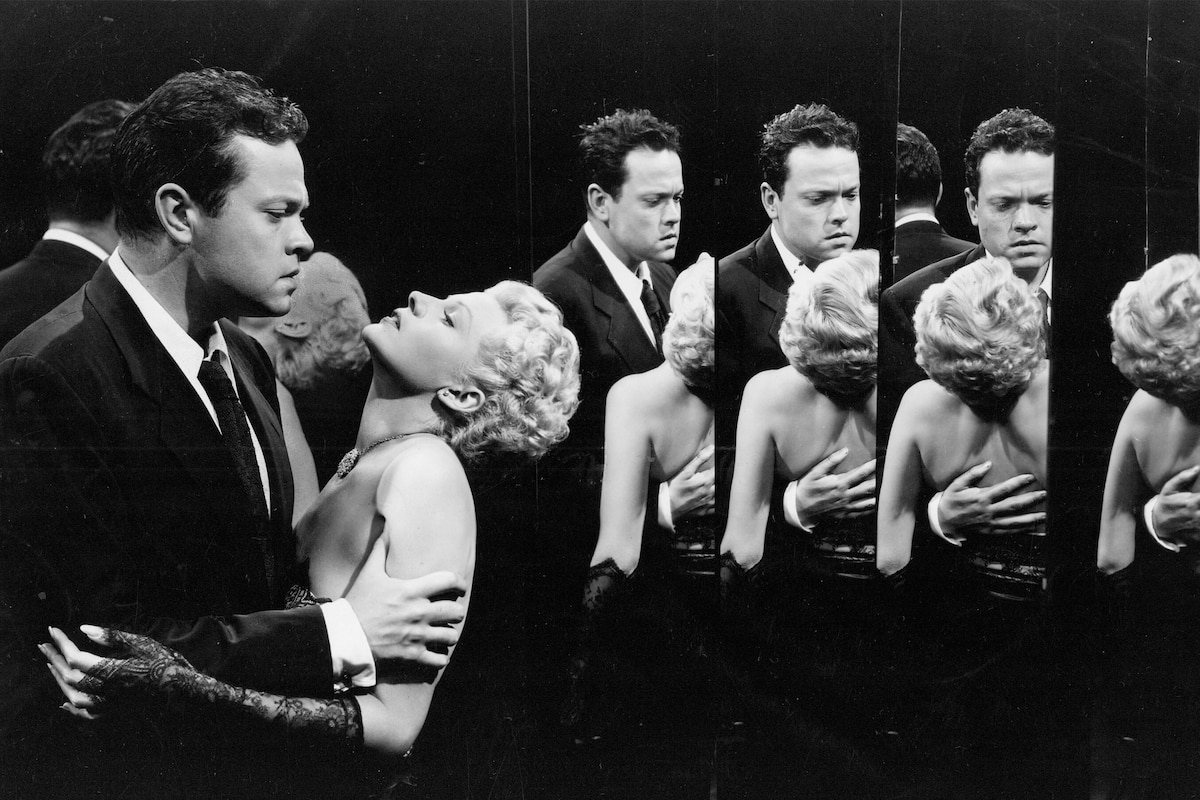
In response to the film and Welles's radical makeover of his star, columnist Louella Parsons (who despised Welles ever since he harpooned her boss, William Randolph Hearst, in Citizen Kane, 1941) called him "awesome Orson, the self-styled genius." She claimed he had deliberately and maliciously set out to destroy Rita Hayworth's career. She then declared Welles "washed up." By the film's completion, the marriage was in ruins as well.
"The six people who saw what Orson Welles did to Rita in
Producer William Castle is best known for the low-budget, gimmicky horror films he produced and directed throughout the 1950s and 60s; typical among them was The Tingler (1959), which had a vibrating device attached to theater seats that would go off at tense moments to give viewers a fright. He was known for appearing in his own trailers with over-the-top promotion of such films as House on Haunted Hill (1959), the 3-D Thirteen Ghosts (1960), and some of the unintentionally camp horror movies Joan Crawford made late in her career - Strait-Jacket (1964) and I Saw What You Did (1965).
Inspired by Castle's success, Alfred Hitchcock made his own low-budget thriller, Psycho (1960); in turn, Castle emulated Hitchcock's success with that picture by making a knock-off of it, Homicidal (1961).
Castle and Hitchcock shared other traits. Castle also used a silhouette of himself as a marketing device the way Hitchcock did. That trademark was parodied in the movie Matinee (1993), in which John Goodman played a character inspired by Castle.
Castle bought the screen rights to Ira Levin's best seller Rosemary's Baby (1968), but to avoid any confusion between that production and his earlier B movies, Paramount would only greenlight it if he didn't direct. Roman Polanski got that assignment while Castle produced and played a small bit as the man standing outside the pay phone.
Seven months before The Lady from Shanghai was released in the U.S., Hayworth and Welles were divorced. She declared on the witness stand, "Mr. Welles showed no interest in establishing a home. Mr. Welles told me he should never have married me in the first place, as it interfered with his freedom in his way of life."
Several alumni of Welles's famous Mercury Theater appear in this film. Everett Sloane (Arthur Bannister) made his screen debut in Citizen Kane and was also directed by Welles (uncredited) in Journey into Fear (1943). Sloane had a long and distinguished career on his own in film, stage and television before committing suicide in 1965, a possible reaction to news that he was going blind.
Mercury Player William Alland made his screen debut as the inquisitive reporter in Citizen Kane, on which he also served as Welles's assistant. He went on to produce a number of movies, only occasionally acting in small roles, such as the reporter in this picture and the Second Murderer in Welles's film of Shakespeare's Macbeth.
Legend has it that Welles's theatrical ambitions were inspired by meeting touring stage actor Erskine Sanford as a young boy. Sanford later joined Welles's Mercury Theater and followed the young director to Hollywood to play the flustered newspaper owner Mr. Carter in Citizen Kane. He appeared in a total of five Welles films, including his turn in The Lady from Shanghai as the judge.
Ted de Corsia made his screen debut in this picture at the age of 44. If his thuggish demeanor is familiar, it's because he made a career of playing a number of villains in crime thrillers and occasional Westerns, among them The Naked City (1948), The Big Combo (1955) and Gunfight at the O.K. Corral (1957).
Songwriters Doris Fisher and Allan Roberts, who wrote the song Rita Hayworth sings (she actually lip-synchs it) in The Lady from Shanghai, also composed her most famous number, "Put the Blame on Mame," with which she performed a sizzling striptease in Gilda (1946). They also wrote the hit "You Always Hurt the One You Love," and in 1940, Fisher and her father composed the Ink Spots hit "Whispering Grass." Later in life she switched careers from music to architecture and design and helped furnish the White House during the Kennedy administration.
Hayworth's singing voice in this movie was dubbed by Anita Ellis, who also performed the star's songs in three other pictures, including her most famous number, "Put the Blame on Mame." Although she also had success on radio and records, Ellis suffered from crippling stage fright, which limited her live concert career but made film work perfect for her. She also supplied the voice for Shelley Winters, Vera-Ellen, Jeanne Crain, and others. Ellis was the older sister of acclaimed Broadway star Larry Kert.
by Rob Nixon
Famous Quotes from THE LADY FROM SHANGHAI
O'HARA (Orson Welles): When I start out to make a fool of myself, there's very little can stop me.
O'HARA: New York is not as big a city as it pretends to be.
BANNISTER (Everett Sloane): Before you start that novel you're going to write, you better learn something. You've been traveling around the world too much to find out anything about it.
O'HARA: Living on a hook takes away your appetite.
O'HARA: I've always found it very... sanitary to be broke.
ELSA (Rita Hayworth): You need more than luck in Shanghai.
O'HARA: It's a bright, guilty world.
GRISBY (Glenn Anders): Just tell 'em you're taking a little tarrrr-get practice.
O'HARA: Is this what you folks do for amusement in the evenings, sit around toasting marshmallows and calling each other names? If you're so anxious for me to join the game, I'd be glad to. I can think of a few names I'd like to be calling you myself.
BANNISTER: George, that's the first time anybody ever thought enough of you to call you a shark. If you were a good lawyer, you'd be flattered.
ELSA: Everything's bad, Michael, everything. You can't escape it or fight it. You've got to get along with it. Deal with it, make terms.
ELSA: Those who follow their nature keep their original nature in the end.
BANNISTER: Killing you is killing myself. But, you know, I'm pretty tired of both of us.
O'HARA: Well, everybody is somebody's fool. The only way to stay out of trouble is to grow old, so I guess I'll concentrate on that. Maybe I'll live so long, I'll forget her. Maybe I'll die trying.
Compiled by Rob Nixon
Trivia (3/12) - THE LADY FROM SHANGHAI
by Rob Nixon | February 16, 2005
SIGN UP FOR OUR NEWSLETTERS

CONNECT WITH TCM