The Critics' Corner on THE LADY FROM SHANGHAI
The Lady from Shanghai (1947) was completed in 1946 but Columbia, fearful of its box office prospects, wanted to protect Rita Hayworth's popularity and image by releasing other more commercially promising pictures before the public saw this one. The studio held the release back for nearly two years. It ran first in France (1947), Finland, England, Australia, and Sweden before it finally opened in the U.S. in 1948. The studio did nothing to push the film, allowing it to be shown as the bottom half of double bills. Although it got many favorable reviews, audiences avoided it.
"The penny-dreadful aspects of The Lady from Shanghai are obvious, but the film is nevertheless often remarkable." - John McCarter, The New Yorker, June 19, 1948.
"Apparently what writer-director-actor Orson Welles had in mind was a full-blooded whodunit of the tough school, and he has succeeded in providing some of the standard ingredients." - Newsweek, June 21, 1948.
"Rambling style used by Welles has occasional flashes of imagination, particularly in the tricky backgrounds he uses to unfold the yarn, but effects, while good on their own, are distracting to the murder plot. Contributing to the stylized effect stressed by Welles is the photography, which features artful compositions entirely in keeping with the production mood." - Variety, April 10, 1948.
"Orson Welles, who produced, directed, wrote and starred in the film, is sometimes self-indulgent in his use of visual tricks and techniques, which at times sacrifice plot for visual brilliance, but he pulls it together in the end to produce a stunning, difficult film. Rita Hayworth gives one of her best performances as the deceptive, seductive temptress, hard-edged and cynical. The film confounds, unsettles and disorients the viewer, very much as Welles intended to do. While not an easy film, it is well worth the attention required to follow it, and Welles offers no easy solutions or any false happy endings to his tour-de-force mystery." - Linda Rasmussen, All Movie Guide.
"The Lady from Shanghai is a morality play without preachment; it can be taken as a bizarre adventure yarn, a bravura thriller, a profound drama of decay, or all three...Behind the magical showmanship is the voice of a poet decrying the sin and corruption of a confused world." - Peter Bogdanovich.
"The only raison d'etre for The Lady from Shanghai...is the cinema itself; and since Orson Welles is behind the camera that's already saying a lot, even if the spectator doesn't experience the emotion that he felt while watching Kane and Ambersons. É Visually the film is superb, and I agree with Bazin when he says, ÔHad he only made Citizen Kane [1941], The Magnificent Ambersons [1942], and The Lady from Shanghai, Orson Welles would still deserve a place among the citations carved on the Arch of Triumph celebrating the history of cinema.'" - Francois Truffaut, foreword to the book Orson Welles: A Critical View by Andre Bazin (Harper & Row, 1978).
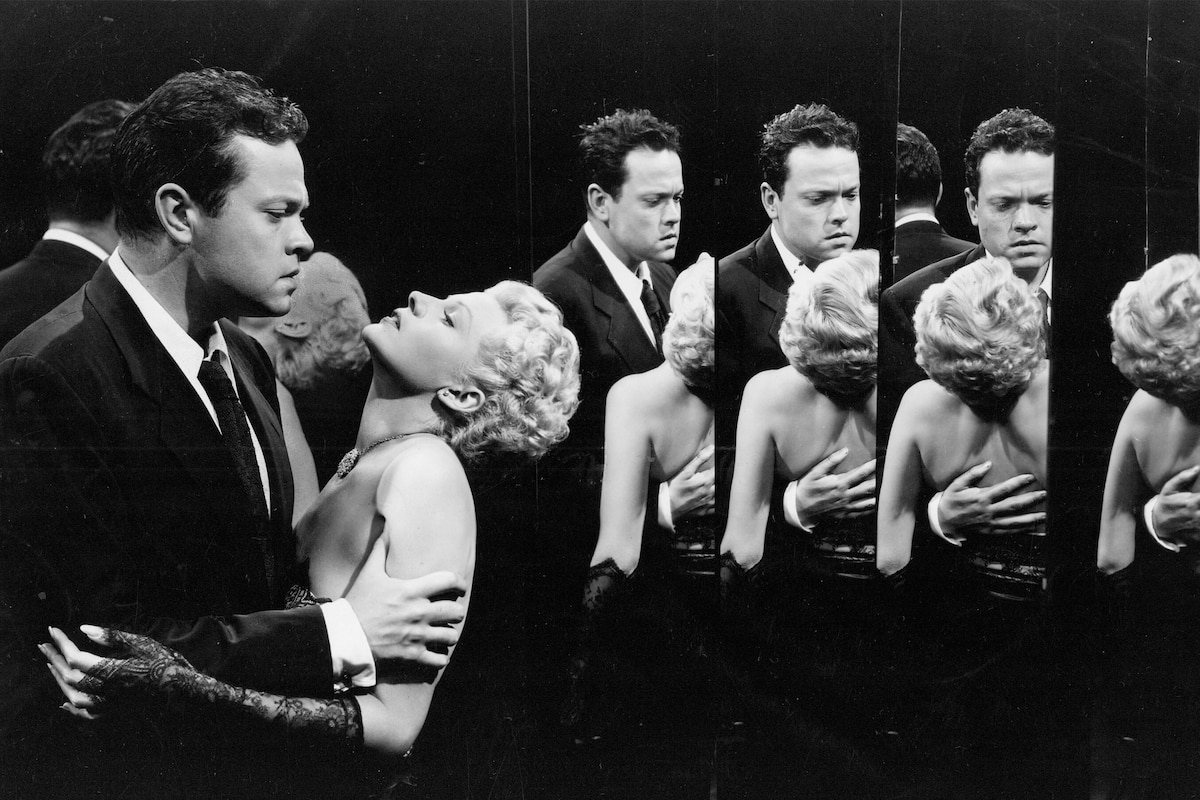
"The scene in the hall of mirrors...stands as a brilliant expressionist metaphor for sexual unease and its accompanying loss of identity. Complex, courageous, and utterly compelling." - Martyn Auty, TimeOut Film Guide (Penguin, 2000).
"That "garbled" thriller, The Lady from Shanghai, is unavoidably a commentary on Welles's marriage to Rita Hayworth and, incidentally, the clearest sign of his misogyny and his shyness of attractive, mature women." - David Thomson, The New Biographical Dictionary of Film.
"Perhaps Orson Welles' most enjoyable film, a longtime cult favorite...the story itself is classic film noir material (though Welles' Irish brogue doesn't immediately bring Philip Marlowe to mind) - you can find traces, especially when analyzing Hayworth's character, of The Maltese Falcon [1941], but I see it as more of a twist on Gilda [1946], with Hayworth's character changing from sympathetic to sinner. But in tone I think the picture anticipates Beat the Devil [1953]; here, too, are the tongue-in-cheek humor, the improvisation, the bizarre characters, the blonde (played by an actress known for a different hair color) who is a habitual liar, the sense that the director is having a grand time behind his camera." - Danny Peary, Guide for the Film Fanatic.
"With this film, Welles shattered the myth of the good-hearted heroine in American cinema. Rita Hayworth (Welles' second wife) had become enshrined in Gilda two years previously. In The Lady from Shanghai Welles undermines her glamour, leaving her to die in the Magic Mirror maze instead of in the arms of the hero. Paradoxically, this is also Welles' wittiest film." - Peter Cowie, Eighty Years of Cinema.
"The difficulty a viewer faces in interpreting Orson Welles's The Lady from Shanghai may be the first sign of its complexity. As in Touch of Evil [1958] ten years later, the film spins such intricate webs in terms of plot that several viewings are needed for anyone to find its crucial junctures and crossovers...The film uses a high contrast of black and white, essaying compositional angles that are more zany and unpredictable than those of Citizen Kane...Its genre is its own, and the film must be viewed independently of the models of editing one remembers from The Magnificent Ambersons and Citizen Kane." - Tom Conley, The International Dictionary of Films and Filmmakers.
"Absurd, unintelligible, plainly much of it cut and rearranged, this thriller was obviously left too much in Welles's hands and then just as unfairly taken out of them; but whole sequences of sheer brilliance remain, notably the final shoot-out in the hall of mirrors." - Halliwell's Film & Video Guide.
"Script is wordy and full of holes which need the plug of taut story telling and more forthright action. Rambling style used by Orson Welles has occasional flashes of imagination, particularly in the tricky backgrounds he uses to unfold the yarn, but effects, while good on their own, are distracting to the murder plot." - Variety Movie Guide.
"In some respects, the loss of control lets Welles off the hook, making it easy to credit him with Shanghai's virtues and forgive him its faults. But its virtues - acidic, politically relevant dialogue and daring camerawork, in particular - are unmistakably his. Stop-start pacing, intrusive music, and an overly explanatory voiceover delivered by Welles in an Irish accent that sounds far less convincing than the one used in the film all prove distractions, but they're ignorable." - Keith Phipps, The Onion A.V. Club
Compiled by Rob Nixon & Jeff Stafford
The Critics Corner (3/12) - THE LADY FROM SHANGHAI
by Rob Nixon & Jeff Stafford | February 16, 2005
SIGN UP FOR OUR NEWSLETTERS

CONNECT WITH TCM