Behind the Camera on THE LADY FROM SHANGHAI
At the start of production, the first thing Welles did was order Hayworth's trademark long, luscious red hair bobbed and dyed blonde (the color they decided on was called "topaz blonde"). Whether Hayworth was complicit in the decision or not (one source credits her with the idea), Cohn was absolutely furious, not only because Welles was drastically changing her screen image but because it was turned into a major media event, with press in attendance and photos of the makeover going out worldwide. The pre-cutting hoopla was so widespread that people were writing in, begging for a lock of her hair, including a minister who pointed out that cutting a woman's hair was a sin.
Shooting began in fall 1946. More than 35 days were spent on location in and around Acapulco, where Errol Flynn and his yacht were contracted to stand in for the Bannister's boat, Circe. Flynn actually piloted the vessel and can be glimpsed briefly in a shot outside a Mexican cantina. He was paid $1500 per day, plus lunches for his crew.
Other locations included the New York Maritime Union hall, the Aquarium and Mandarin Theater in San Francisco, and various other locations around those cities and in Los Angeles and Sausalito, Cal. Some scenes were shot later in the studio, and the sequence of Hayworth running through an Acapulco colonnade was done at the 20th Century Fox ranch.
The Central Park scene was shot using a carriage that was bought in Mexico and shipped to New York. Huge arc lights, a sound boom and a 20-foot camera crane followed the carriage nearly a mile to get a single dolly shot. Unfortunately, it was later cut by the editor Columbia brought in to "fix" the picture - a very effective editing job but completely ruining Welles's concept.
Welles and cinematographer Charles Lawton, Jr. had lengthy pre-production conferences during which they decided to use low-key interior lighting and natural light wherever possible. Filters were used for the outdoor skies to keep the transitions between outdoor and indoor scenes from being too glaring. Stark contrasts were set up in exterior shots to achieve some dramatic facial modeling. For instance, in a scene between O'Hara and Grisby, Welles wore a white linen suit to make his face look dark and somber.
Shooting aboard the close quarters of the yacht presented special challenges, which Welles and Lawton turned to good effect through the use of cramped, claustrophobic compositions. But shooting against the glare of the sea and sky often rendered light meters useless causing over-exposure. A series of experimental tests were made to figure out how to overcome the problem.
Wide-angle lenses were used to lend distortion to close-ups.
In the aquarium scene, the tanks were shot separately, enlarged, and matted in to make the sea creatures appear more monstrous and looming closer to the actors.
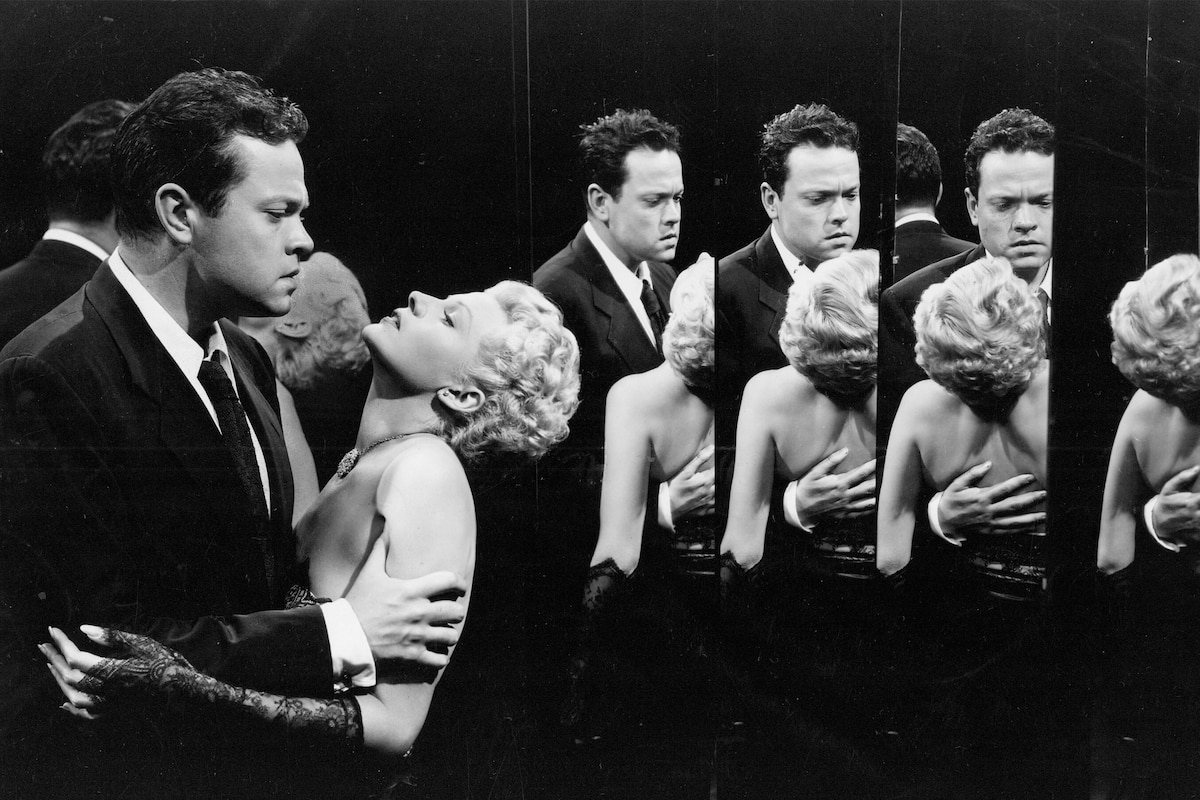
The justly famous Funhouse/Hall of Mirrors sequence took extensive work. The two sets were actually intended to be separate locations (as they were in San Francisco's Playland where the exteriors were shot). A scene in an earlier draft of the script would have made that clear and explained not only how the characters got from one to the other but how they were able to enter the closed attractions.
Welles wanted to pattern the funhouse on the expressionist images of the German silent The Cabinet of Dr. Caligari (1920). Stephen Goosson designed an elaborate set with sliding doors, distorting mirrors and a 125-foot zigzag slide from the roof of a studio sound stage down into a pit that was 80 feet long, 40 feet wide and 20 feet deep. For one shot simulating Welles's point of view as he hurtled down the slide, Lawton and camera operator Irving Klein slid the entire length of it on their stomachs with the camera on a mat. The director himself spent more than a week from 10:30 at night until 5 in the morning painting the set.
The Hall of Mirrors maze was designed with the help of special effects wizard Lawrence Butler, who had provided the screen magic in such films as Things to Come (1936) and The Thief of Bagdad (1940). It contained 2,912 square feet of glass. Some of the mirrors were two-way, allowing Lawton and his crew to shoot through them; other times they shot through holes drilled in the glass.
The Mexico shoot was plagued by a number of problems, many of them detailed by producer William Castle in his diary. During the day, the temperature was usually blisteringly hot, and at least once, Hayworth collapsed from the heat. At night, millions of poisonous insects swarmed around the arc lights, often blotting them out. One insect caused a substantial delay in shooting when Welles was bitten and his eye swollen shut to almost three times its normal size.
An assistant cameraman, working bareheaded in the blazing sun, suddenly dropped dead of a heart attack. The often-drunk Flynn tried to put him into a duffel bag, and Welles immediately sent someone ashore to alert authorities before Flynn could bury the man at sea.
Some scenes were filmed close to a crocodile-infested river. The rock from which Hayworth's character dives into the ocean had to be scraped to remove poisonous barnacles. A Mexican swimming champion armed with a spear had to swim off camera near Hayworth to ward off deadly barracuda in the waters.
Shooting was also delayed whenever Flynn disappeared for extended lengths of time. His contract stipulated the yacht could not be used unless he was present.
As the temperature rose and the shoot stretched longer than planned, financial problems worsened, and the studio began sending memos and emissaries to find out what was going on. One of the biggest sources of delay was Welles himself, as Castle noted frequently in his diary: "His whims and demands many, he has spent the first week picking locations, then changing his mind and picking others."
The cast was frequently frustrated and confused by arriving on the set to find Welles rewriting the script from day to day. His method of working with his actors was often harsh and manipulative. Sometimes he deliberately rattled them to get nervous, edgy performances. Other times he would cause them to forget their lines so they could improvise new ones. One such line that survives on screen was made up on the spot by a flustered Erskine Sanford as the judge: "This isn't a football game!"
Everett Sloane refused to wear the leg braces constructed for his character, complaining bitterly of the pain they caused. Sloane was reportedly impossible to deal with and shunned everyone on the set.
Glenn Anders, whose work dated back to the days of D.W. Griffith, was called in by Welles to play Grisby. When he arrived on the set his first day, Welles immediately ordered him to lie down on a stretcher under a sheet and play dead. The actor did as instructed and while he lay there, he said, a studio rep handed him a pen and a contract to sign. At that point, Anders claimed, he still knew nothing about the film or the part he was playing. Over the course of shooting, Anders became so upset about Welles's bullying, the crew dubbed him "Glenn Anguish."
Welles never viewed the rushes; he just shipped them off to Viola Lawrence, Columbia's chief editor, who had been assigned to the picture. When she saw that Welles had not shot a single close-up, not even one of Rita Hayworth, she went immediately to Cohn, who ordered the director to film some. On location, Welles ignored the command, although he finally complied upon his return to the studio.
Welles had outlined his editing strategy and concept, but the final cut was not granted to him by contract. Lawrence put together a rough cut for Cohn, who hit the roof when he saw it. "I'll give $1000 to anyone who can explain the story to me," he said. Welles took some of the criticism but laid most of the blame on Lawrence's editing. Cohn ordered a new structure for the film, which would have placed the courtroom scene at the center of the narrative with the rest of the action in flashbacks. But he was talked out of it when it became apparent that major re-shooting would have to be done.
Welles still had to re-shoot some of the footage, forcing him to match shots of Hayworth with a stand-in, who was paid $500 to have her hair cut and bleached like the star.
The extensive funhouse sequence was one of the greatest losses Welles had to endure, cut from a reel to only a few minutes. Fortunately for Welles, the Hall of Mirrors climax remained virtually untouched, except for the insertion of some music at the end which the director hated.
The biggest bone of contention was over the music and sound design. While Welles's reputation often rests on his visual style, he was also known for his mastery of sound thanks to his background in radio. His intention in this picture was to have the sound be a disruptive element, a device to unsettle the viewer (such as keying voices in at such a low level a viewer would have to strain to make out what was being said). Except for a few minor instances of this effect (the grating voices of Bannister and Grisby, the overdubbing of the final dialogue in the Hall of Mirrors), almost all were "corrected" by the Columbia sound department.
The rough musical soundtrack Welles had provided, inspired by South American and Mexican music, was thrown out and a typical Hollywood score was commissioned from composer Heinz Roemheld. Welles despised the music that was added and complained loudly to Cohn. Of the music accompanying Hayworth's dive into the water, Welles said it was more suitable "for some antic moment in a [Disney-produced] Silly Symphony, a pratfall by Pluto the Pup, or a wild jump into space by Donald Duck."
Welles's sound design for the Hall of Mirrors remained mostly intact, and he was pleased that Roemheld had not added any lush symphonic touch to Elsa's death. He was livid, however, over the echo of the film's romantic theme song, "Please Don't Kiss Me," which was added to the final moments. Cohn had purchased the song hoping to make additional income from the sale of records and sheet music. Welles felt this tacked-on musical finale was "obvious to the point of vulgarity, and does incalculable injury to the finish of the picture."
After production wrapped, Cohn said that The Lady from Shanghai was the last time he would bankroll a project whose on-screen lead was also the co-writer, producer, and director. In a situation like that, he reasoned, he was unable to fire any of them.
by Rob Nixon
Behind the Camera (3/12) - THE LADY FROM SHANGHAI
by Rob Nixon | February 16, 2005
SIGN UP FOR OUR NEWSLETTERS

CONNECT WITH TCM