The Big Idea Behind THE LADY FROM SHANGHAI
Orson Welles agreed to do The Lady from Shanghai (1947) in an act of desperation. After the failure and controversy surrounding his first two films, he found himself working outside of the original RKO contract that gave him unprecedented freedom on his first film. In spite of having done admirable, low-profile work on independent producer Sam Spiegel's The Stranger (1946), a modest hit he took on to prove he was not a reckless spender or raging egotist, Welles was still not regarded as a bankable director by studio bigwigs. He had gone back to the site of his first triumphs, the New York theater, and was working with producer Mike Todd on a mammoth stage adaptation of Jules Verne's Around the World in 80 Days, when the two ran out of money. Welles put in a call to Columbia Pictures head Harry Cohn, boss of Welles's estranged wife, Rita Hayworth, and offered to write and direct a picture for the $50,000 he and Todd needed to mount their play. Cohn agreed, stipulating he would send the money if Welles would direct the movie free of charge. Although the funds were not enough to save the stage production (which closed after a very short run), Welles soon found himself at the helm of The Lady from Shanghai.
Harry Cohn was an odd choice for Welles to turn to in need. The Columbia boss, who regarded Hayworth as his personal property, didn't approve of Welles's marriage to her in 1943. With the Welles-Hayworth marriage now on the rocks (and no set plan to use her in the film), it's not likely he was using his connection with her as a way of wooing Cohn. What is more possible is that he knew Cohn was good friends with Sam Spiegel, for whom Welles had made The Stranger. Welles brought that film in under budget and in less than the scheduled production time. It even made money, the only Welles film that can truly be said to have been profitable, so he likely reasoned that Spiegel would give him a good recommendation - and he was right.
There are a couple of versions of how Welles came upon the source material for The Lady from Shanghai. He claimed that while on the phone to Cohn, he found himself backed into a corner when the studio executive asked for details about the film project he had in mind. Welles said he spotted a copy of a thriller novel, If I Die Before I Wake by Sherwood King, and told Cohn this would make an ideal picture. Other sources have stated that Columbia already owned the rights to the book and that William Castle was set to produce it as a low-budget programmer. In any case, Welles said he agreed to adapt the story without ever having read it (although Spiegel later contradicted this), and hired himself as the producer with Castle serving as associate producer.
Reportedly, when Welles finally read the book he thought it was horrible. He then set about writing the adaptation in three days.
The novel, a simple, tightly structured thriller about the murder of a millionaire attorney, is not as different from the film as some have claimed. But Welles did take the basic story and construct a labyrinth of plot details and added twists until he came up with a narrative that reputedly even he did not fully follow. Complicating matters, Welles would continue to make changes to the story throughout the course of production.
One of the major changes Welles made was to move the novel's setting from Long Island to Mexico and the San Francisco Bay Area. That may have been done partially because Welles hoped to do more work on his South American opus It's All True (1993), a wish that was never realized. He may have also found the distant location shooting to be a good way to keep Cohn and his minions off his back so he could do the picture without interference. Oddly enough, the studio boss mostly stayed out of his way for much of the shooting, even though Welles told Cohn early on he intended to make a film that was "off center, queer, strange."
The script itself went through numerous changes during production, and an examination of the original screenplay reveals several scenes that, for one reason or another, never made it into the final film. One such scene was a pre-credit sequence that would have shown Elsa skillfully avoiding a mysterious group of men shadowing her through the city streets. Immediately after the opening titles, we would have seen her husband receiving a call telling him she had slipped from sight without a trace.
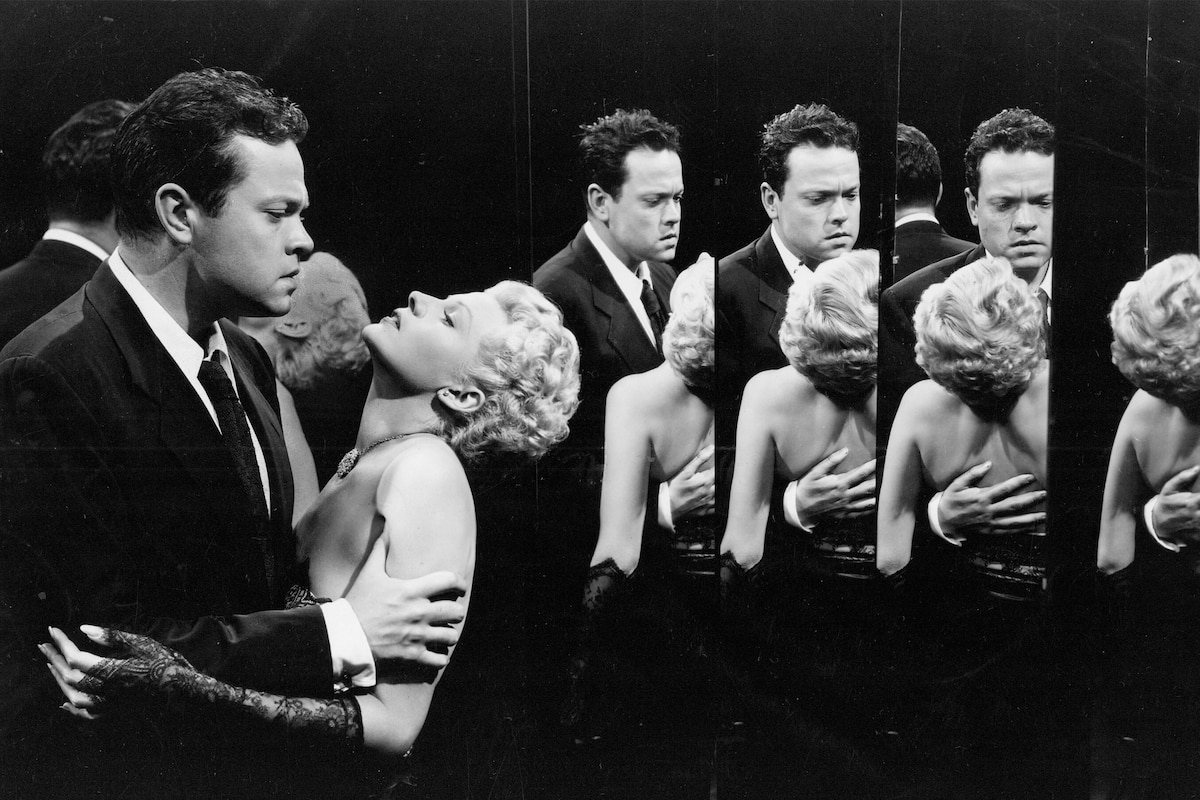
The Hall of Mirrors finale was originally scripted to be longer, giving O'Hara and Elsa a much more tender and ambiguous farewell. It may be that Welles never intended to end the film that way and only used this as a dodge to get Cohn's approval. It's not likely the studio head would have looked kindly on a conclusion that had Welles coldly walking away from Hayworth lying on the floor dying.
Rita Hayworth was not the first choice for the project. The picture was originally intended for Ida Lupino, though Welles wanted to use French actress Barbara Laage (who had yet to make her first film appearance). Instead Cohn stepped in and decreed the lead would go to Hayworth, and that the budget would be suitably increased for his biggest star. It may be that Cohn saw the publicity potential in having Welles reunited with his famous wife for a lavish Columbia production. He may also have simply been trying to exploit Hayworth as much as possible before her contract ran out and she started making pictures through her own company.
As for Hayworth, there have been a number of reasons put forth by different sources for her agreeing to do the picture: the chance of a reconciliation with her husband, her hope that it would make enough money for him to be able to support their daughter, the desire to shake the sex goddess image and be taken seriously as an actress, an opportunity to work with one of the cinema's most daring artists, or simply the obedience of a woman who was constantly being controlled by the powerful men in her life.
Welles cast himself in the male lead, for a percentage of the profits, and brought in some of his colleagues from the Mercury Theater days for other roles, notably Everett Sloane (Charles Foster Kane's right-hand man) as the crippled, shifty lawyer Arthur Bannister.
In the early stages, the novel's title was used as the working title of the picture, but Welles didn't like it because of its association with the child's bedtime prayer. He proposed the title "Black Irish," but the studio thought the ethnic resonance of that would be confusing. "Take This Woman" became the official name for a while. That may have been nixed, however, because of its resemblance to the MGM disaster I Take This Woman (1940), which went through so many changes and delays in production it became known as "I Re-Take This Woman."
by Rob Nixon
The Big Idea (3/12) - THE LADY FROM SHANGHAI
by Rob Nixon | February 16, 2005
SIGN UP FOR OUR NEWSLETTERS

CONNECT WITH TCM