SYNOPSIS
Irish sailor Michael O'Hara saves a beautiful woman from a robbery in Central Park; she turns out to be Elsa Bannister, wife of the famed defense lawyer Arthur Bannister. Bannister offers Michael a job on his yacht, which is sailing from New York to San Francisco. During the voyage Michael finds himself attracted to Elsa; at the same time, he becomes enmeshed in a Byzantine web of intrigue between Elsa, Arthur, and Arthur's partner Grisby. During a stop in Acapulco, Grisby asks Michael to pretend to murder him once they reach San Francisco so that he can collect his share of the insurance and run away to create a new life for himself. Michael agrees, only to discover that he has been framed for a real murder; the only way out now is to allow none other than Arthur Bannister himself to defend his case in court.
Director: Orson Welles
Producers: Orson Welles, William Castle
Screenplay: Orson Welles, based on the novel "If I Die Before I Wake" by Sherwood King
Cinematography: Charles Lawton, Jr.
Editing: Viola Lawrence
Art Direction: Sturges Carne, Stephen Goosson
Original Music: Heinz Roemheld, Doris Fisher & Allen Roberts (song "Please Don't Kiss Me")
Cast: Rita Hayworth (Elsa Bannister), Orson Welles (Michael O'Hara), Everett Sloane (Arthur Bannister), Glenn Anders (George Grisby), Ted de Corsia (Sidney Broome).
BW-88m.
Why THE LADY FROM SHANGHAI is Essential
After the scandal of Citizen Kane (1941, nearly destroyed for its thinly disguised depiction of newspaper magnate William Randolph Hearst), the tragedy of The Magnificent Ambersons (1942, a masterpiece cut to shreds by the studio), and the debacle of It's All True (the aborted South American film, portions of which were released posthumously in 1993), "boy genius" Orson Welles was no longer welcome in Hollywood. His marriage to the most glamorous star of the period in near ruins and his financial situation bordering on the desperate, he agreed to take on a directing assignment strictly for the cash. But anyone who thought Orson Welles had sold out to make a routine crowd-pleasing whodunit had their eyes opened wide upon the release of The Lady from Shanghai (1947).
According to Orson Welles, the idea for The Lady from Shanghai came purely by accident: "I was working on Around the World in 80 Days [a stage musical of the Jules Verne novel, produced by Michael Todd] and we found ourselves in Boston on the day of the premiere, unable to get the costumes from the station because $50,000 was due and our producer, Mr. Todd, had gone broke. Without that money we couldn't open. I called Harry Cohn [head of Columbia Studios] in Hollywood and I said, 'I have a great story for you if you could send me $50,000 by telegram in one hour. I'll sign a contract to make it.' 'What story?' Cohn said. I was calling from a pay phone, and next to it was a display of paperbacks and I gave him the title of one of them, Lady from Shanghai. I said, 'Buy the novel and I'll make the film.' An hour later, we got the money."
The novel from which the film was adapted was in fact entitled If I Die Before I Wake; in addition to that title, other working titles for the film included Black Irish and Take This Woman. William Castle, who later found fame as the producer/director of gimmicky horror films such as House on Haunted Hill (1959), The Tingler (1959) and Thirteen Ghosts (1960), already owned the rights to the book. He consequently acted as an associate producer and may have contributed to the script.
According to Welles, he originally intended to cast the actress Barbara Laage, an unknown, in the role of Elsa Bannister. However, Cohn suggested Rita Hayworth instead. Hayworth's legendary long red hair was cut short and dyed blonde for the film, much to the discomfort of Harry Cohn and the executives at Columbia Studies, who were banking on the appeal of Hayworth's star image, which had been carefully built up in films such as Gilda (1946). The film was shot on location in New York, San Francisco and Acapulco; the yacht used in the film belonged to Errol Flynn. Welles, who was officially separated from Hayworth at the time, moved back in with her during the production. However, their reconciliation was only temporary; the two divorced before the film was finally released, after a year's delay, in May of 1948. In retrospect, the film has often been interpreted as a commentary on their doomed marriage.
For many years The Lady from Shanghai has had the reputation of being one of Welles' great failures. Welles spoke at length about the troubled production in an interview with Peter Bogdanovich included in the book This is Orson Welles (revised ed. 1998), essential reading for anyone interested in Welles and his work. "Friends avoided me," Welles said. "Whenever it was mentioned, people would clear their throats and change the subject very quickly out of consideration for my feelings. I only found out that it was considered a good picture when I got to Europe. The first nice thing I ever heard about it from an American was from Truman Capote. One night in Sicily, he quoted whole pages of dialogue word for word." Among the problems associated with the film were supposed production delays on Welles' part, the sort of thing for which he had already gained notoriety in Hollywood. In fact, as Peter Bogdanovich has pointed out, most of the delays were due to Rita Hayworth's illness. In addition, the assistant cameraman Donald Ray Cory died of heart failure during the Acapulco shoot. The chief cinematographer Charles Lawton, Jr. also fell ill; the great Rudolph Maté shot part of the film for him, though his credits don't appear onscreen.
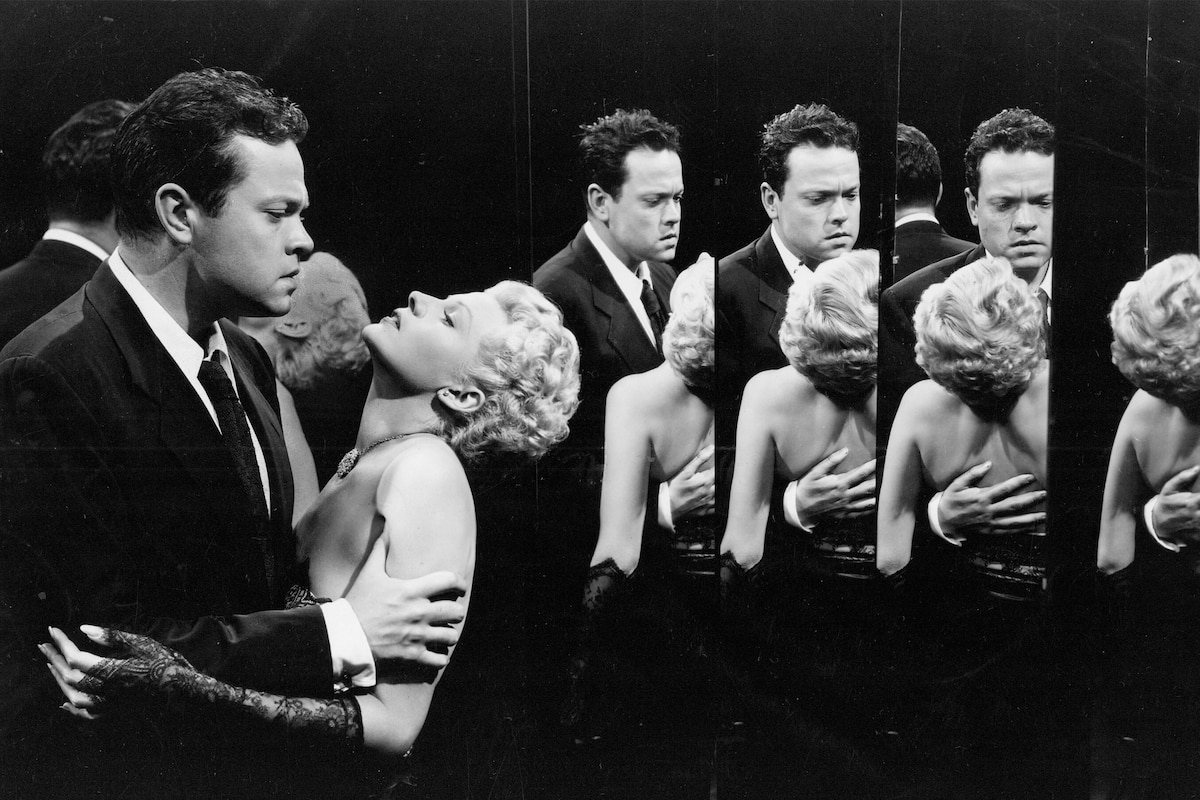
Welles' rough cut of the film ran approximately 155 minutes. When it tested poorly with preview audiences, the editor Viola Lawrence, at the request of the studio, cut out over an hour of footage, bringing the film to its current length of 87 minutes. The Chinese opera sequence and the funhouse sequence were originally much more elaborate set-pieces; Welles was particularly proud of the latter and has insisted that it would have been, if anything, more memorable than the climactic shootout in the hall of mirrors. Only a few stills remain to suggest what the funhouse sequence in its entirety might have looked like. However, even more than the cuts Welles objected to the musical score, which consists largely of quotations from the song "Please Don't Kiss Me" which Rita Hayworth sings on the yacht. In his memo to Harry Cohn after seeing the re-cut film, Welles wrote: "The only idea which seems to have occurred to this present composer is the rather weary one of using a popular song -- the "theme¿ -- in as many arrangements as possible. Throughout we have musical references to "Please Don't Kiss Me" for almost every bridge and also for a great deal of the background material. The tune is pleasing, it may do very well on the Hit Parade -- but Lady from Shanghai is not a musical comedy [...]" However, even in its somewhat mutilated form The Lady from Shanghai remains a well-acted and stylish example of the film noir. Hayworth, Sloane and Anders in particular stand out and the movie is distinguished by its striking deep-focus and chiaroscuro cinematography and a number of offbeat touches that only a director like Welles could have dreamed up.
As experimental and groundbreaking in its way as Kane (perhaps more so in many respects), this film was always intended by its director-writer-star to be "something off-center, queer, strange," as Welles said in a memo to Columbia Pictures head Harry Cohn. By giving his picture the feel of a bad dream and striving for performances that were "original, or at least oblique," Welles was working against cliché. Film critic Pauline Kael once pointed out that Welles's contribution to the evolution of film language lay in his dramatizing the techniques of cinema. That is obvious in every frame of The Lady from Shanghai. Jump cuts in the editing, the almost Brechtian distancing effect of the stylized performances, the doubling of the film frame in the Chinese theater scene, the deep focus that disorients by giving far backgrounds equal weight with extreme close-ups, the use of optical devices ranging from water tumblers to windshields to (in the film's most famous set pieces) aquarium glass and multiple mirrors - all of these serve to forefront the experience of watching cinema and to push the envelope of what is expected and permissible on screen.
by James Steffen & Rob Nixon
The Essentials (3/12) - THE LADY FROM SHANGHAI
by James Steffen & Rob Nixon | February 16, 2005
SIGN UP FOR OUR NEWSLETTERS

CONNECT WITH TCM