Rosalie dazzled audiences and dismayed critics in 1937 with a story
that traveled from the Army-Navy game to a mythical European kingdom before
returning to West Point for a lavish finale that presented a glamorized,
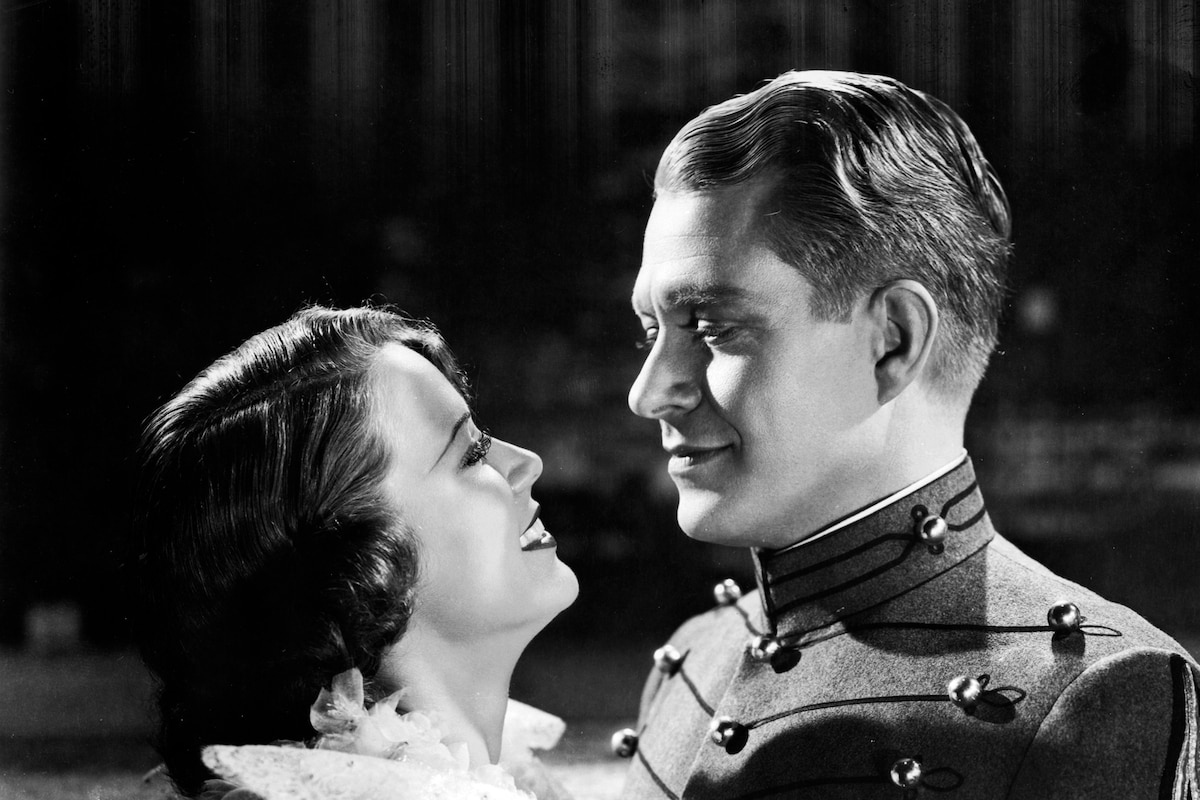
Hollywood take on the famed military academy. With Nelson Eddy and Ray
Bolger playing for the Army team, Eleanor Powell as a visiting princess
from Vasser, a Cole Porter music score, a cast of 2,000 and a budget of a
then-impressive $2 million, West Point never had it so good.
Rosalie first hit the boards in 1927 in a lavish Flo Ziegfeld
production starring Marilyn Miller as the middle European princess who
becomes Americanized by love for a West Point cadet. The story had been
inspired by two recent news events: Lindbergh's solo flight across the
Atlantic (the West Pointer flies to Europe to be with his ladylove) and the
New York visit of Queen Marie of Romania. Allegedly Ziegfeld was not all
that enthusiastic about the show, only producing it because his mother had
been named Rosalie. Much to his surprise, it became one of the hits of the
year.
MGM originally acquired the show as a vehicle for Marion Davies, but though
she completed a film version, the studio decided not to release it.
Sources disagree as to whether any of her version was used in the 1937
rendition that did make it to movie theatres. If any of it did, footage of
its blonde star would have been missing, as the title role was taken over
by the studio's new dancing sensation, the decidedly brunette Eleanor
Powell. But she never got to dance to the original score that combined
tunes by Sigmund Romberg and George Gershwin (the latter writing the show's
biggest hit, "How Long Has This Been Going On"). MGM scrapped their
numbers in favor of a new score by another great Broadway tunesmith, Cole
Porter.
Although dancing star Powell seemed a strange match for classical baritone
Nelson Eddy (who was usually paired with Jeanette MacDonald in the sort of musicals which had made him a star), Porter came up with a winning combination of hot rhythm numbers for her and more traditional ballads for him. In the latter category was the film's one enduring standard, "In the Still of the Night." Oddly, Eddy didn't want to sing it. He considered
the melody too unconventional and didn't think audiences would take to the
song's unusually long melodic line. Usually, Porter would have adapted his
score to the star's taste, but he felt this song was too good to lose, so
he appealed to studio head Louis B. Mayer, who was moved to tears by the
number. On his orders, it stayed in the picture.
Mayer also exercised his influence over the film's title number. Porter
tried five times to come up with a musical tribute to the leading lady that
Mayer would buy, but the mogul found each version too highbrow. Finally,
the composer turned out the simplest number he could come up with; some
biographers have suggested he deliberately tried to write a bad song. Not
only did Mayer love it, but it went on to become a big hit. Porter finally
changed his mind about the song when fellow songwriter Irving Berlin
advised him, "Listen, kid, never hate a song that has sold a half-million
copies."
The critics weren't much more enthusiastic about the film than Porter had
been about its title song. Writing in The New York Times, Bosley
Crowther called it "one of the most pretentious demonstrations of sheer
mass and weight since the last Navy games." Years later, Pauline Kael
quipped, "the sets are to make a person of taste weep." But the public
loved it. Drawn by the hit songs, the popularity of Powell and Eddy, and a
lavish production in the grand style, they made Rosalie one of MGM's
top box-office hits of the year.
Producer: William Anthony McGuire
Director: W.S. Van Dyke
Screenplay: William Anthony McGuire
Based on the Play by William Anthony McGuire and Guy Bolton
Cinematography: Oliver T. Marsh
Art Direction: Cedric Gibbons
Music: Herbert Stothart
Cast: Nelson Eddy (Dick Thorpe), Eleanor Powell (Rosalie), Ilona
Massey (Brenda), Ray Bolger (Bill Delroy), Frank Morgan (King Frederic),
Edna May Oliver (Queen), Billy Gilbert (First Officer), Reginald Owen
(Chancellor), George Zucco (General Maroff), Virginia Grey (Mary Callahan),
William Demarest (Army's Coach), Jerry Colonna (Second Officer), The
Albertina Rasch Dancers.
BW-124m.
by Frank Miller
Rosalie
by Frank Miller | February 22, 2006
SIGN UP FOR OUR NEWSLETTERS

CONNECT WITH TCM