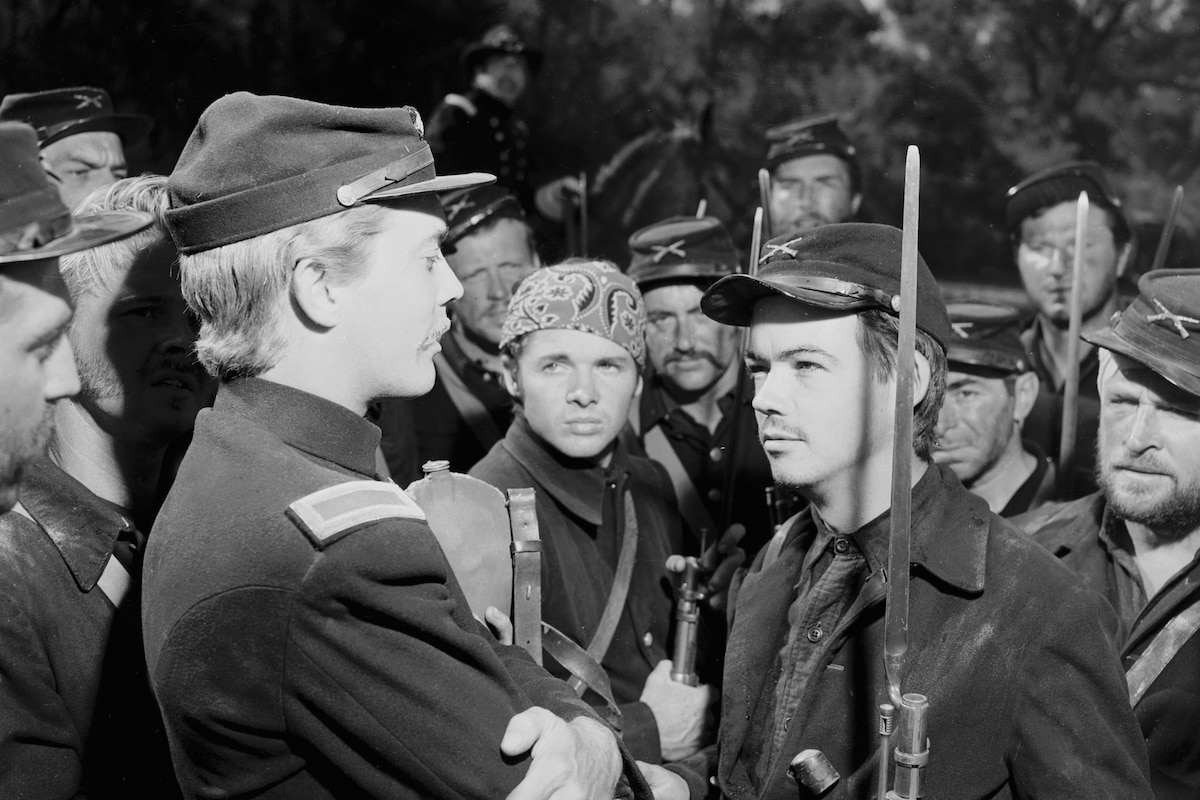
Throughout his long and illustrious career, John Huston always maintained that this Civil War picture examining the fine line between cowardice and bravery, "could have been" his greatest film, and clearly it is among the director's best, despite the altering by studio executives. Audie Murphy, the most decorated hero of World War II, plays Henry Fleming, a youth who joins the Union army and waits impatiently for the orders that will take him into battle. When the time finally comes to fight, the once boastful Henry flees in terror instead of facing the enemy. Eventually, he must confront his fear and return to his unit for another battle.
What's striking about The Red Badge of Courage (1951) is that it doesn't have a traditional story line. Instead, it covers a few, brief hours of war and the effect it has on a handful of characters. Director John Huston skillfully presents Stephen Crane's famous story as an allegory of all wars and his direction is lucid in every scene, from the film's sweeping battle sequences to isolated moments of terror and panic when Henry Fleming is confronted with death all around him. Cinematographer Harold Rosson gives the film a rough, granular texture, beautifully evoking the period and the photographs of Civil War cameraman Matthew Brady. Yet most of all, it is Murphy and the cast of charismatic near-unknowns that give the film its soul, especially Andy Devine as a cheery soldier who lets "God do his worrying."
One of the unanswered questions about The Red Badge of Courage is how much more effective it might have been in its original form. Huston left the production immediately after its completion to fly across the world to make The African Queen (1951), leaving his film in the hands of studio chiefs who cut it after the film failed miserably with preview audiences. They removed much of the director's questioning of the need for warfare (which they found objectionable during the then-current Cold War), added narration by James Whitmore, and reduced the running time to a paltry 69 minutes. Still embarrassed by the negative audience reaction, MGM sent the film out without fanfare, offering it as a second feature on double bills, hardly a way to recoup its $1.6 million production costs. Without the studio's support, the film became a commercial bomb. Audiences failed to identify with the film's grim realism and the classic Crane story wasn't enough of a draw to insure box-office success. It also didn't help that the film featured no big name stars in leading roles. And despite positive reviews by the critics (specifically for Murphy, who received the best notices of his career), American audiences in 1951 were simply not ready to examine the fine line between cowardice and bravery, especially in lieu of their victories during World War II and their current involvement in the Korean War.
A sad footnote for those who have ever hoped for a fully restored version of this classic film: Huston received a cable from MGM in 1975 which asked if he had a print of the original cut of The Red Badge of Courage. Unfortunately, it didn't exist, as it was destroyed years earlier. From that point on, Huston stipulated in all his future contracts that he would receive a sixteen-millimeter print of the first cut of any film he made in an effort to avoid the terrible lessons learned on The Red Badge of Courage. For those so inclined, full details of the frustrating events and ego clashes that occurred during the making of this film are strikingly captured in Lillian Ross's book Picture: A Story About Hollywood.
Producer: Gottfried Reinhardt
Director: John Huston
Screenplay: Stephen Crane (novel), Albert Band (adaptation), John Huston
Production Design: Lee Katz
Cinematography: Harold Rosson
Film Editing: Ben Lewis
Original Music: Bronislau Kaper
Principal Cast: Andy Devine (The Cheerful Soldier), Robert Easton (Thompson), Douglas Dick (The Lieutenant), Tim Durant (The General), Arthur Hunnicutt (Bill Porter).
BW-70m. Closed captioning.
By Michael Toole
