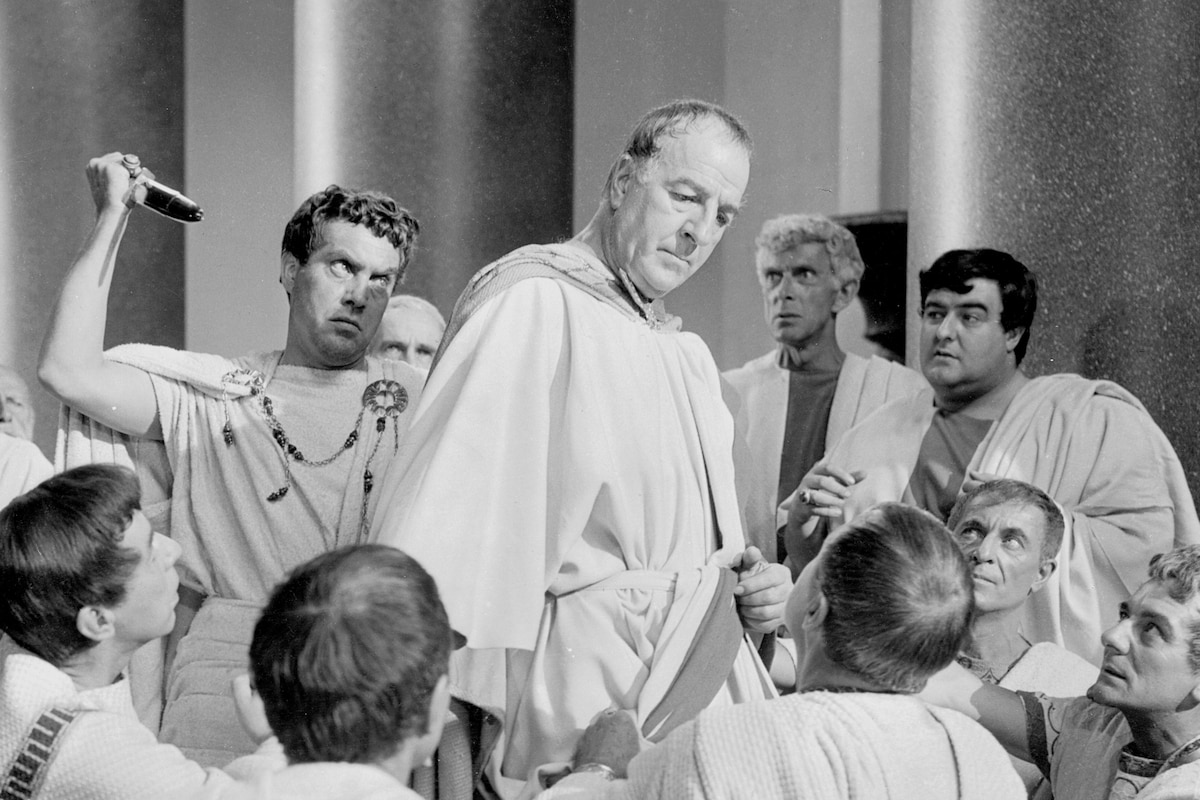
Director Joseph L. Mankiewicz set out to "eliminate the bric a brac" so commonly a part of studio historical spectacles when he adapted Shakespeare's Julius Caesar in 1953. Placed beside blockbusters like Quo Vadis (1951) or Ben-Hur (1959), Julius Caesar makes life in Rome seem uncrowded and intimate in scope. The simplicity of the set design, in fact, won the film the Oscar® for Best Art/Set Decoration that year at the Academy Awards ceremony because the art team of Cedric Gibbons, Edward C. Carfagno, Hugh Hunt and Edwin B. Willis recreated Rome on a human scale. Gone is the towering Circus Maximus. The film only glimpses the gates of the great arena. Instead it focuses on the solid bases of grand buildings, stairways and upward glances at statues of tribute. This Rome is a people's Rome, viewed from the vantage point of every citizen. The only set with real grandeur is Caesar's residence. The Senate hall is the simplest of all.
One sequence that draws special mention is the battle scene towards the end of the film. Shot in Bronson Caverns, California, the setting is reminiscent of a Monument Valley Western. In fact, a portion of The Searchers was filmed there.
Mankiewicz's vision worked for Julius Caesar, throwing the focus away from the background and onto the actors. It also laid a plain visual palate to balance Shakespeare's weighty language. And while the sets appear simple, Julius Caesar was still the third most expensive film MGM made that year.
Director: Joseph L. Mankiewicz
Producer: John Houseman
Cinematography: Joseph Ruttenberg
Editing: John D. Dunning
Music: Miklos Rozsa
Art Direction: Edward C. Carfagno, Cedric Gibbons
Set Decoration: Hugh Hunt, Edwin B. Willis
Costume Design: Herschel McCoy
Cast: Marlon Brando (Marc Antony), James Mason (Brutus), John Gielgud (Cassius), Louis Calhern (Julius Caesar), Edmond O'Brien (Casca), Deborah Kerr (Portia), Greer Garson (Calpurnia).
BW-122m. Closed captioning. Descriptive Video.
by Stephanie Thames
Julius Caesar (architectural version) - Julius Caesar (1953)
by Stephanie Thames | August 22, 2005
SIGN UP FOR OUR NEWSLETTERS

CONNECT WITH TCM