"If a man isn't inspired by his own death, he's beyond inspiration."
Ronald Colman, If I Were King (1938)
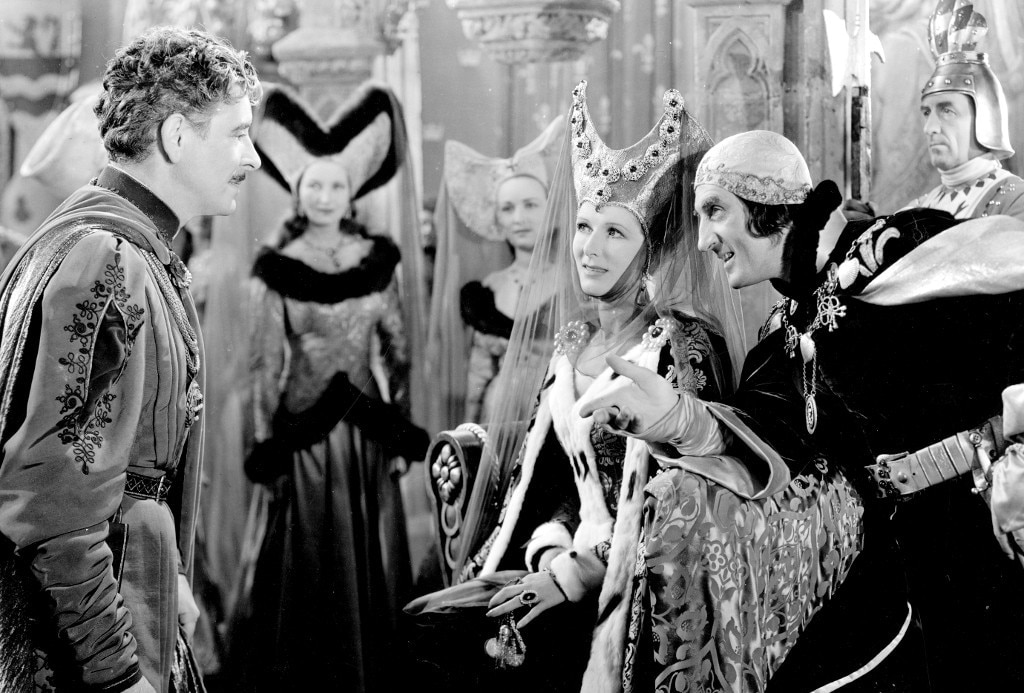
Few actors could turn a line of dialogue into poetry as effectively as Ronald Colman could. When the script was as good as the one Preston Sturges provided for If I Were King, the classic tale of a famous French poet who spent a day as a king, Colman performed with an authority few could match. Not only was he a memorable and believable poet, but with the help of stunt coordinator Ralph Faulkner -- with whom he had worked a year earlier on the
definitive romantic adventure, The Prisoner of Zenda -- he proved he could swash his buckle as well as current romantic heartthrob Errol Flynn. His performance more than lived up to the film's ad line: "His love-making was as dangerous as his swordplay."
The role of Francois Villon -- poet, thief and king for a day in 14th
century Paris -- had been a star-maker on Broadway for E.H. Sothern in the
early years of the 20th century. It had already been filmed in 1914 and
1920 (the latter starring William Farnum, who plays General Barbezier in
this version), when Rudolf Friml turned it into the successful operetta
The Vagabond King in 1925, with such hit songs as "Only a Rose" and
"Love Me Tonight." John Barrymore starred in a silent version in 1927
under the title The Beloved Rogue, while Dennis King, who had sung
the role on stage, top-lined a now-lost film version of The Vagabond
King that co-starred Jeanette MacDonald in 1930.
But it was Colman, in the only sound version of the original play, who was
the definitive Villon, leading his army of beggars against the invading
Duke of Burgundy and torn between the noblewoman (Frances Dee) and street
urchin (Ellen Drew) who love him. Colman was a rarity in Hollywood, a
silent star who had successfully made the transition to talking films. For
this he could thank his stage training and a voice among the most lyrical
in screen history. He also could thank the success of one of his first
talking films, the original Bulldog Drummond in 1929. He followed
with such hits as A Tale of Two Cities (1935) and Lost Horizon (1937), all
of which capitalized on his romantic image, before scoring again with If
I Were King. It would take a break from that image, however, to win
him a long overdue Oscar® in 1947, when he played a psychotic actor who
confuses the real world with his role as Othello in A Double
Life.
As a product of one of Hollywood's major studios, Paramount, If I Were
King was a quality production all the way. It was produced and
directed by Frank Lloyd, who had won Best Picture and Best Director
Oscars® for Cavalcade (1933), then directed another Best Picture-winner
with Mutiny on the Bounty (1935). Sturges was already the studio's top
scribe when he brought his patented blend of intellect and infectious
mischief to the script. He would go on to write and direct such classic
comedies as The Lady Eve (1941) and The Miracle of Morgan's Creek (1944).
Edith Head provided the period costumes, while the art department went
all-out to re-create medieval Paris, winning one of the film's three
Oscar® nominations for their work (designer Hans Dreier would be
nominated again for the 1956 re-make of The Vagabond King).
Also nominated for the film were Richard Hageman's score and Basil
Rathbone's scene-stealing performance as King Louis XI, who lets the court
think him mad as he manipulates nobles and peasants to consolidate his
power. Rathbone, who was Margaret Mitchell's first choice to play Rhett
Butler in Gone With the Wind (1939), would achieve screen immortality the
following year with his first performance as Sherlock Holmes, in The
Hound of the Baskervilles, a role he would repeat in a series of films
for Universal Studios throughout the '40s. Another future sleuth in the
film was Sidney Toler, cast as one of Villon's lower-class friends, who
would take on the role of Charlie Chanlater in 1938.
Producer/Director: Frank Lloyd
Screenplay: Preston Sturges
Based on the Novel and Play by Justin Huntly McCarthy
Cinematography: Theodor Sparkuhl
Art Direction: Hans Dreier, John Goodman
Music: Richard Hageman
Cast: Ronald Colman (François Villon), Basil Rathbone (Louis XI),
Frances Dee (Katherine de Vaucelles), Ellen Drew (Huguette), Henry Wilcoxon
(Captain of the Watch), Stanley Ridges (Rene de Montigny), Sidney Toler
(Robin Turgis), John Miljan (Thibaut d'Aussigny), William Farnum (General
Barbezier).
BW-101m.
by Frank Miller
If I Were King
by Frank Miller | September 10, 2007
SIGN UP FOR OUR NEWSLETTERS

CONNECT WITH TCM