In the late 1930s, Marlene Dietrich had refused offers from the Third Reich to return to Germany. She despised Hitler and what he was doing to her beloved homeland, and she became an American citizen in 1939. During World War II, she entertained U.S. troops and made anti-Nazi propaganda broadcasts in German.
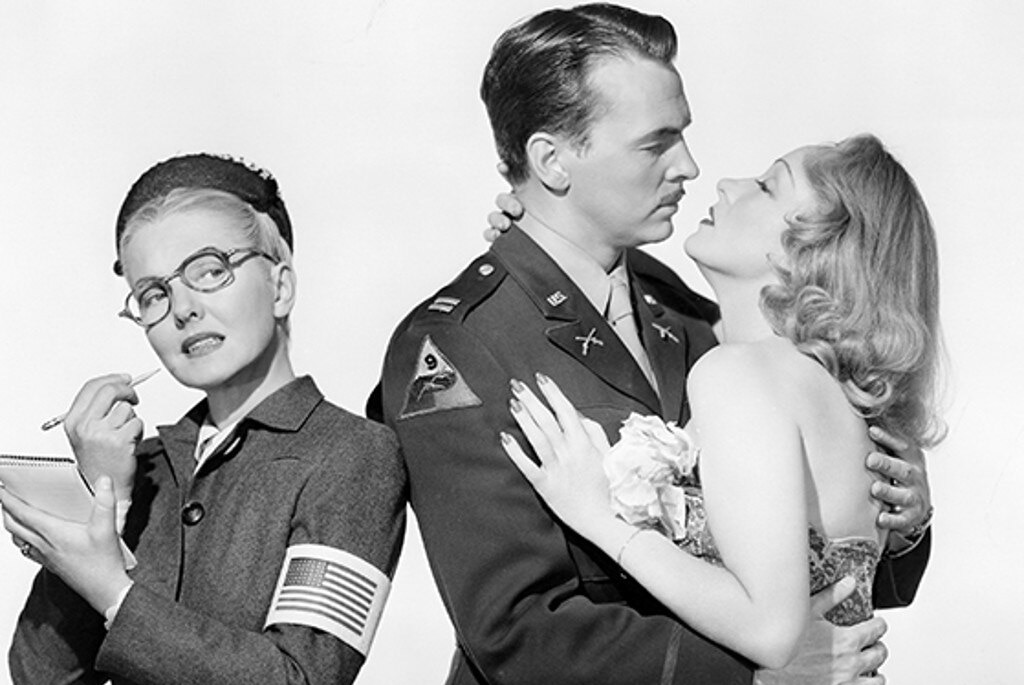
After the war, director Billy Wilder decided to make A Foreign Affair (1948), a satiric comedy about the rampant corruption during the Allied occupation of Berlin. A prim Congresswoman (Jean Arthur), part of a committee investigating the morale - and morals - of American occupation troops, falls for an American officer (John Lund). He happens to be involved with a seductive nightclub singer who had been the mistress of a high-ranking Nazi. Wilder knew that Dietrich's unassailable anti-Nazi credentials, and her war record, made her an unlikely, yet ideal, choice to play the chanteuse. But Dietrich, repelled by the idea of playing a Nazi, refused. On the pretext of asking Dietrich's advice on casting the role, Wilder showed her screen tests of two American actresses, and asked what she thought of their accents. Dietrich was appalled, and (as Wilder hoped) told him that nobody but she could play the role. Just before filming began on A Foreign Affair, Marlene Dietrich was awarded the Medal of Freedom, the U.S. government's highest civilian honor, for her wartime service.
Most of the film was shot in Hollywood. But before principal photography began, Wilder spent time in Berlin shooting background footage of the devastated city. Cleverly incorporated into the film, the footage added an ironic counterpoint to the comedy. Dietrich was delighted to be working with Wilder, whom she'd known in Berlin in the 1920s. But their constant joking and reminiscing in German annoyed Jean Arthur, who hadn't made a film in several years, and was notoriously insecure. One night, Arthur showed up at Wilder's house and hysterically accused him of destroying her close-ups to please Dietrich. Weary of Dietrich's narcissism and Arthur's paranoia, Wilder complained to John Lund that he had "one dame who's afraid to look in the mirror, and another who won't stop." All that self-absorption paid off for Dietrich, however. At 46 and about to become a grandmother, she looked stunning and sang Frederick Hollander's bitter, melancholy songs with great panache. Hollander, who had written Dietrich's cabaret numbers in The Blue Angel (1930), and accompanied her in that film, also plays her pianist in A Foreign Affair.
Probably Dietrich's most controversial film, A Foreign Affair was the first of Wilder's movies to arouse widespread debate. Some critics thought it was brilliant and sardonic. Others reacted negatively to a comedy about postwar profiteering, and were horrified that the filmmakers considered Nazi war crimes a fit subject for comedy. Wilder was denounced on the floor of Congress. The army banned A Foreign Affair in occupied Germany but it was finally shown there in 1977, to great acclaim. Today, the arguments about the film rage on among film scholars and Billy Wilder aficionados. But about Dietrich's performance, there has always been unanimity: it is one of her very best.
Producer: Charles Brackett
Director: Billy Wilder
Screenplay: Charles Brackett, Richard L. Breen, Robert Harari; adapted by David Shaw; story by Billy Wilder
Editor: Doane Harrison
Cinematography: Charles B. Lang
Art Direction: Hans Dreier, Walter Tyler
Music: Frederick Hollander
Cast: Jean Arthur (Phoebe Frost), Marlene Dietrich (Erica von Schluetow, John Lund (Captain John Pringle), Millard Mitchell (Colonel Rufus J. Plummer), Peter von Zerneck (Hans Otto Birgel), Frederick Hollander (Pianist).
BW-116m.
by Margarita Landazuri
A Foreign Affair
by Margarita Landazuri | January 24, 2006
SIGN UP FOR OUR NEWSLETTERS

CONNECT WITH TCM