Synopsis: When General Badoglio of the Italian Army signs an armistice with the Allies on September 8, 1943, the German Wehrmacht rejects the truce and occupies the city of Naples. In retribution, the Germans publicly execute an innocent sailor and round up the male inhabitants of the city for deportation to German labor camps. However, starting on September 28 the people of Naples organize a four-day rebellion against the Germans in an attempt to drive them out of the city. Ordinary people from all walks of life become heroes in the Resistance.
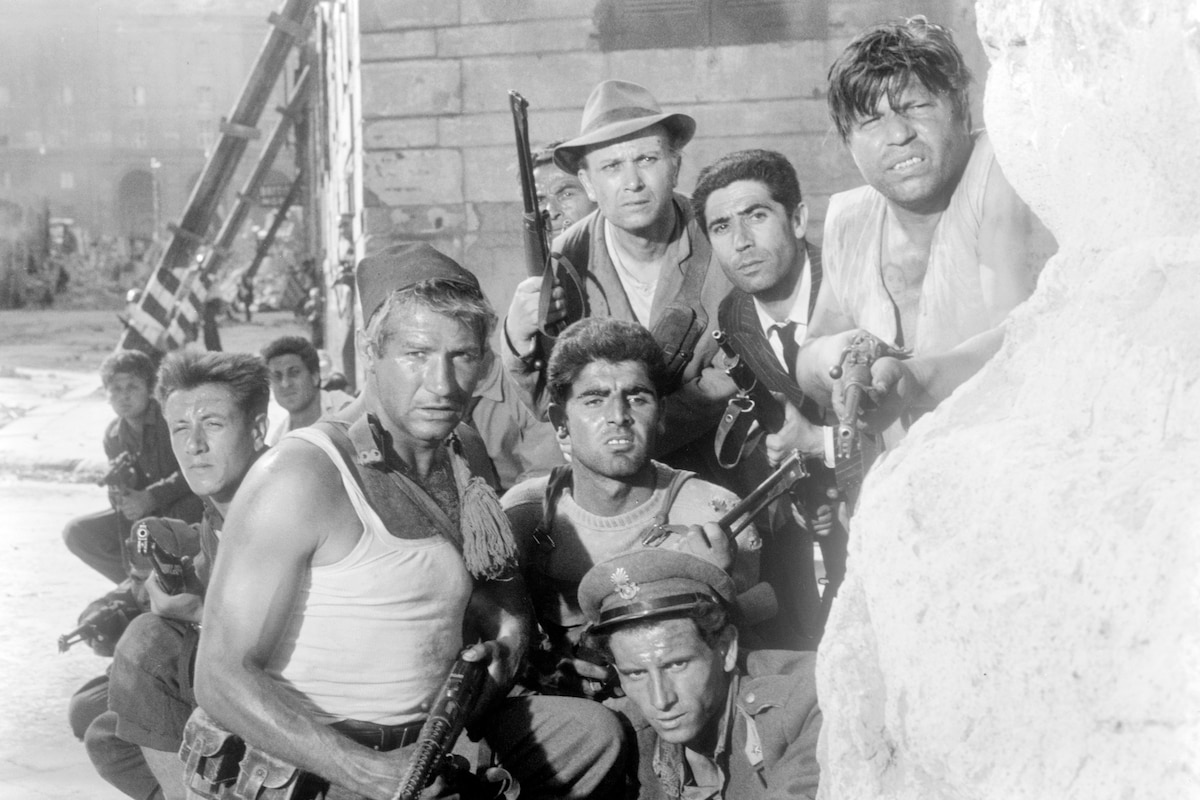
The Four Days of Naples (1962), based on historical events, is unusual as an example of a film in which the protagonist could be said to be the masses, not unlike Soviet films such as Sergei Eisenstein's The Battleship Potemkin (1925); the original Italian credits even omit the usual cast listing. While the film does follow the individual stories of several characters over the course of the film, we do not know in the beginning which of them will live or die, nor what their ultimate significance will be in the events to come. However, the film does in fact include quite a few notable Italian actors, including: Lea Massari, best known for L'Avventura (1960) and Murmur of the Heart (1971); Gian Maria Volonte, who later appeared in A Fistful of Dollars (1964) and Christ Stopped at Eboli (1979); Aldo Giuffre, best known stateside for The Good, the Bad and the Ugly (1966); and the American-born Frank Wolff, who appeared in Salvatore Giuliano (1962) and Once Upon a Time in the West (1968).
The real star of the film, however, is its direction and its striking black-and-white cinematography. While some sources describe the film as having a "newsreel" style, in fact the direction is very polished, with dynamic and carefully designed compositions and camera movements throughout. One particularly effective technique is its use of the telephoto lens to pick out the faces of nameless individuals in crowds. The expressive faces at times recall Eisenstein's use of non-professional actors in Potemkin, though of course it is also one of the defining features of Italian cinema as a whole. The director, Nanni (Giovanni) Loy (1925-1995), is probably best known for Where's Picone? (1984), a black comedy on organized crime in Naples starring Giancarlo Giannini. Born in Sardinia, he earned a law degree before studying film at the Centro Sperimantale di Cinematografia in Rome. After The Four Days of Naples Loy worked for a few years in television, directing a Candid Camera-type show. He later directed vehicles for the popular Italian actor Nino Manfredi, among them The Head of the Family (1969), Operation Snafu (1970) and Café Express (1980). He also taught directing at the Centro Sperimentale. The gifted cinematographer Marcello Gatti (b. 1924) has collaborated with Roman Polanski in What? (1972) and with Gillo Pontecorvo in Burn! (1969), Operation Ogre (1980) and above all, The Battle of Algiers (1965).
The Four Days of Naples was released in the U.S. in March 1963 and was well received on the whole. Bosley Crowther of The New York Times wrote: "Almost every shot in every sequence is packed with eloquence and meaning. Dozens of them lacerate in the senses and remain etched in memory [...]" Variety described it as "one of the major Italian achievements of the year. Pic is one of [the] most moving, rousing epics of resistance against Nazism seen in a long time." Time called it "the best battle movie made in Italy since Open City [1945] and Paisan [1946]." However, Stanley Kaufman of The New Republic was less convinced: "The film conforms so closely to Loy's idea of audience expectations that we sit back and watch it trying to tug heartstrings." The Four Days of Naples was nominated for Best Foreign Language Film (1962) and Best Original Screenplay (1963).
Producer: Goffredo Lombardo
Director: Nanni Loy
Screenplay: Carlo Bernari, Pasquale Festa Campanile, Massimo Franciosa and Nanni Loy
Photography: Marcello Gatti
Editor: Ruggero Mastroianni
Set Decorations: Gianni Polidori
Music: Carlo Rustichelli
Cast: Regina Bianchi (Concetta Capuozzo); Aldo Giuffre (Pitrella); Lea Massari (Maria); Jean Sorel (Livornese); Franco Sportelli (Professor Rosati); Charles Belmont (Sailor); Gian Maria Volonte (Stimolo); Frank Wolff (Salvatore); Luigi De Filippo (Cicillo); Pupella Maggio (Mother of Arturo); Georges Wilson (Reformatory director); Raffaele Barbato (Ajello); Dominico Formato (Gennaro Capuozzo); Curt Lowens (Sakau); Enzo Turco (Valente).
BW-121m. Letterboxed.
by James Steffen
The Four Days of Naples
by James Steffen | January 27, 2005
SIGN UP FOR OUR NEWSLETTERS

CONNECT WITH TCM