It's easy here in the relative comfort of the 21st century to read about a movie being shot on location without considering the manpower and logistics involved. You get a script, a crew, a couple of stars, then you grab some plane tickets and before you know it, your mug is on Entertainment Tonight talking about how making the picture was one big love-fest. But the reality is that big location shoots are a nightmare, even with a cell phone on your hip, and a martini in your hand. So imagine W. S. ("Woody") Van Dyke's incredibly daunting task of assembling and transporting a crew, equipment, and plenty of gin for his martinis all the way to Africa in 1929 in order to bring Trader Horn (1931) to the screen.
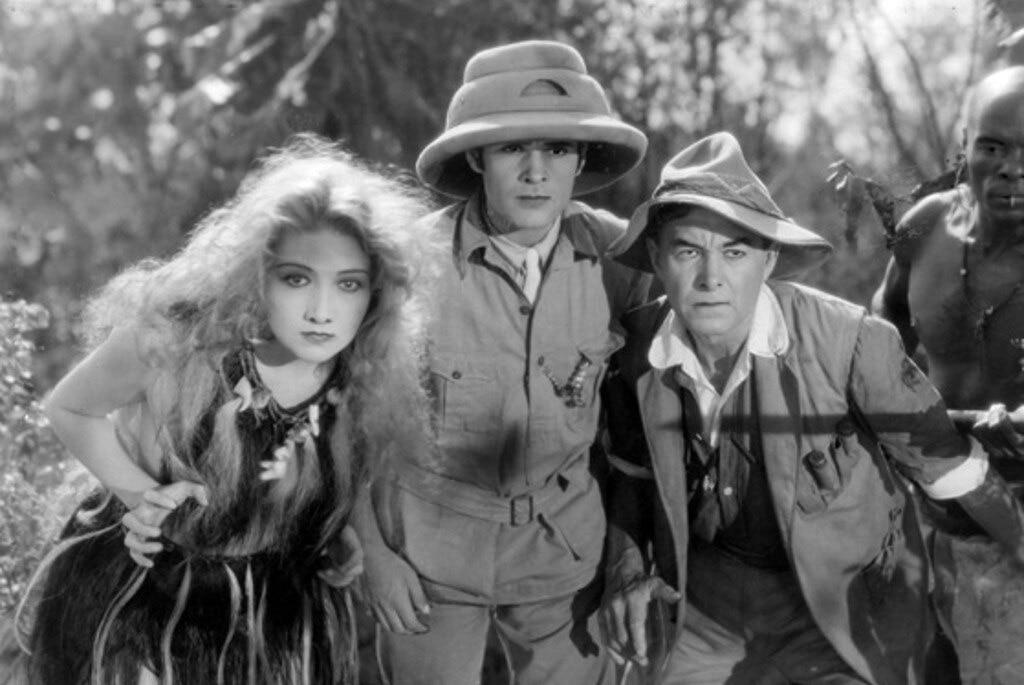
Trader Horn was Van Dyke's third exotic on-location adventure for MGM; the first two - filmed in the South Seas - were White Shadows in the South Seas (1928) and The Pagan, (1929). The narrative follows the title character, an African trader (Harry Carey), and his partner, Peru (Duncan Renaldo), as they travel deep into uncharted territory to swap wares with the local natives. On their trek upriver the traders meet Edith Trend, a missionary woman (Olive Fuller Golden) in search of a daughter who disappeared in the wilds some 20 years earlier. Though the two men warn Edith of the dangers involved, she takes off on her own, only to be found dead a few days later. Nevertheless, Trader Horn and Peru decide to continue the search for Edith's missing daughter, traveling deep into the jungle. Their journey soon puts them in harm's way; they are taken captive by a bloodthirsty tribe of natives ruled by a mysterious white woman (Edwina Booth). If you've ever seen any Tarzan films, you can probably guess the rest.
Trader Horn was the book sensation of its day, so it was inevitable that Louis B. Mayer and Irving Thalberg would snatch up the rights for MGM as a possible feature film. But the project was met with skepticism by some within the MGM production department who knew the difficulty of on-location shoots. When the project was pitched to Van Dyke, the director took a few days to read over the story proposal, decided to accept it, and returned the manuscript to Mayer with a note that said, "only a goof would try it."
But Van Dyke was no goof, and he approached what would be Hollywood's very first expedition to "The Dark Continent" in dead earnest. From the moment MGM announced the project, letters began pouring in from "authorities" on Africa pointing out what they should and should not do. However, before setting foot in Africa, Van Dyke first had to assemble a cast willing to suffer the rigors of the exhaustive shoot. Wallace Beery was first approached for the part of the Trader, but he had no interest in working in Africa, so Thalberg turned to Harry Carey who was having difficulty finding work. Carey was in desperate need of money after a burst dam practically destroyed his ranch. Carey gladly accepted the part for $600 a week. But the role of the missing daughter turned tribal leader required a more unorthodox method of casting. On the day of the screen tests, thousands of blondes lined up to vie for the part. Worried they didn't have enough negative to test them all, Van Dyke decided to drive by in a camera car pretending to shoot them all, only committing to a few he found promising. The young Miss Booth saw what was going on, assumed there was no film in the camera at all, and became enraged. She made a scene, protesting right to Van Dyke's face, and took off across the lot with the director in hot pursuit. Van Dyke knew he had found the right girl for the part!
At long last the crew arrived in Africa, but the production immediately took a down turn. The truck carrying the sound equipment fell into the river, cast and crew were plagued by insects and snakes, hostile natives threatened the entire company, and Carey nearly lost his leg (if not his life!) during one scene. As Carey flees cannibals in the film, he is forced to swing on a vine (think Tarzan) over a crocodile-infested river. When you watch this scene, keep your eyes on the crocodiles - they are no special effect. While shooting, Carey made a low pass over the snapping jaws, and nearly became lunch.
Escaping the rigors of the daily shoot, Van Dyke found solace in a gin bottle - lots of them! His liquid therapy began to take its toll on the film, and Mayer was appalled at the mixture of slapdash and often useless footage from Van Dyke's unit. When the beleaguered crew returned from Africa, Mayer fired everyone and scrapped the project. But in the interest of recouping some of their investment, executives at MGM convinced Mayer and Thalberg that the project could be salvaged. So they hired a crew to build sets and secretly shoot additional footage in Mexico without the public finding out that the film was not entirely shot in Africa.
When Trader Horn was finally released, it was met with widespread enthusiasm. "Animal" pictures had long been popular fare, and this one made a huge impression with its startling sights and sounds of the jungle. One breathless woman remarked after seeing the film "I don't mind animal pictures when they're silent. But when you hear them, it's terribly realistic!" Meanwhile, MGM executives were hearing realistic sounds of their own, a distinct "cha-ching" as the film grossed nearly a million dollars at the box office; and applause when Trader Horn earned an Oscar® nomination for Best Picture.
But the difficult production aspects of Trader Horn continued to haunt some cast and crewmembers for several years, particularly Edwina Booth. She was plagued for years by rumors that she had contracted a fatal disease on location as a result of either the "malarial environment" or witchcraft. In reality, Miss Booth did sue MGM after she came down with an illness, which she blamed on the fact that the studio insisted she sunbathe in the nude, and failed to provide her with adequate protection from the environment. The suit was settled out of court, and Miss Booth retired from the motion picture business after teaming up with Harry Carey in two subsequent films.
Producer: Irving Thalberg
Director: W. S. Van Dyke
Screenplay by Richard Schayer, Cyril Hume, Dale Van Every, John Thomas Neville, based on the book by Alfred Aloysius Horn.
Cinematography: Clyde De Vinna
Film Editing: Ben Lewis
Music: William Axt, Sol Levy
Cast: Harry Carey (Trader Horn), Edwina Booth (Nina Trend), Duncan Renaldo (Peru), Olive Carey (Edith Trend), Mutia Omoolu (Rencharo).
BW-123m. Closed captioning.
by Bill Goodman
Trader Horn
by Bill Goodman | January 27, 2005
SIGN UP FOR OUR NEWSLETTERS

CONNECT WITH TCM