Arguably the only good movie to ever contain an
exclamation point in its
title, director Jack Conway's Viva Villa! is
an exciting MGM biopic based on
the life of Mexican revolutionary Pancho
Villa. The film was nominated for
three Academy Awards, and was one of the
major box-office successes of
1934, but, truth be told, Conway didn't really
direct all of it.
Historical accuracy was seldom a priority with
this type of film, but
producer David O. Selznick (who called Viva
Villa! one of his
favorite pictures) tried to balance out the theatrics
with at least partial
authenticity. The movie was shot mostly in Mexico,
adding thousands of
dollars to its budget. Some alterations to the original
screenplay were also made
after it was negatively assessed by both the
Mexican government and Villa's
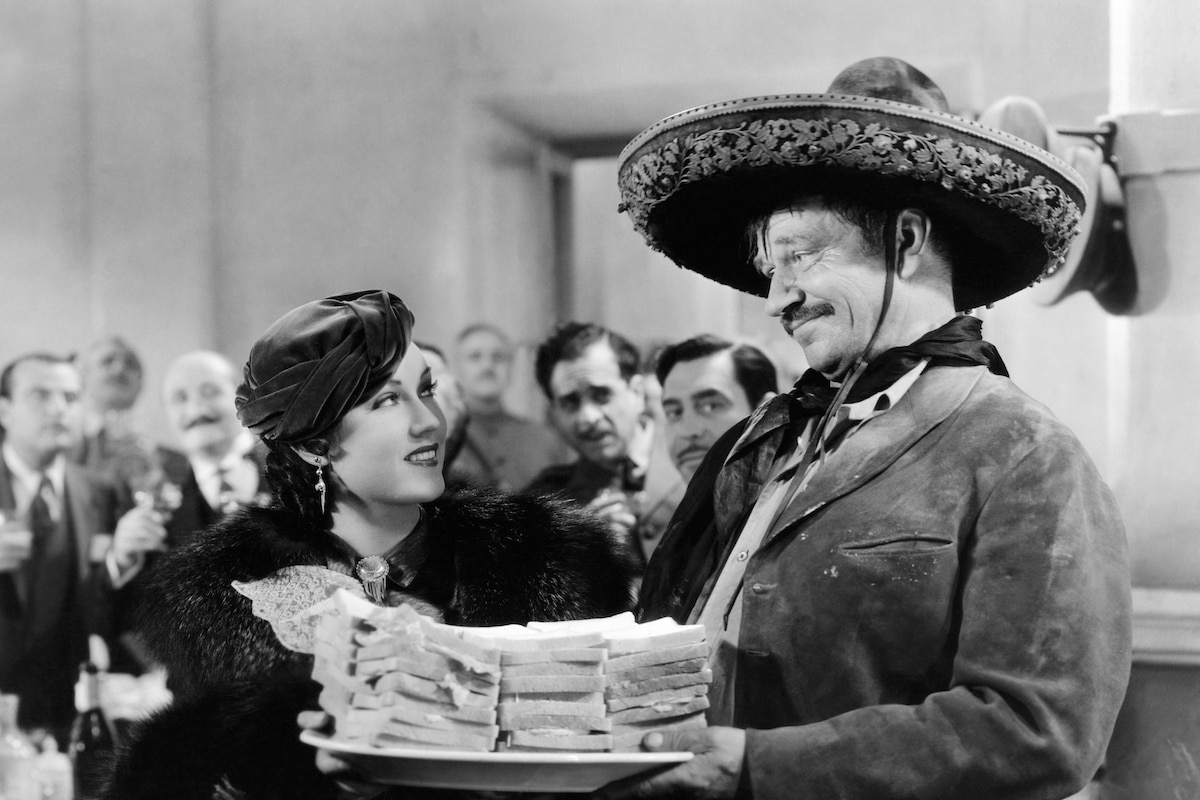
widow. Still, Wallace Beery's performance as
Villa is so extravagant, it
nearly overwhelms any sense of
reality.
Screenwriter Ben Hecht attempts to lay some emotional
groundwork for Villa's
future rampaging: when young Pancho (Phillip Cooper)
sees his father whipped
to death by a soldier, the boy kills the officer,
grows up to become Wallace
Beery, and rounds up a group of bandits who
pillage the Mexican countryside,
robbing from the rich and giving to the
poor. Along the way, Pancho
encounters Johnny Sykes (Stuart Erwin), an
American newspaper reporter who helps spread the bandit's legend in
print.
On his crime spree, Villa meets a wealthy landowner (Donald
Cook) and his
beautiful sister (Fay Wray), who approve of their charismatic
friend's Robin
Hood philosophy. Through them, Villa joins forces with
Madero (Henry B.
Walthall), the scholarly leader of the quickly escalating
peasant revolt.
Pancho's unbridled enthusiasm gets the best of him, however,
when he starts
robbing banks and shooting innocent people. Soon, he's out
of control,
making enemies and then corpses of the very folks who originally
supported him.
Sykes, of course, prints the Villa myth, rather than the
reality, every step
of the way.
Major hit or not, Viva
Villa!'s troubled production was a studio-era
predecessor to what
Francis Ford Coppola and his crew endured while filming
Apocalypse
Now (1979). If anything could go wrong, it did, up to and
including the
loss of both the original director and one of the lead actors.
Louis B.
Mayer even got punched in the mouth at one point.
Howard Hawks
was Viva Villa!'s first director, and he did a lot more
than make a
few casting decisions. To this day, it's unclear how much of
the finished
picture is his, but Hawks understood the theoretical prestige of
working for
MGM, not that it suited his personality. In later years he
wrote, "Metro
was the best place in the world for getting a script and
handing it to a
director with it all cast and the sets all built - they had
the best set
designers, and they had good writers - but I don't think an
independent
worked well over there."
During the location shoot, real soldiers
and peasants were used as extras,
and some of them were quite a bit wilder
than MGM expected. Hawks claimed
that he was once interrupted by a man who
poked a rifle in his ribs and, in
Spanish, shouted "this is for the
revolution." The director decked him
without shouting anything at
all.
Shootings often took place near the set, and one man
inexplicably turned a
pistol on himself after speeding by and crashing his
car through a fence.
MGM's crew was housed in old railroad cars, and they
were regularly served
nearly inedible food (Hawks said he survived mostly on
brandy and oranges).
As a special bonus, the film became the subject of
angry debate among
Mexican citizens and government leaders who were leery of
romanticizing
Villa. Several reels of footage were also destroyed when a
plane that was
carrying them crashed on the way to California.
But
that, believe it or not, isn't the worst of it. Lee Tracy was known as
one
of the more enthusiastic drinkers in the film industry; his name was
often
mentioned in the same breath as such famous imbibers as John Barrymore
and
W.C. Fields. Tracy's fast-talking persona was perfect for the
character
Johnny Sykes, and he filmed several key scenes with Hawks behind
the camera.
One Sunday, during a national holiday, the cast and crew were
celebrating in
the streets with the locals...except for Tracy, who was
standing buck-naked
on a balcony, shouting obscenities at the crowd.
Eventually, he urinated on
a group of Mexican military cadets and had to be
rushed out of the country
lest he be strung up for his anti-social
behavior.
This all led to the firing of Tracy, as well as Selznick
having to send a
letter of apology to the Mexican government. The firing,
in turn, led to an
argument between Mayer and Hawks, who wanted Tracy to
stay on the picture
regardless of the actor's bad reputation. Hawks belted
Mayer, another
pink slip was written up, and much of the picture had to be
re-shot with
Conway directing. Ah, the glamour of
Hollywood!
Producer: David O. Selznick
Director: Jack Conway,
Howard Hawks (uncredited)
Screenplay: Ben Hecht
Cinematography:
James Wong Howe
Editing: Robert J. Kern
Music: Herbert Stothart
Art
Design: Harry Oliver
Set Design: Edwin B. Willis
Costumes: Dolly
Tree
Principal Cast: Wallace Beery (Pancho Villa), Fay Wray (Teresa),
Stuart
Irwin (Johnny Sykes), Donald Cook (Don Felipe), George E. Stone
(Chavito),
Leo Carrillo (Sierra), Henry B. Walthall
(Madero).
BW-111m.
by Paul Tatara
Viva Villa!
by Paul Tatara | August 30, 2010
SIGN UP FOR OUR NEWSLETTERS

CONNECT WITH TCM