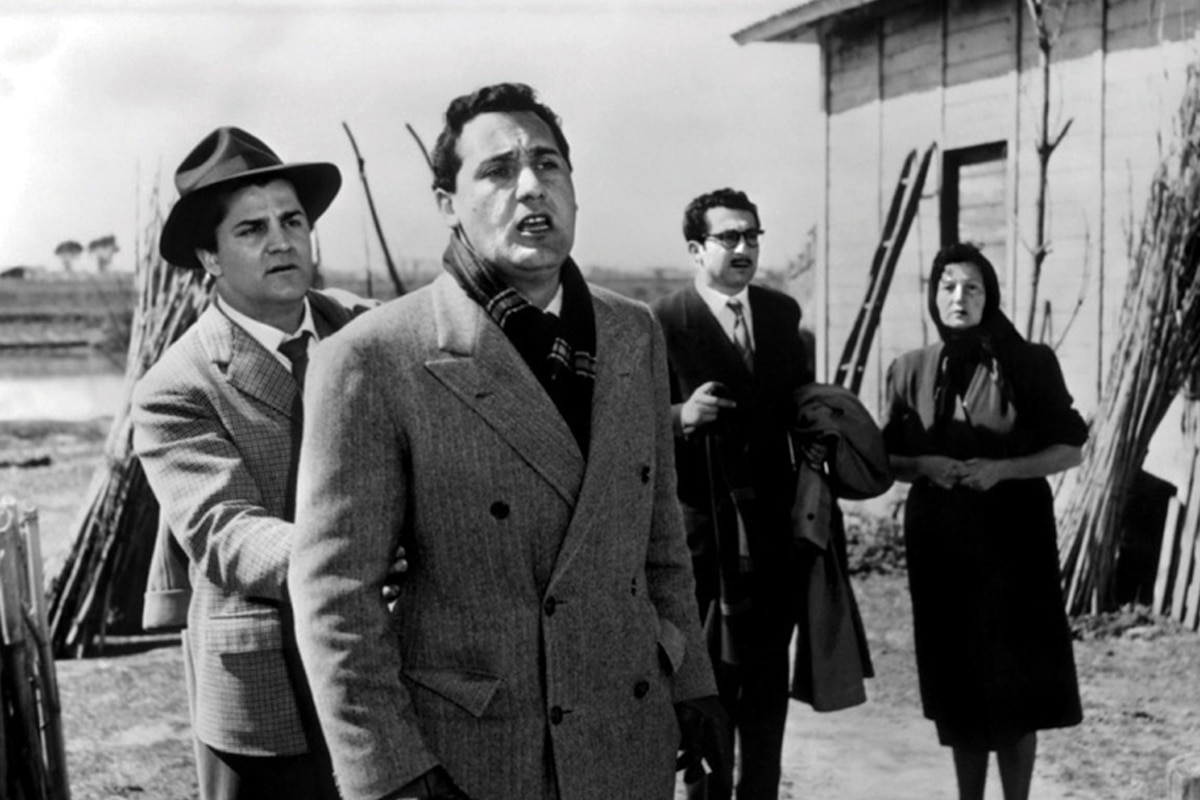
Federico Fellini's 1953 masterpiece I Vitelloni illustrates the director's typical command of human frailty in this portrait of the idle 20-something offspring of the Italian middle class. The title translates as "big slabs of veal," an apt analogy for the five immature, spoiled men frittering away their lives in the Adriatic seaside town of Rimini, where Fellini also grew up.
The film opens as the buzz and excitement of summer changes, in an instant, to the bitter reality of tourist season's end. The five friends -- Fausto, Leopoldo, Riccardo, Alberto and Moraldo -- roam Rimini's streets in idle recreation, play pool and wait for Carnival, which becomes a stand-in for an unlived fantasy life.
The lothario of the group Fausto (Franco Fabrizi) is eventually forced, against his will, to settle down when he impregnates local beauty queen Sandra (Eleonora Ruffo) though his roving eye and tomcatting ways continue.
His friends have their dreams too. Leopoldo (Leopoldo Trieste) is the most ambitious among them, an amateur playwright, dreaming of escape. And the taciturn Moraldo (Franco Interlenghi) becomes a stand-in for Fellini himself, observing all of the changes in his friends' lives.
I Vitelloni was Fellini's first international success and his third film made a year before his career-defining La Strada (1954). Though La Strada was written before I Vitelloni, when Fellini showed the former script to his producer he was told it wouldn't make a lira. So he went back to the drawing board with Ennio Flaiano and Tullio Pinelli, his co-screenwriters on The White Sheik (1952). "In spite of our different backgrounds, the spirit of the script we wrote was Fellini's," claimed Pinelli.
I Vitelloni won a Silver Lion at the Venice Film Festival. Because it takes place in the director's hometown of Rimini (which would also later provide the setting for Amarcord, 1973), many consider the film to be autobiographical. In I, Fellini (by Charlotte Chandler), the director stated "For a young man in Rimini, the life was inert, provincial, opaque, dull, without cultural stimulation of any kind. Every night was the same...When I left Rimini, I thought my friends would be envious because I was leaving, but far from it. They were perplexed. They didn't feel the drive to leave that I did." Fellini never considered actually shooting the film in Rimini, fearing that as a returning film director, he would appear patronizing to his townsfolk, and the young men he grew up with who now worked in undistinguished jobs in the small town.
The film also starred Fellini's brother Riccardo, who plays an amateur singer, and who Fellini felt would best of all understand the vitelloni sensibility, since he had once been one himself. Since the film's release in 1953 it has gone on to influence a host of films about small town boys with big time dreams like Martin Scorsese's Mean Streets (1973) and Barry Levinson's Diner (1982).
I Vitelloni's producer Lorenzo Pegoraro was initially distressed at the lack of big names in the production and the casting of Alberto Sordi. "Sordi makes people run away," he complained. But Sordi would go on to become one of Italy's biggest screen comics and years later, when I Vitelloni was revived, the poster was altered to put Sordi's name above the title. On the first day of shooting Pegoraro was still so angry over the casting of the film with unknowns that he reportedly locked himself in the bathroom and refused to come out to sign checks.
The Italian neorealist director Vittorio De Sica was initially considered as a possible marquee "name" in the role of Natali, an aging actor who visits the town and tries to seduce Leopoldo. But De Sica wanted to alter the character to suit his needs and Fellini was reluctant to do so, so the role eventually went to Achille Majeroni. Ironically enough, Franco Interlenghi, who plays Fellini's stand-in Moraldo, was the small boy in De Sica's Shoeshine (1946).
Director: Federico Fellini
Producer: Jacques Bar, Mario De Vecchi, Lorenzo Pegoraro
Screenplay: Ennio Flaiano from a story by Federico Fellini, Ennio Flaiano and Tullio Pinelli
Cinematography: Carlo Carlini, Otello Martelli, Luciano Trasatti
Production Design: Mario Chiari
Music: Nino Rota
Cast: Franco Interlenghi (Moraldo), Alberto Sordi (Alberto), Franco Fabrizi (Fausto), Leopoldo Trieste (Leopoldo), Riccardo Fellini (Riccardo).
BW-104m.
by Felicia Feaster
I Vitelloni
by Felicia Feaster | January 26, 2005
SIGN UP FOR OUR NEWSLETTERS

CONNECT WITH TCM