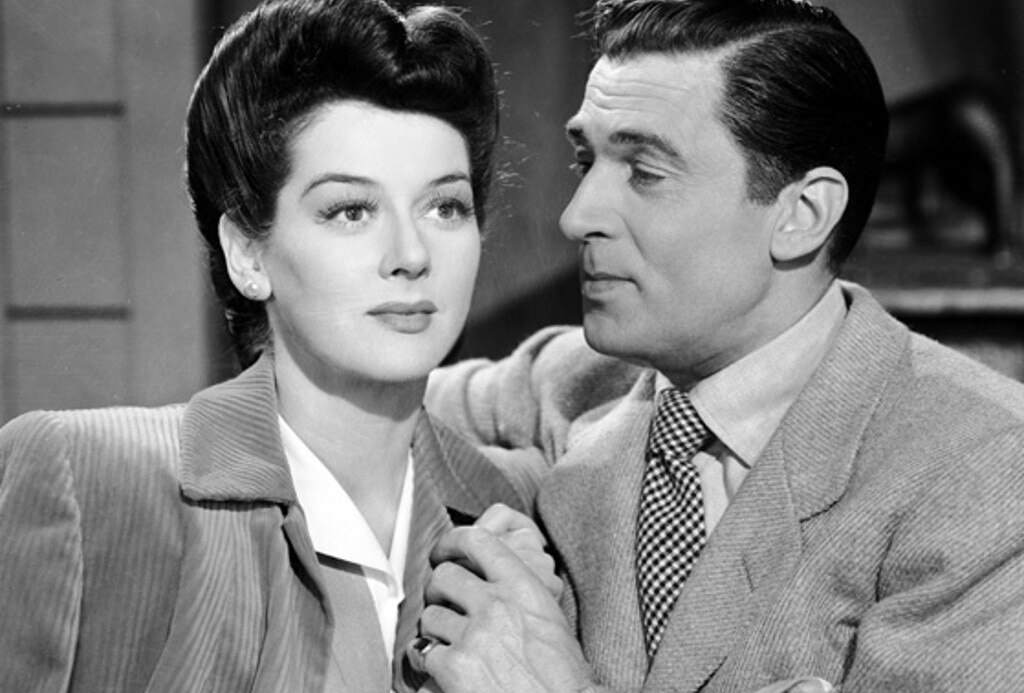
Rosalind Russell found her place in Hollywood as the screen's funniest and most capable career woman, and it was films like this 1941 comedy that helped build that image. Her role as a lady judge was tailor-made for
her-few other Hollywood leading ladies could have convincingly played a woman who had risen so far while still so young. And the romantic tale-she's pursued by a reporter (Walter Pidgeon) out to find if she has any dirty secrets that could sell papers-was the kind of stuff that kept audiences coming back to movie theatres several times a week. But even
though it helped make her a major star, Design for Scandal would mark the end of her MGM contract as she set out to pursue a very successful free-lance career.
Russell had been one of the last MGM stars signed and groomed by Irving Thalberg, but initially she was treated as a second-lead version of Myrna Loy. She made it into major roles in drama at first, with hits in 1937's
Night Must Fall, with Robert Montgomery, and 1938's The Citadel, with Robert Donat. Then in 1939 she fought for the role of an acid-tongued society gossip in The Women and pretty much stole the
picture from an all-star cast that included Norma Shearer, Joan Crawford, Paulette Goddard and Joan Fontaine. The film established her as one of Hollywood's top comediennes and fastest-talking actresses. The following year, Columbia borrowed her to play the tough news hen working for unscrupulous editor Cary Grant in the screen's greatest newspaper comedy, His Girl Friday, and Russell's future as a career woman was set. Design for Scandal continued that typing, followed by such comic hits as My Sister Eileen, which brought Russell her first Oscar nomination, and Take a Letter, Darling, both in 1942.
His Girl Friday played another important role in Russell's life when co-star Grant introduced her to producer Carl Brisson. They married in 1941, shortly after she had finished work on Design for Scandal,
and he would play a major role in shaping her career. Just for starters, he convinced her not to re-sign with MGM when her initial seven-year contract expired.
Russell was always lucky in her leading men. Grant had helped re-shape her career, and she had scored comic triumphs opposite James Stewart (No Time for Comedy, 1940) and Melvyn Douglas (This Thing Called Love, 1941). She was just as lucky in Design for Scandal, in which she co-starred with the often under-rated Walter Pidgeon. Pidgeon was MGM's all-purpose leading man of the forties, particularly as Greer Garson's teammate in eight films, including the Oscar-winning Mrs. Miniver. But though he rarely got a chance to shine on his own (as he
did on loan to 20th Century-Fox for Fritz Lang's 1942 Man Hunt), he had a unique talent for making the studio's female stars look smart and sexy, which is just what happened in Design for Scandal. With Pidgeon as her co-star, Russell looked like an asset the studio could ill afford to lose.
Producer: John W. Considine, Jr.
Director: Norman Taurog
Screenplay: Lionel Houser
Cinematography: Leonard Smith, William Daniels
Art Direction: Cedric Gibbons
Music: Franz Waxman
Cast: Rosalind Russell (Cornelia Porter), Walter Pidgeon (Jeff
Sherman), Edward Arnold (Judson M. Blair), Vera Vague (Jane Porter), Lee
Bowman (Walter Caldwell), Jean Rogers (Dotty), Donald Meek (Mr. Wade), Guy
Kibbee (Judge Graham), Anne Revere (Nettie, the Maid).
by Frank Miller
Design for Scandal
by Frank Miller | March 15, 2007
SIGN UP FOR OUR NEWSLETTERS

CONNECT WITH TCM