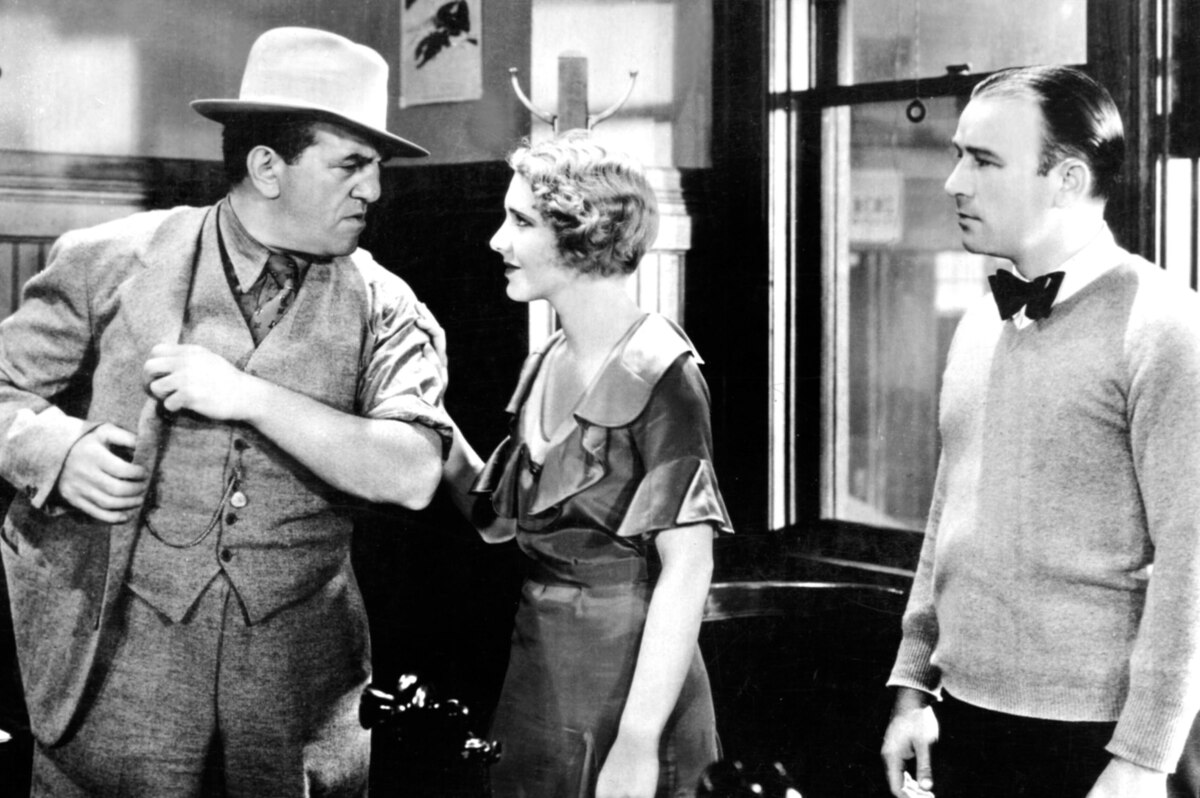
A vagrant named Larry Doyle (Robert Armstrong) is given a chance to make something of himself by Dan Thorn (Louis Wolheim), the owner of a railroad yard. It soon becomes apparent that Doyle is a man of many talents whose once promising future was derailed by a tragedy in his life. Finding acceptance in his new job, Doyle advances himself quickly in Thorn's family business but finds himself falling in love with his boss's fiancée, Mary Ryan (Jean Arthur). She also feels an irresistible attraction to Larry, a situation that leads to a near-tragic incident on the tracks.
An early sound era feature, Danger Lights (1930) is in the grand tradition of silent era melodrama, complete with a heroine forced to choose between two men who love her and a race against time to save a life in the final reel. Though predictable and corny in many respects, the real reason to see Danger Lights is for the evocative cinematography of Karl Struss which captures the smoky, industrial environment of railroad yards with locomotives hissing stream, engine brakes squeeching, and the clanging of warning bells. There are some truly spectacular visual sequences here; one, where Larry and Mary first reveal their passion for each other on a lonely stretch of bridge as a train rushes past, only inches away; another when Larry commandeers the train for a high speed race to Chicago for a medical emergency. You can catch glimpses of a now by-gone America along the tracks, the way the countryside and the small towns looked in 1930.
For Danger Lights, Struss was working with a new 'wide stereoscopic' film process that was invented by George K. Spoor and P. J. Berggren. It employed the use of 63.5mm film as opposed to the standard 35mm format and allowed for greater depth and detail in screen composition. Unfortunately, Danger Lights was the only film to use this new process due to financial drawbacks. Theatre owners would have to purchase special equipment to show films in the 63.5mm process and with the Depression at its height few exhibitors could afford to shoulder this extra financial burden. It wasn't until the fifties that wide screen movies like The Robe (1953) or Around the World in 80 Days (1956) became popular but at the time of its release Danger Lights was perceived as only an interesting novelty.
In addition to Struss's cinematography, movie buffs will also enjoy seeing Jean Arthur during her Paramount contract days. For Danger Lights she was loaned out to RKO but typical of her other roles at this time, Arthur was typecast as the innocent ingénue. All this would change in 1935 when she got an opportunity to demonstrate a much wider range in her breakthrough film, The Whole Town's Talking.
Producer: William LeBaron
Director: George B. Seitz
Screenplay: Frederick Hugh Herbert, James Ashmore Creelman
Cinematography: John W. Boyle, Karl Struss
Costume Design: Max Ree
Film Editing: Archie Marshek
Special Effects: Don Jahraus
Cast: Louis Wolheim (Dan Thorn), Robert Armstrong (Larry Doyle), Jean Arthur (Mary Ryan), Frank Sheridan (Ed Ryan), Hugh Herbert (Engineer).
BW-87m.
by Jeff Stafford
Danger Lights
by Jeff Stafford | October 17, 2006
SIGN UP FOR OUR NEWSLETTERS

CONNECT WITH TCM