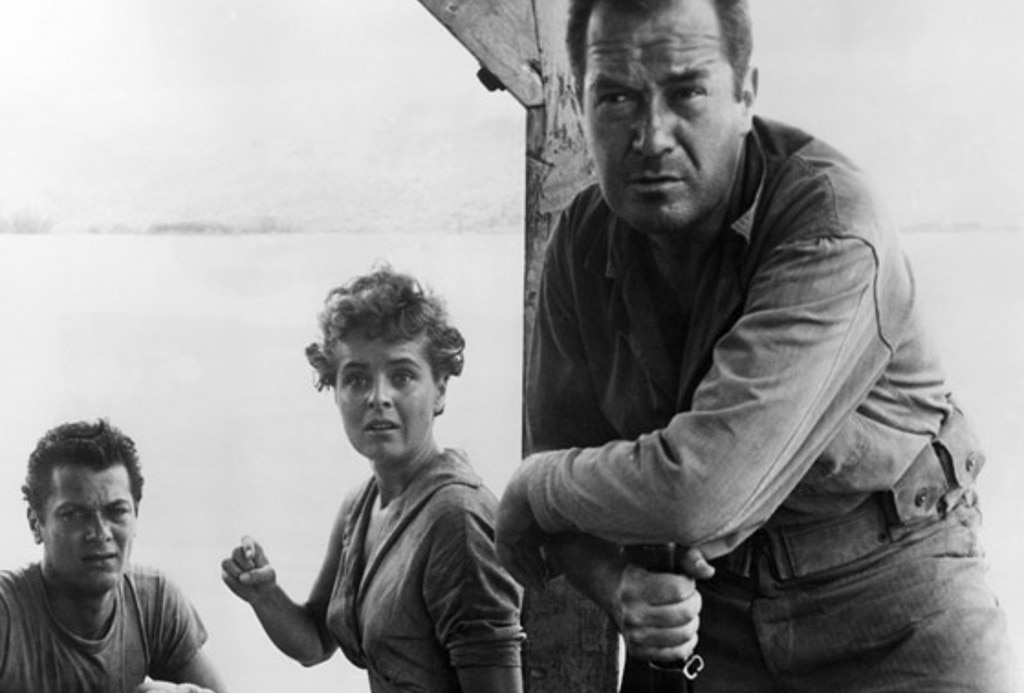
A taut World War II action thriller filmed in Hawaii, Beachhead (1954) was an important stepping-stone in the film career of rising star Tony Curtis. Having successfully impersonated the legendary magician Houdini (1953) the previous year, Curtis was given the opportunity to explore darker, more troubling aspects of his on-screen persona in Beachhead, traits that might arise only out of the most dire situations.
Curtis plays a marine named Burke who's trapped with his platoon in a dense tropical jungle, thick with rotting foliage and poisonous creatures. Their mission is to rescue an enemy informant (Eduard Franz) and his daughter (Mary Murphy) on the island while avoiding the encroaching Japanese soldiers. Curtis conveys a palpable sense of claustrophobia and imminent doom in this minimalist yet grimly realistic drama. At one point, he snaps at an injured Mary Murphy, who has been urging Curtis to leave her behind to the enemy soldiers. Curtis gives just the right mixture of fear, hatred and determination as he hisses, "The Japs. Do you think I can leave you to them?" In another exchange, Murphy bravely says, "I'm not afraid" to which Curtis sarcastically responds, "That solves everything." In real life, Curtis was a World War II veteran who saw action in the Pacific. In his autobiography, he wrote that "making Beachhead was a very intense experience for me because it hit close to home and my own reality. It gave me my first long exposure to Hawaii, which I fell in love with and where I bought some real estate, but I was relieved when the film was over."
Beachhead's sense of urgency is largely due to director Stuart Heisler and cinematographer Gordon Avil who chose to shoot the film in a cinema verit¿ style. This realistic method of filming throws you into the middle of the action, giving moviegoers a "you are there" viewpoint. Cinema verit¿, which is distinguished by its hand-held camera shots, abrupt jump cuts and rough, home movie-like qualities, would become more commonplace in the sixties with the television news coverage of the Viet Nam War and documentaries like Showman (1963), by the Maysles Brothers, and Titicut Follies (1967), by Frederick Wiseman. But Beachhead was not a documentary; it was a fictional film that was shot on location in Kauai, Hawaii and filmed in Technicolor, a rare choice for early cinema verit¿ filmmaking. It was also one of the first genre pictures outside of film noir to incorporate a decidedly "un-Hollywood" filmmaking style into a standard Hollywood narrative.
Producer: Howard W. Koch
Director: Stuart Heisler
Screenplay: Richard Alan Simmons, based on the novel I've Got Mine by Richard G. Hubler
Special Effects: Russell Shearman
Cinematography: Gordon Avil
Film Editing: John F. Schreyer
Original Music: Art Lange, Emil Newman
Cast: Tony Curtis (Burke), Frank Lovejoy (Sgt. Fletcher), Mary Murphy (Nina), Eduard Franz (Bouchard), Skip Homeier (Reynolds), John Doucette (Major Scott), Alan Wells (Biggerman), Akira Fukunaga (Japanese sailor).
C-90m.
By Scott McGee
Beachhead
by Scott McGee | April 08, 2008
SIGN UP FOR OUR NEWSLETTERS

CONNECT WITH TCM