Michelangelo was, first and foremost, a sculptor, according to novelist Irving Stone, who wrote a best-selling novel about the artist entitled The Agony and the Ecstasy. But that important observation was lost when it came time to condense the lengthy biography for a screen adaptation. Twentieth Century Fox decided to restrict their take on the original Renaissance man to one of two paintings completed by Michelangelo: the Sistine Chapel ceiling. Stone sent a proposed treatment to the studio that would open the film with the events surrounding the creation and reception of Michelangelo's David. Director Carol Reed and star Charlton Heston both agreed that the inclusion of these scenes would lead to a more rounded portrayal of the angst-ridden artist. Studio mogul Darryl Zanuck, however, feared that the allotted budget could not accommodate the scheduling and shooting of new scenes and nixed the idea.
Carol Reed's stature had fallen some since the days of The Third Man (1949); most recently, he had had a disastrous experience shooting Mutiny on the Bounty (1962) with the unpredictable Marlon Brando. Heston recalled that the enthusiasm he felt for Reed was not immediately shared with others, but wrote in his diary, "We have a chance for a superior film with (Reed); he confers class on the whole project." Reed viewed the film as "a study of a genius, not a hero in the conventional sense," and added, "What interests me most is that Michelangelo was a man tormented by self-criticism, anxious about the work still left to do, who thought of his art as an act of self-confession." Charlton Heston, who had been intrigued by Philip Dunne's script even before any studio had signed on to produce it, found Michelangelo an elusive character. The actor not only spent time at the quarries where he had worked, but also climbed a scaffold to view the famous ceiling close up to ruminate on what had driven the artist's perfectionism.
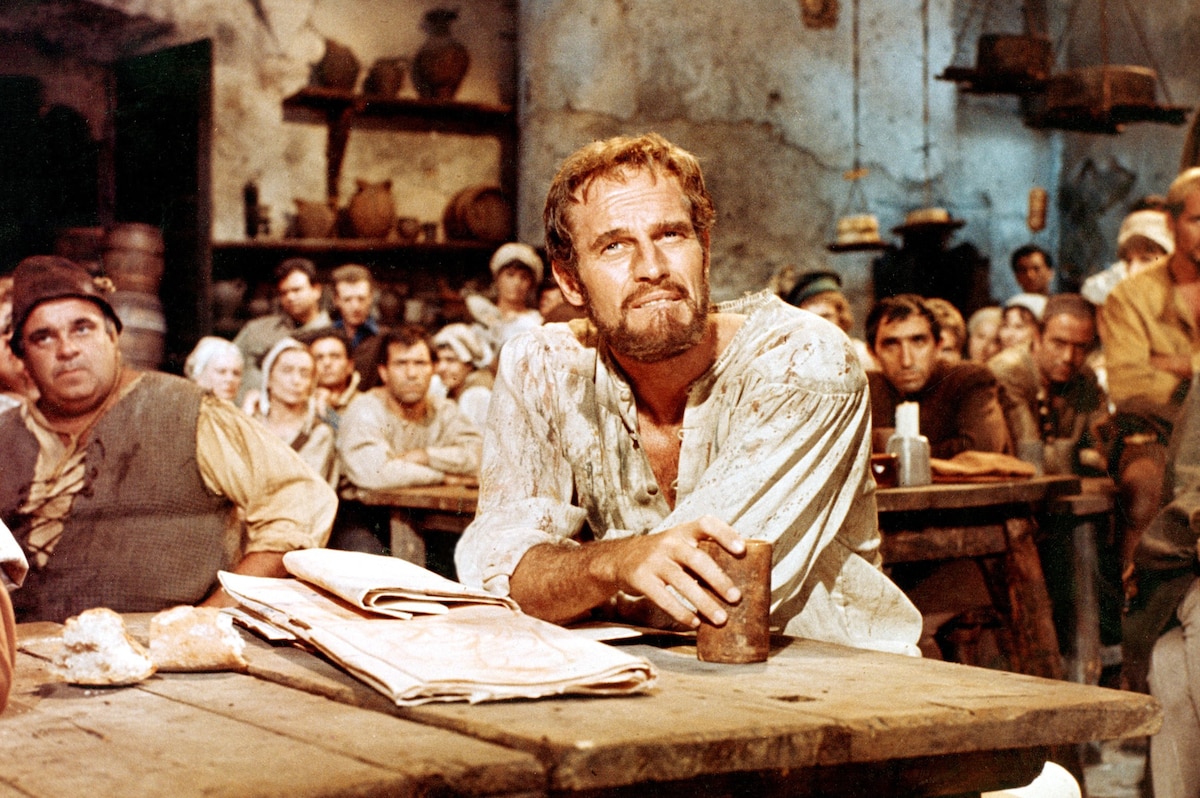
Heston was also particularly sensitive about his physical portrayal of the artist. He felt that he had been taken to task by some critics of his previous work for looking the same in all of his previous films. In his biography In the Arena, he recalled that although he had based his makeup on portraits of the artist, "[Zanuck] didn't like my beard, or the way I'd twisted my nose... (and) he was especially distressed with the headcloth I wore." Exclaimed a frustrated Zanuck, "... You look like Othello, or some damn thing, for God's sake!" Heston and the director ignored these concerns and the makeup job remained. At least one critic, in Variety, later noted that Heston had "effectively submerged" his recognizable face with a beard and the "austere garb."
If Heston was obsessed with finding the man behind the story, Rex Harrison, who played Pope Julius II, was a little less concerned with historical accuracy. Harrison refused to wear the papal crown or don facial hair - an odd demand given that this particular Pope was well known as the first in centuries to have a beard and mustache. Harrison even admitted in his autobiography Rex that he had lifts placed in his shoes to bring him up to Heston's 6-foot-3 height. "I eyed Heston and congratulated myself that at least he no longer towered above me. As the film went on, however, it seemed to me that he was growing. Eyeball to eyeball he was once more a couple of inches taller than I. I looked down at his feet - not a sign of lifts! He must have grown through sheer tenacity. Neither of us made any comment, nor did our wardrobe men - it was a very funny, silent contest." A cordial but slightly strained relationship continued between the two actors and Harrison even admitted to making himself believe that "the picture was about Pope Julius rather than about Michelangelo." As for Heston, he compared his co-star to a racehorse that would appear "snorting, rearing, kicking at the starting gate" and who "picked petulantly at small points, for indiscernible reasons" like the ivory pointer that Julius had in his study. "What am I to do with this silly stick, for God's sake?" Harrison would ask. "In the end, of course, he broke it across my back," Heston said, "as the script indicated, as the real Julius had done to the real Michelangelo, and indeed as Rex knew perfectly well all along."
The tug of war between Michelangelo and the Pope over the completion the Sistine Chapel, a job that took four years and endless revisions, seemed to be replicated on the set between the lighting cameraman, Leon Shamroy and the rest of the production crew. Heston recorded in his journal that Shamroy was spending two thirds of each day lighting the set. Technical superiority certainly was evident in the finished product - reflected not only in the Academy Award nomination for cinematography, art direction and sound, but also by the astonishing replica of the Sistine Chapel built at Cinecitta, Dino De Laurentiis' Roman studios.
This proved to be an attraction unto itself. Although the Vatican was unusually generous in offering the actual site for shooting, technical requirements and the difficulty of ensuring that nothing would be damaged, made use of the actual chapel an impossibility. The decision was made to build a replica to scale. Studio technicians fussed over methods to reproduce the famous fresco, finally settling on photographing the original work and blowing up the photos to cover the ceiling in the "new" chapel. Interestingly, after the colors were brightened and cracks "filled in" by the set decorators, the facsimile ceiling presaged the results of the actual restoration of the chapel in the mid 1980's. Other locations for The Agony and the Ecstasy included the stone quarry in the village of Carrara where Michelangelo found the marble for his sculpture of Moses for the tomb of Pope Julius.
Heston later fondly recalled the reception the film received at a sneak preview in Minneapolis, writing, "I've been involved in some enormously successful films, but The Agony and the Ecstasy had far and away the best sneak preview response of any film I've ever been in...." Describing the standing ovation and loud shouts of applause, he was baffled by the modest box office that followed. As for Irving Stone's lament that Michelangelo's true artistic obsession had been overlooked, he was pleased to find that the feature film inspired the film's art director to produce a short documentary entitled, The Artist Who Did Not Want to Paint (1965).
Producer/Director: Carol Reed
Screenplay: Philip Dunne, based on the novel by Irving Stone
Art Designer: Jack Martin Smith
Costume Designer: Vittorio Nino Novarese
Cinematography: Leon Shamroy
Editing: Samuel E. Beetley
Music: Alex North
Cast: Charlton Heston (Michelangelo), Rex Harrison (Pope Julius II), Diane Cilento (Contessina de Medici), Harry Andrews (Bramante), Alberto Lupo (Duke of Urbino), Adolfo Celi (Giovanni de Medici), Venantino Venantini (Paris de Grassis), Tomas Milian (Raphael).
C-124m. Letterboxed.
by Genevieve McGillicuddy
The Agony and the Ecstasy
by Genevieve McGillicuddy | December 14, 2004
SIGN UP FOR OUR NEWSLETTERS

CONNECT WITH TCM