It's somewhat ironic that one of the best war-inspired films of the 1940s
hit movie screens the same week that the war ended. Delmer Daves' Pride
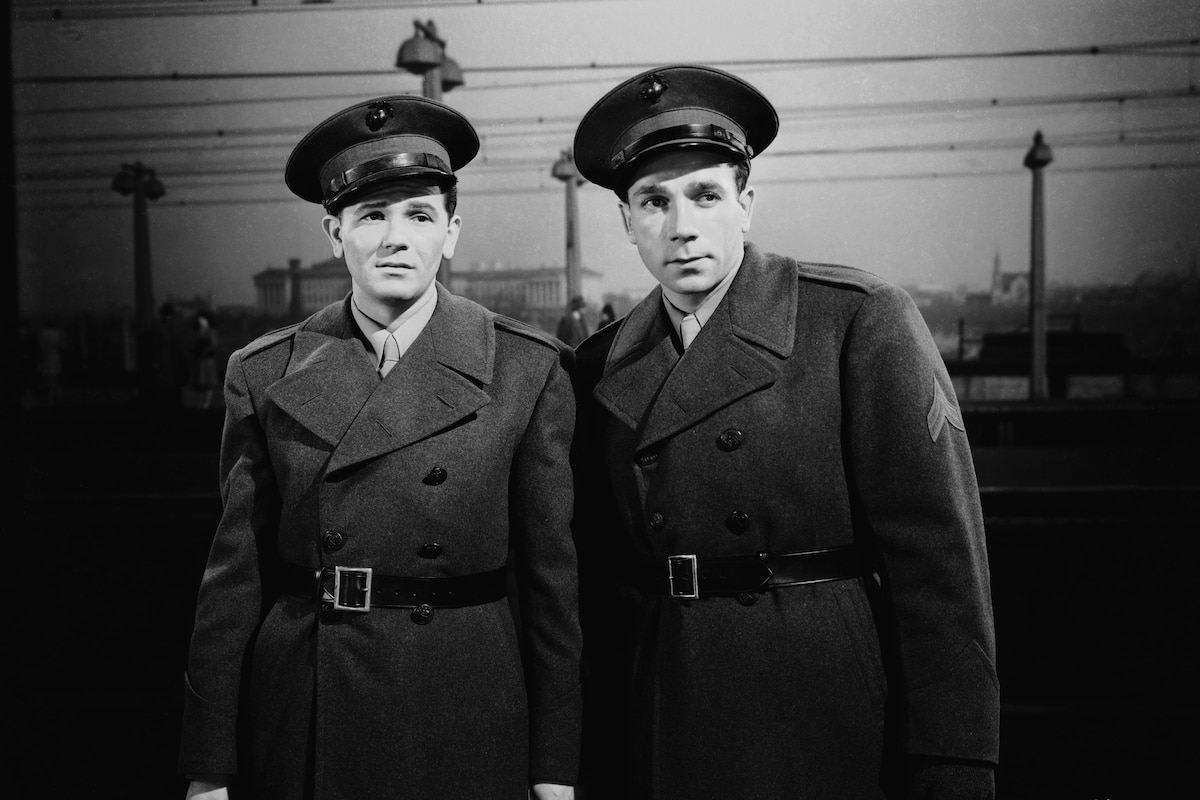
of the Marines (1945) is an uncompromising portrait of Al Schmid, a real-life
soldier who was blinded in combat, then had to come to grips with his
condition upon returning home. Schmid's tortured attempts to acclimate to society are somewhat reminiscent of the challenges facing Marlon
Brando's wheelchair-bound character in Fred Zinnemann's The Men (1950). But
Daves and his gifted screenwriter, Albert Maltz, avoid the often polemic tone of Zinnemann's film, and are well served by one of John Garfield's strongest performances.
Garfield himself initiated this project when he read a Life magazine
article about Schmid, and it's easy to see why: there's enough drama in this
role for three actors. In the first part of the picture, Schmid is shown
courting and marrying his girlfriend (Eleanor Parker), in his hometown of
Philadelphia. When war is declared, he joins the Marines, and is shipped
off to Guadalcanal. One night, while under attack by the Japanese, Schmid
mans a machine gun and mows down literally hundreds of enemy soldiers. But
a grenade blast blinds him, and he's sent home a bitter, changed
man.
It's on the home front that Schmid faces his biggest challenges. He'll
eventually find a new kind of courage, but not before passing through a dark
psychological corridor of anguish and self-doubt, one that also effects his
wife. Few punches are pulled in this often harrowing picture, and Garfield
is nothing short of magnificent.
Although Daves' Westerns were often ripe with liberal politics, if you
looked beneath the surface, Pride of the Marines
eventually gained a reputation as his most left-leaning picture. Several
years after the movie's release, screenwriter Maltz had the misfortune of
becoming one of The Hollywood Ten, a group of higher-echelon film talents
who were accused by the House Un-American Activities Committee of being
Communists. HUAC used pieces of the dialogue in Pride of the Marines -
mostly lines dealing with social consciousness and the struggling underclass
as evidence that Maltz had, indeed, deviously inserted coded messages into
his work.
Maltz's script is hardly apolitical, but it's quite a stretch to view it as
pro-Communist. In fact, the main concern before its release was a simple
scene that showed white and black soldiers enjoying each other's company.
"In the recreation hall scene," producer Jerry Wald wrote to Daves, "please
don't mix colored boys and whites around the piano. This stuff is usually
cut out of pictures in the South." No one made any mention of the
possibility that the film would instill Marxist teachings in the hearts of
its viewers. But then again, Joseph McCarthy didn't work for Warner
Bros.
Maltz's career would be derailed for several years due to his blacklisting
by HUAC. And Garfield, who refused to testify against his colleagues, also found himself unable to work in films. Many
people feel that the harassment he suffered from HUAC contributed to his death from heart failure, at the age of
39.
Producer: Jerry Wald
Director: Delmer Daves
Screenplay: Albert Maltz (from a book by Roger Butterfield)
Music: Franz Waxman
Camera: Peverell Marley
Editor: Owen Marks
Art Direction: Leo Kuter
Sound: Stanley Jones
Set Decoration: Walter F. Tilford
Cast: John Garfield (Al Schmid), Eleanor Parker (Ruth Hartley),
Dane Clark (Lee Diamond), John Ridgely (Jim Merchant), Rosemary DeCamp
(Virginia Pfeiffer), Ann Doran (Ella Merchant), Warren Douglas (Kebabian),
Don McGuire (Irish), Tom D'Andrea (Tom), Rory Mallinson (Doctor), Stephen
Richards (Ainslee).
BW-119m. Closed captioning.
by Paul Tatara
Pride of the Marines
by Paul Tatara | November 19, 2004
SIGN UP FOR OUR NEWSLETTERS

CONNECT WITH TCM