Film buffs, and even some movie historians, have a tendency to guild the
lily when it comes to Hollywood's golden era. Actors like James Stewart and
Spencer Tracy, though enormously gifted, were part of the cinematic assembly
line, just like everyone else. Their best films are so iconic, we tend to
ignore the ones that seem somewhat beneath their abilities.
Malaya (1949), which, along with Tracy and Stewart, features a surprisingly
strong supporting cast, qualifies as one of those movies. Though based on a
true story, you may find yourself rolling your eyes over the script. But
it's worth watching for the rare teaming of two great, casually commanding
actors. As a reviewer for The New York Times put it back in 1950:
"Succeeding developments put a heavy strain on continuing belief in this
film as a reliable document, but that should not dim its luster as a
slambang melodrama."
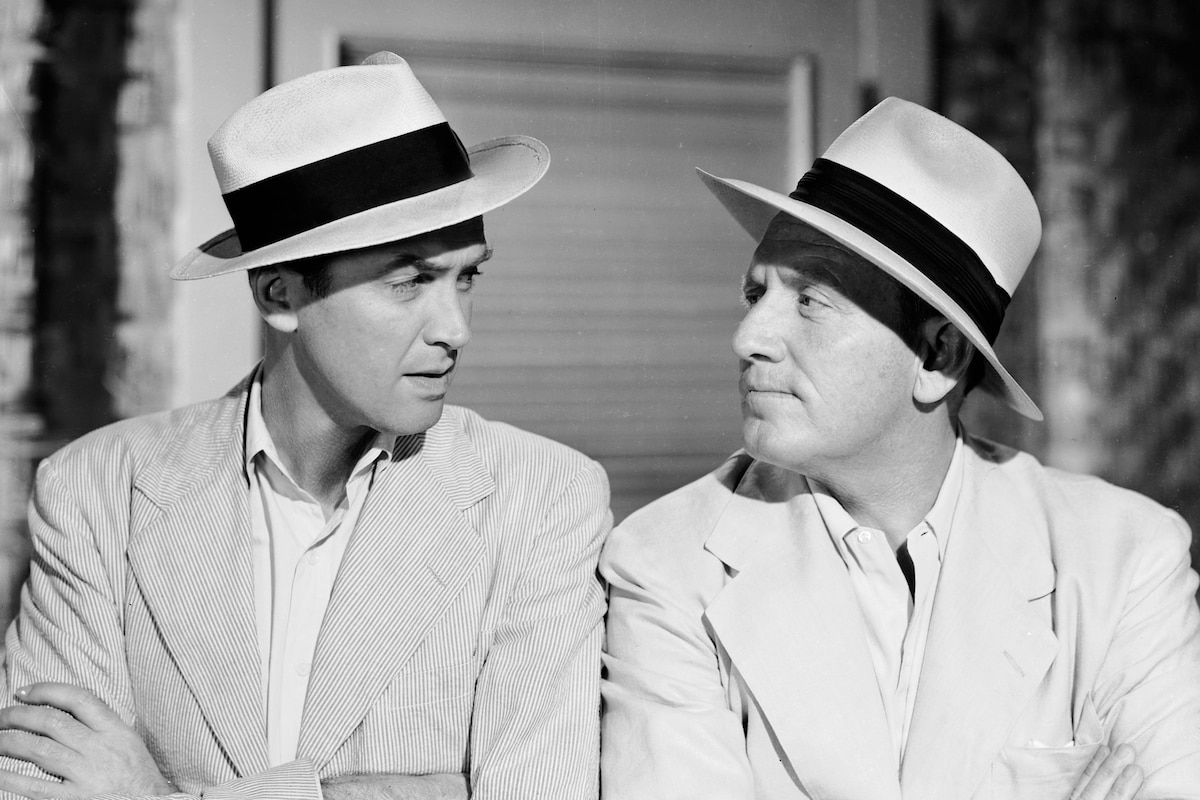
Stewart plays a former newspaper reporter who's recruited by the government
to smuggle rubber out of Japanese-occupied Malaya. Tracy is a professional
smuggler who's released from Alcatraz when he agrees to help Stewart with
the dangerous mission. Before it's over, one of the stars will make the
ultimate sacrifice for his country, one will profit from his experience,
and the American military will be up to its neck in rubber.
The story's origins hardly scream "major motion picture". During the war, a
patriotic newspaperman named Manchester Boddy wrote a letter to Franklin
Roosevelt, suggesting a scheme in which rubber could be readily smuggled out
of occupied territory. Roosevelt responded to Boddy, saying that the U.S.
was already moving in that direction. Later, Boddy sold his story to RKO
production chief, Dore Schary, who thought he could turn it into an
adventure story. When Schary left RKO for MGM, he made sure to take Frank
Fenton's script with him.
In retrospect, Schary's enduring faith in Fenton's work seems a tad
misguided. But he still managed to lure a crew of terrific actors to the
project, at a time when the industry , due to the newfangled pressures of
television, was shying away from big budgets. Stewart signed up simply
because he wanted another chance to work with Tracy, who was in Stewart's
very first film, The Murder Man (1935). With
heavyweights like Stewart and Tracy on board, other notables such as
Sydney Greenstreet, Lionel Barrymore, and Gilbert Roland also signed onto the project.
But director Richard Thorpe was hardly the
type to rescue a weak storyline, since he was well-known within the industry
for printing the first take of virtually every scene he shot. Actors were
openly leery of him. He did, however, bring all of his pictures in under
budget, which endeared him to MGM management like Dore Schary.
Stewart, for his part, did his best to keep Tracy's legendary drinking
binges at bay during filming. In order to keep Tracy on the set and away
from the bottle, Stewart concocted a plan in which the two of them would
take a trip around the world when the shoot was finished. Every day, he
bombarded Tracy with brochures describing the exotic locales that they could
visit. "He'd pore over the brochures and talk with great excitement about
Greece and Rome and the Taj Mahal," Stewart said. "Anyway, the strategy
seemed to work, and Spence showed up every day and did his usual fine
job."
But, like so many other people, Stewart couldn't catch Tracy acting. When
filming wrapped, Stewart asked his co-star if he had his passport ready.
"What passport?" Tracy asked. "For our trip to Europe and Asia," Stewart
replied. "Europe and Asia?" Tracy said. "Why, I wouldn't go across the
street with you, you son-of-a-bitch."
Producer: Edwin H. Knopf
Director: Richard Thorpe
Screenplay: Frank Fenton (based on an original story by Manchester
Boddy)
Cinematography: George Folsey
Editing: Ben Lewis
Art Direction: Cedric Gibbons and Malcolm Brown
Music: Bronislau Kaper
Music Conductor: Andre Previn
Sound: Douglas Shearer
Cast: Spencer Tracy (Carnahan), James Stewart (John Royer),
Valentina Cortese (Luana), Sydney Greenstreet (The Dutchman), John
Hodiak (Kellar), Lionel Barrymore (John Manchester), Gilbert Roland (Romano).
BW-95m. Closed captioning.
by Paul Tatara
Malaya
by Paul Tatara | July 30, 2006
SIGN UP FOR OUR NEWSLETTERS

CONNECT WITH TCM