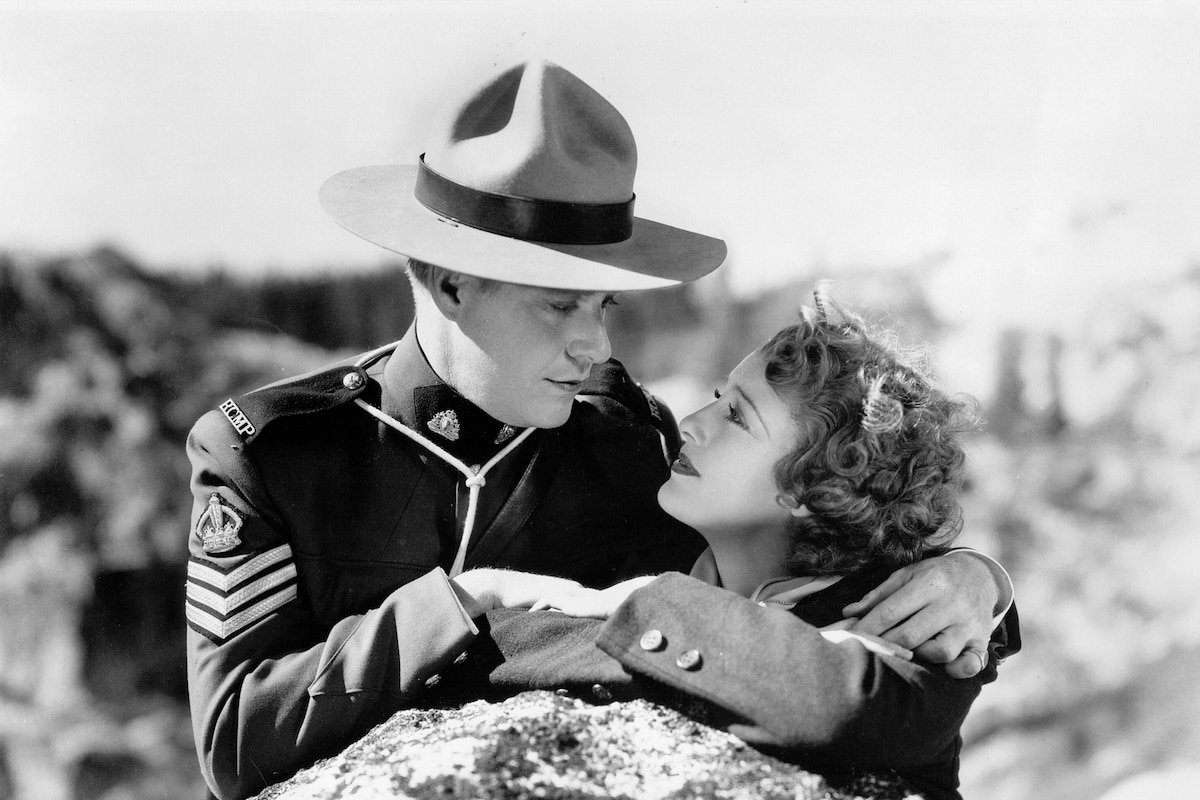
Rose-Marie (1936) was the second screen teaming of Jeanette MacDonald and Nelson
Eddy, following the surprising success of Naughty Marietta (1935), which had the public
clamoring for more. Rose-Marie was the first sound film version of the 1924 Rudolph
Friml operetta. It had been filmed as a 1928 silent starring Joan Crawford and James Murray.
But while the later version featured the Friml score, including the famous Indian Love
Call, it changed the Otto Harbach-Oscar Hammerstein story completely. MacDonald plays a
famous opera singer on tour in Canada. Her brother is an escaped convict, and MacDonald leaves
her tour and travels incognito into the woods, hoping to find him before the Mounties do. Eddy
plays the Mountie pursuing her brother who eventually pursues the diva.
By the time they made Naughty Marietta, MacDonald was already a big star. Eddy had a
successful concert career, but hadn't made many films. MGM next planned to co-star Eddy in
Rose-Marie with opera star Grace Moore, who still owed MGM a film. But Moore
balked at co-starring with someone she considered an "unknown." In the meantime, Naughty
Marietta was turning out to be a huge hit, so the studio was happy to replace Moore with
MacDonald, and assigned W.S. Van Dyke, who helmed Naughty Marietta, to direct
Rose-Marie.
Van Dyke was a speedy, economical director, who nevertheless could be counted on to
deliver a classy and well-acted product. The studio made a decision that was revolutionary for
the time: they would shoot the outdoor scenes on location, with the Lake
Tahoe area of northern California standing in for Canada. Rose-Marie was one of the
first musicals to use a naturalistic setting. A special train of seventeen box cars carted the
equipment to the location. Movie crews built several 40-foot totem poles in state parkland at
Emerald Bay for the Indian totem pole dance. With a cast of almost a thousand people (cast, extras and crew), feeding everyone was a problem, and the cuisine was less-than-gourmet box
lunches. One day, for a treat, the crew set up a table for Van Dyke with a hot meal. The director
asked if it was the same food that the crew was getting, and when he found out that it wasn't, he
refused the meal and stood in line for box lunches like everyone else. The director was a dedicated
prankster, and one of his more elaborate jokes involved rigging a fake explosion, for which the
film's vocal coach believed himself responsible. Another time, while filming a scene in which
MacDonald falls into a river, he sent the crew to lunch and left the star sitting in the
water.
Rose-Marie was an important film in the careers of several newcomers. Cast as
MacDonald's brother on the lam was James Stewart, in his third film. Van Dyke had noticed
Stewart in his previous bit parts, and asked for him to play John Flower. This was the film that
really started Stewart's career, and he always gave credit to Van Dyke for the boost. Also a
standout in Rose-Marie was Allan Jones, the tenor who shares operatic arias with
MacDonald in the film. He was newly-arrived at MGM, and had only been featured in musical
sequences in films. Eddy, who had recently been in the same position as Jones, felt threatened by
the other singer, and demanded that Jones' scenes be trimmed. But the following year, Jones
would get his chance, when he co-starred with MacDonald in The Firefly (1937). Less
auspicious was the part played in Rose-Marie by another newcomer, David Niven, cast
as one of MacDonald's suitors. He receives a screen credit as "David Nivens," but in his
autobiography Niven claims that in the finished film, his bit part had been reshot with another
actor.
Rose-Marie was even bigger at the box office than Naughty Marietta. Jeanette
MacDonald and Nelson Eddy would make a total of eight films together, and sang 37 duets in
them. But of all those films and all those romantic melodies, the one that is considered the
quintessential MacDonald-Eddy number, for better or worse, is Indian Love
Call.
,B>
Producer: Hunt Stromberg
Director: W.S. Van Dyke
Screenplay: Frances Goodrich, Albert Hackett, Alice Duer Miller, based on the operetta by Otto
A. Harbach, Oscar Hammerstein II, Rudolf Friml, Herbert Stothart
Art Direction: Cedric Gibbons, Joseph C. Wright, Edwin B. Willis
Cinematography: William H. Daniels
Costume Design: Adrian
Editor: Blanche Sewell
Music: Rudolf Friml, Herbert Stothart, lyrics by Otto A. Harbach, Oscar Hammerstein II, Gus
Kahn
Cast: Jeanette MacDonald (Marie de Flor), Nelson Eddy (Sgt. Bruce), James Stewart (John
Flower), Reginald Owen (Myerson), George Regas (Boniface), Robert Greig (Cafe Manager),
Una O'Connor (Anna), Allan Jones (Tenor), Gilda Gray (Bella), David Nivens (Teddy).
BW-111m. Closed captioning.
by Margarita Landazuri
Rose Marie (1936)
by Margarita Landazuri | November 19, 2004
SIGN UP FOR OUR NEWSLETTERS

CONNECT WITH TCM