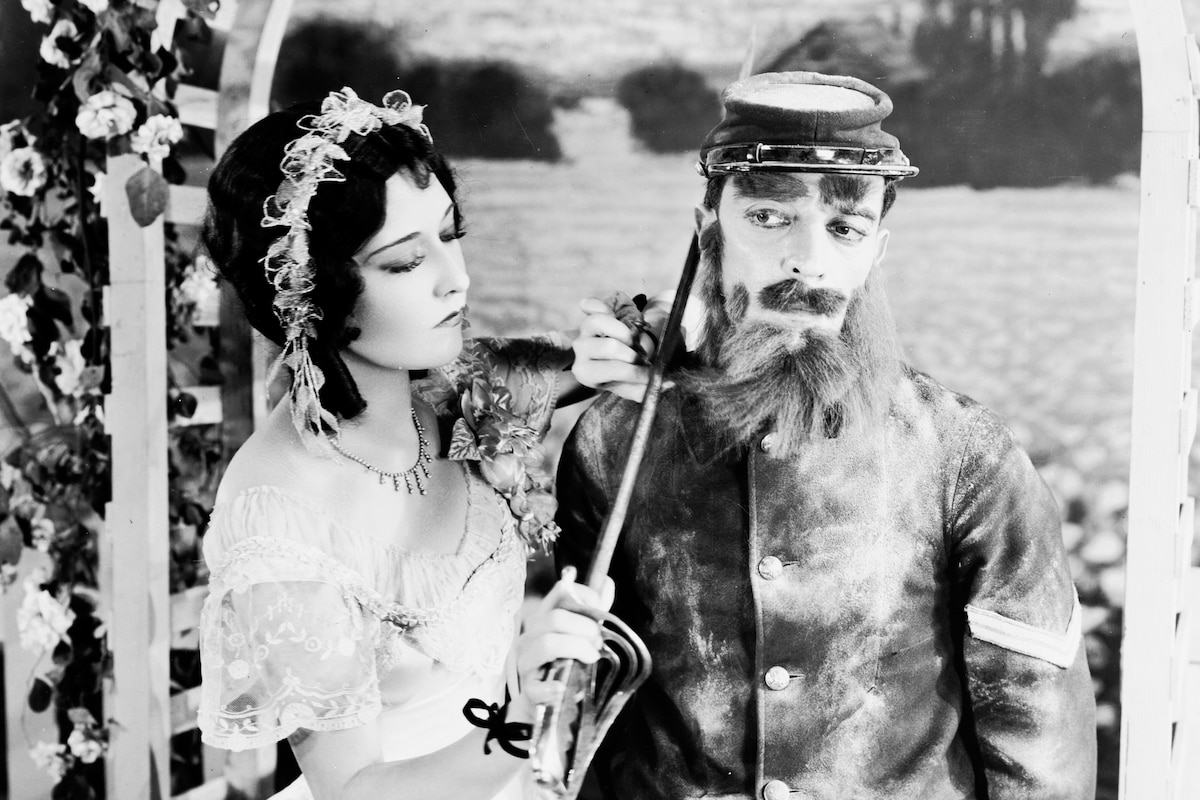
Spite Marriage (1929) was the final silent film from Buster Keaton, one of
the true geniuses of American cinema. Keaton stars as Elmer, a lowly pants
presser who falls in love with a gorgeous actress named Trilby Drew (Dorothy
Sebastian). Elmer is so utterly taken with Trilby, he attends no less than
35 of her stage performances. In a cruel attempt to inspire jealousy in her
leading man (Edward Earle), Trilby marries Elmer. It's not long before
Elmer realizes he's been played for a fool. Heartbroken, he leaves Trilby,
only to end up shanghaied and forced to work on a rum-runner's boat (in
reality, Keaton's personal yacht). After a boisterous, very unlikely
adventure at sea, Elmer wins Trilby for himself.
Spite Marriage was an unqualified success at the time of its release,
even though Keaton wasn't particularly thrilled to participate in its
creation. He originally approached MGM production head Irving Thalberg with
the idea of shooting a comic Western co-starring himself and Marie Dressler.
But the creative autonomy Keaton received while writing, filming, and acting
in such pre-MGM masterpieces as Steamboat Bill Jr. (1928) and The
General (1927) was now a thing of the past.
Thalberg was constantly aware of the bottom line. He felt that Keaton's
prior films, which were partly created out of time-consuming improvisations,
were not as profitable as they could have been. Buster's first feature with
MGM, The Cameraman (1928), was rather carefully supervised and did
considerable business at the box office. Thalberg was convinced that Keaton -
strictly adhering to a completed script - would benefit the studio.
It's ironic that Keaton - whose career would collapse partially due to the
onset of talkies - wanted Spite Marriage to be his first sound
picture. Though his brilliance as a physical performer was undeniable, he
realized the success of Warner Bros.' The Jazz Singer (1927) marked
the beginning of the end of the silent era. While interested in the
possibilities of sound, Keaton, much like his comic peer, Charles Chaplin,
was concerned that the new technology would be embraced to the eventual
detriment of his art. He envisioned a type of comedy that would rely mostly
on humorous sound effects. "It needn't be one long yak-yak," he told
Thalberg.
Nevertheless, Thalberg insisted that Spite Marriage would be
completely silent...especially since MGM had only one set of sound equipment
at its disposal. Keaton and his director, Edward Sedgwick, forged ahead
while chafing under the supervision of both Thalberg and producer Larry
Weingarten, who happened to be married to Thalberg's sister. Luckily, this
friction threw off some memorable sparks; many of the better moments in
Spite Marriage arose via head-butting with the executives. "I'm
afraid," Keaton said years later, "that Larry Weingarten was plenty sore,
especially when the putting-the-bride-to-bed (sic) was such a
success."
The sequence Keaton refers to is a genuine classic, in which he drunkenly
attempts to get an equally inebriated Sebastian into bed without waking her
up. It's a tour de force of comic timing, as he hauls his co-star around in
a variety of ungainly positions. (Gregory Peck can be seen enacting the
same routine, to less inspired effect, with Audrey Hepburn in Roman
Holiday, 1953. Keaton also returned to it in the 1950s, frequently
performing it on stage with his third wife, Eleanor Norris.) Though her
work in this scene is severely inhibited by definition, Sebastian was the
strongest actress to ever share the screen with Keaton. Their ease with one
another can be traced to the fact that they were enjoying what would become
a lengthy love affair while filming Spite Marriage.
Keaton and Sedgwick would go on to make seven more films together, all of
which were talkies and far less rewarding than Spite Marriage. It's
an often under-appreciated treasure, and the last fully realized display of
Keaton's towering gifts as a filmmaker.
Director: Edward Sedgwick and Buster Keaton (uncredited)
Screenplay: Robert E. Hopkins and Lew Lipton
Art Direction: Cedric Gibbons
Cinematography: Reggie Lanning
Editing: Frank Sullivan
Costume Design: David Cox
Principal Cast: Buster Keaton (Elmer), Dorothy Sebastian (Trilby Drew), Edward Earle (Lionel Benmore), Leila Hyams (Ethyl Norcrosse), William Bechtel (Nussbaum), John Byron (Scarzi).
BW-76m.
by Paul Tatara
Spite Marriage
by Paul Tatara | November 12, 2004
SIGN UP FOR OUR NEWSLETTERS

CONNECT WITH TCM