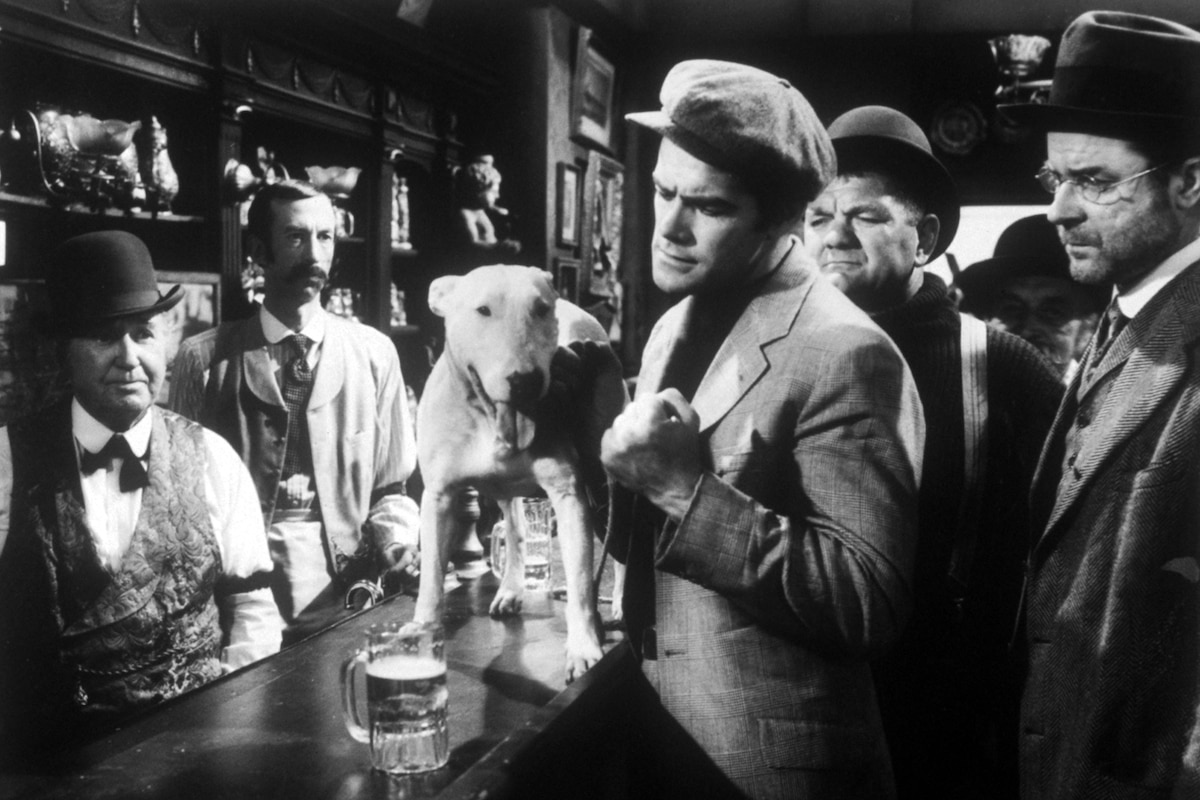
Like most of Hollywood in the fifties, MGM was in the throes of changing times as it scrambled to come up with bigger pictures and more adult subject matter to lure people away from the free entertainment on their TV sets at home. But when the studio decided to create a simple family film in the mold of its earlier Lassie Come Home (1943) and National Velvet (1944), they showed that they still had the old magic. It's a Dog's Life (1955) may be largely forgotten today; it doesn't feature any of MGM's top stars and didn't set any box-office records, but it's a testament to the studio's reputation as Hollywood's house of quality.
To start with, MGM stinted for nothing in putting together a production team for this tale of a turn-of-the-century bull terrier who rises from rags to riches while looking for the prize-winning father who deserted him as a pup. The cast features two Oscar winners - Edmund Gwenn (Miracle on 34th Street, 1947) and Dean Jagger (Twelve O'Clock High, 1949) - with a third behind the camera, cinematographer Paul C. Vogel (Battleground, 1949). Joining them are some of the studio's top younger players of the time, including Jeff Richards, who had played one of the title roles in Seven Brides for Seven Brothers (1954) and Richard Anderson, an MGM standby in the fifties who would go on to play the government liaison in charge of The Six Million Dollar Man (1974-1978) and The Bionic Woman (1976-1978). And the screenplay was written by one of the hottest writers in Hollywood at the time, John Michael Hayes, who was currently in the middle of a four-picture run with Alfred Hitchcock that included the classic Rear Window (1954) and the black comedy The Trouble With Harry (1955).
But the real star of It's a Dog's Life is Wildfire, the prodigious, Oedipally conflicted dog played by Cadence Glacier, C.D.X. Cadence Glacier was a show champion whose trainers had also provided the dogs for Disney's The Shaggy Dog (1959) and the television version of The Thin Man. His work in It's a Dog's Life brought him the American Humane Association's Patsy Award for outstanding performance by an animal in a motion picture.
Of course, like most award winners, Cadence Glacier didn't do it alone. Along with his trainers, he had a little help from actor Vic Morrow, who received no credit for narrating the film as the voice of Wildfire. Morrow's gentle, whimsical narration is one of the film's highlights, and a far cry from his usual casting at the time. He made It's a Dog's Life right after his first MGM film, in which he played the toughest delinquent in The Blackboard Jungle (1955). That debut typed him so badly that he eventually left MGM rather than play any more psychos or gangsters. He then signed to star in the popular television series Combat in 1962. After that series ended its five-year run, Morrow was typed again, and spent the next two decades rebuilding his career, this time as a character actor and occasional director ( Man Called Sledge, 1970. His comeback was cut short by a fatal accident on the set of The Twilight Zone: The Movie (1983).
Producer: Henry Berman
Director: Herman Hoffman
Screenplay: John Michael Hayes
Based on a story by Richard Harding Davis
Cinematography: Paul C. Vogel
Music: Elmer Bernstein
Cast: Jeff Richards (Patch McGill), Jarma Lewis (Mabel Maycroft), Edmund Gwenn (Jeremiah Nolan), Dean Jagger (Mr. Wyndham), Sally Fraser (Dorothy Wyndham), Richard Anderson (George Oakley), Vic Morrow (uncredited; voice of Wildfire).
C-87m. Letterboxed.
by Frank Miller
