Although MGM is rightly remembered for producing several of the most
dazzling musicals in movie history, the studio also displayed an inclination
toward glossy historical biopics. One of the best of the war years was
Tennessee Johnson (1942), a relatively straightforward account of the life
of U.S. President Andrew Johnson (played by Van Heflin). Viewers whose
knowledge of Johnson begins and ends with his facing Presidential
impeachment proceedings will be fascinated by the details of his political
career.
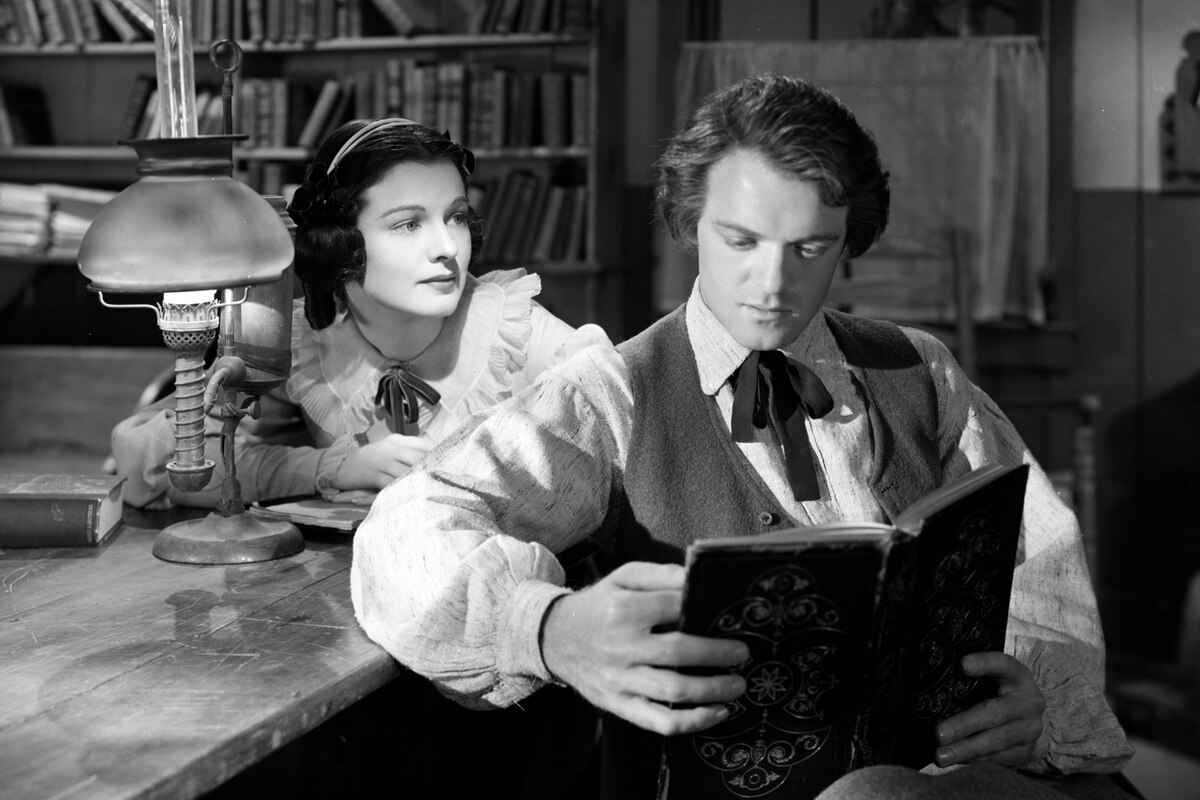
The screenplay (by John Balderston and Wells Root), follows Johnson from his
troubled childhood, during which he was beaten while serving as a tailor's
apprentice, through his education and political awakening under the tutelage
of Eliza McCardle (Ruth Hussey), a school teacher whom he later marries.
These events, of course, serve as a prelude to his unexpected term as
President when Abraham Lincoln is assassinated. Easily the most effective
portion of the film involves Johnson's battle with Senator Tadd Stevens
(Lionel Barrymore), a Radical Republican who trumped up the charges that led
to the threat of impeachment.
Technically speaking, Heflin, an Oscar winner the previous year for
Johnny Eager (1941), was the star of Tennessee Johnson. But
it's old-pro Barrymore, the eldest of the acting Barrymore siblings, who
walks away with the movie. At the time, Barrymore was deeply entrenched in
a string of tepid B-pictures, including the hugely popular Dr.
Kildare series (1938-1941). Tennessee Johnson was a welcome
opportunity for him to chew up the scenery, and he does it with gusto.
This chance to branch out a bit apparently effected Barrymore's personal
life. During shooting, he briefly fled the film set to attend the wedding
of his niece, Diana, whose father, John, had recently passed away. Stunned
by his open display of emotion, Diana later said that it was the first time
he had ever acted "like an Uncle".
The film's director, William Dieterle, definitely got the job
based on his resume. Though he made a wide variety of films during his
career, he had previously helmed several other successful biopics, including
The Story of Louis Pasteur (1936), The Life of Emile Zola
(1937), for which he won an Oscar®, and Dr. Ehrlich's Magic Bullet
(1940), about the discovery of penicillin.
By the way, Tennessee Johnson was called The Man on America's
Conscience when it was later released in England. This overstated the
case considerably, but made more sense to the overseas crowd than MGM's
original title.
Directed by: William Dieterle
Producer: J. Walter Ruben
Screenplay: John L. Balderston and Wells Root, based on a story by Milton Gunzburg and Alvin Meyers
Editing: Robert Kern
Cinematography: Harold Rosson
Art Direction: Cedric Gibbons
Music: Herbert Stothart
Special Effects: Warren Newcombe
Cast: Van Heflin (Andrew Johnson), Ruth Hussey (Eliza McCardle), Lionel Barrymore (Tadd Stevens), Marjorie Main (Mrs. Fisher), Regis Toomey (McDaniel), Montagu Love (Chief Justice Chase), Morris Ankrum (Jefferson Davis), Porter Hall (The Weasel), Sheldon Leonard (Atzerodt).
BW-104m. Closed captioning.
by Paul Tatara
Tennessee Johnson
by Paul Tatara | October 26, 2004
SIGN UP FOR OUR NEWSLETTERS

CONNECT WITH TCM