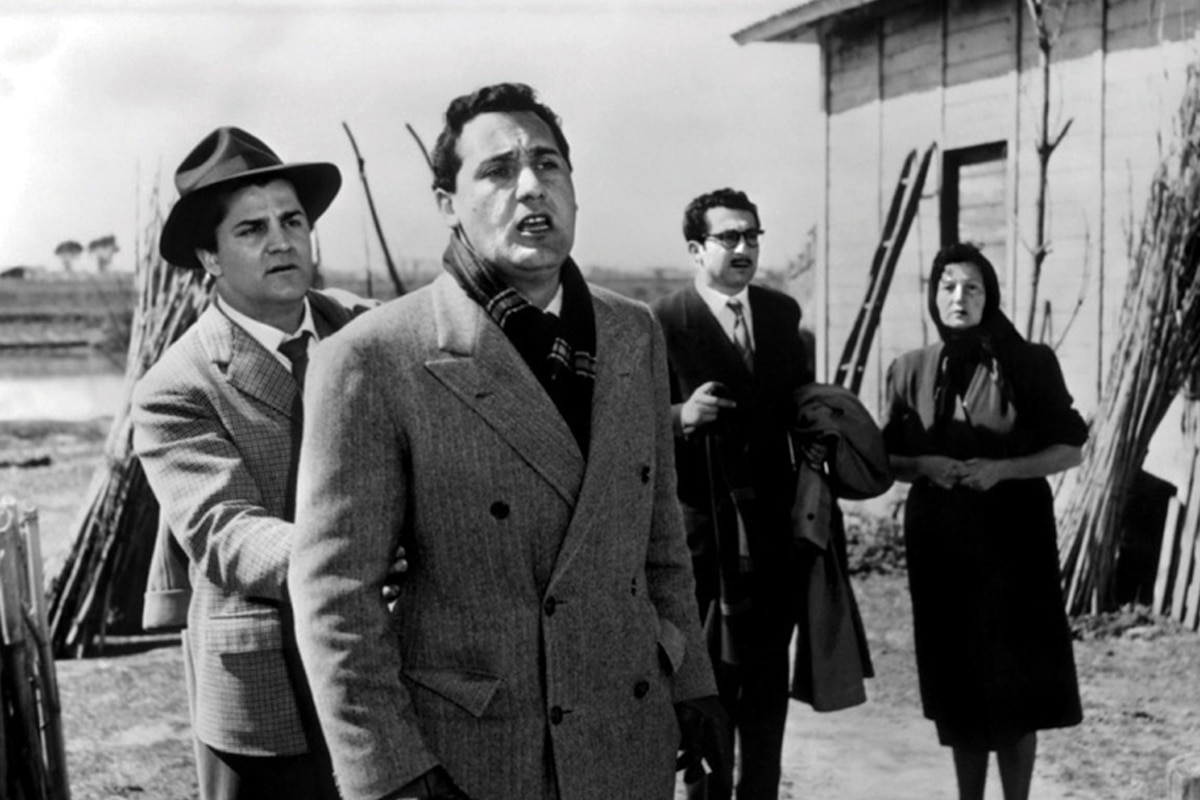
Fellini's second solo feature, the semi-autobiographical I Vitelloni (1953), is still one of the best coming-of-age movies ever, even if the characters are a little late in growing up. As has often been noted, I Vitelloni directly influenced American films such as Diner and Mean Streets. Fellini's film, however, stands in a class by itself thanks to its delicate blend of acerbic character observation, farce and melancholy lyricism; it's a balance that he was not always as successful at maintaining towards the end of his career. He personally regarded it as his best film, though today most people would probably give that honor to later films like 8 1/2 or La Strada.
Synopsis: In a dreary Italian seaside resort (clearly meant to suggest Fellini's home town of Rimini), a group of men in their late twenties and early thirties still live at home with their parents and lack any sense of direction in life, preferring to spend their free time playing pool and picking up women. (The title, which means literally "the big calves," became a popular expression in Italian thanks to Fellini's film.) When Fausto (Franco Fabrizi) impregnates Sandra (Leonora Ruffo), the sister of fellow vitellone Moraldo (Franco Interlenghi), he tries to skip town but his father forces him to marry her. He moves in with Sandra's parents and even agrees reluctantly to take up a job in a religious paraphernalia shop, but is unable to keep his hands off other women. Alberto (Alberto Sordi) mooches off his sister Olga (Claude Farell), but at the same time chastises her for dating the wrong men and expounds pompously on protecting the family honor. Leopoldo (Leopoldo Trieste) is an intellectual who dreams of becoming a great playwright but churns out turgid, cliché-ridden work. Over time, the quiet, observant Moraldo begins to recognize the limitations of his friends and imagines a better life for himself.
Fellini's first film as a solo director, The White Sheik (1952), is a delightful, underrated comedy that already displays many of his characteristic themes and stylistic mannerism, from its naive heroine to Nino Rota's circus-inspired music. I Vitelloni, however, is a far more resonant work, thanks to its spot-on acting and its rich characterization. For example, Fausto's failed attempt at seducing the shopkeeper's wife is painful to watch, as is his absurd but all-too-recognizable attempt to save face by lying to his friends. Even a throwaway moment like the scene where the gang strolls down a street at night, stopping to kick a tin can back and forth before harassing a woman who walks past, rings true as a representation of pent-up boyish energy. A comic highlight is the vulgar musical review performed by the aging, has-been actor that tries to seduce Leopoldo. Yet even as Fellini mocks his characters' shortcomings, he always maintains a genuine sense of affection for them. Some of the vitelloni are developed more fully than others-the singer Riccardo (played by Riccardo Fellini, the director's brother), for instance, hardly registers-but Fellini's choice to concentrate on a few characters gives the film stronger dramatic focus.
The direction is impressive throughout, but perhaps nowhere more so than the Carnival ball sequence, with its dazzling combination of decor, composition, and camera movements. The oversized papier-mache head that the drunken Alberto carries with him down the street afterwards suggests something of the phantasmagorical visions that would dominate Fellini's later films. Also memorable is the image of the gang standing on a pier at the deserted beach, gazing silently out at the ocean, and the beautifully photographed shots of the nighttime town.
Criterion's transfer displays nicely rendered detail and contrast, with only a few very minor instances of print damage. Frankly, the print used for the DVD looks better than the restored 35mm print that played theatrically during the last year or so, and those who remember the old beaten-up and dupey print used for the VHS and laserdisc versions will be thrilled with the improvement. The special features, while they hardly match up to those on the lavish, multi-disc Criterion box sets of Battle of Algiers or The Leopard, are worthwhile nonetheless. The most interesting is "Vitellonismo," a Criterion-produced documentary consisting of interviews with surviving cast members, production team members, and Fellini scholars; it gives a strong sense of film's place in Fellini's career and personal life and contains many engaging anecdotes. I've always had a weakness for the kinds of production stills, posters and other promotional materials reproduced in the stills gallery, but even so the American promotional materials are a hoot for the way they emphasized sex to sensation-hungry "art film" audiences of the early Fifties. Not only was the film titled "The Young and the Passionate," but the tagline was "A daring story of uninhibited youth!" In truth, what little sex there is in the film is deliberately awkward rather than titillating. Lastly, the disc includes the original Italian trailer--too bad they didn't throw in the American trailer--and liner notes by Tom Piazza. I Vitelloni is one of Fellini's best films, Criterion thankfully does right by it.
For more information about I Vitelloni, visit Criterion Collection. To order I Vitelloni, go to
TCM Shopping.
by James Steffen
I Vitelloni on DVD
by James Steffen | November 29, 2004
SIGN UP FOR OUR NEWSLETTERS

CONNECT WITH TCM