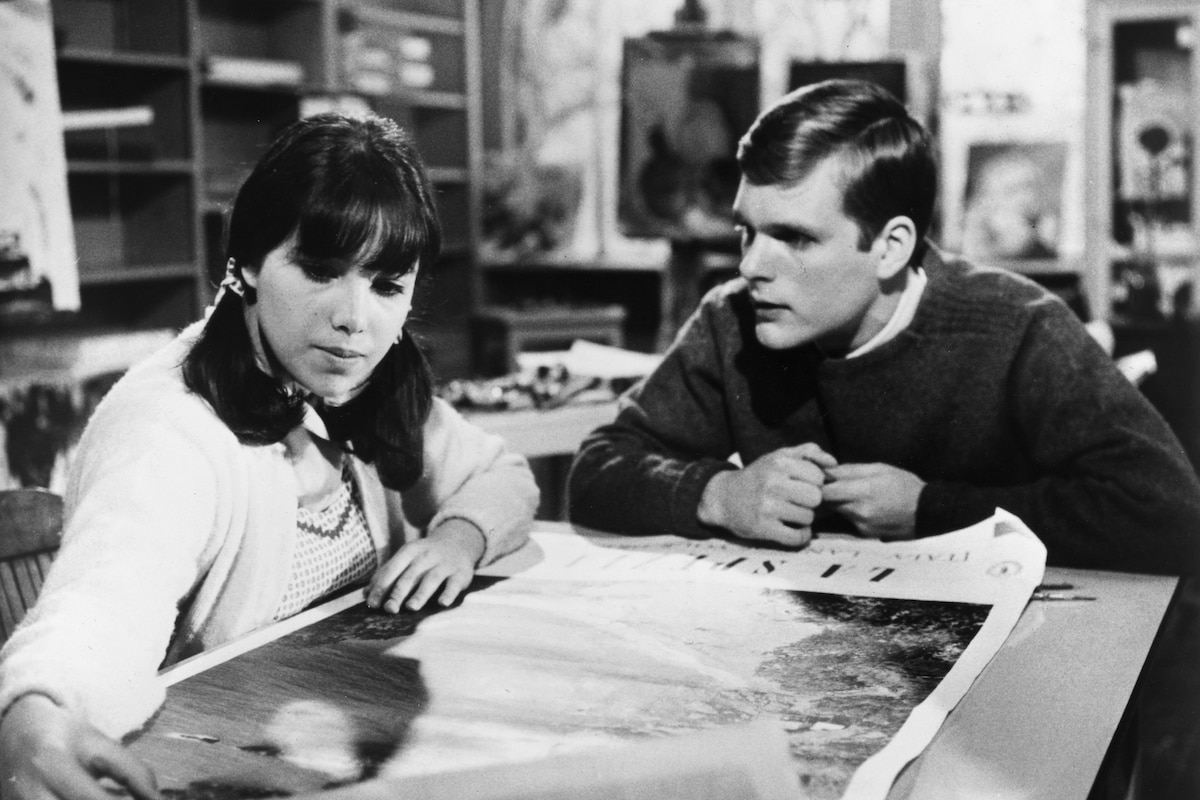
David (Keir Dullea), a young man suffering from an overwhelming fear of being touched, is admitted to a home for disturbed teenagers run by Dr. Alan Swinford (Howard Da Silva). Though at first resistant to interacting with the other patients, David finds himself drawn to Lisa, a schizophrenic girl who speaks only in rhymes. Their relationship, which grows from antagonism to one of trust, gives them both the strength to confront their inner demons and hope for the future.
The debut film for the husband-and-wife team of Frank and Eleanor Perry, David and Lisa (1962) was a surprise commercial success when it was first released. Made on a remarkably low budget of $200,000, the film worked on several levels - as a technically accomplished first feature, as a love story, and most importantly, as a more realistic look at the treatment of mental illness minus the usual psychobabble and sensationalism associated with Hollywood produced films in the same genre. What particularly impressed critics were the naturalistic performances and the seamless mixture of documentary-like realism with nightmarish dream sequences, all strikingly photographed in black and white by Leonard Hirschfield in and around Philadelphia. In a year that saw the release of such landmark films as Lawrence of Arabia, To Kill a Mockingbird, The Manchurian Candidate and Lolita, it was no small achievement that David and Lisa won Oscar® nominations for Best Director and Best Screenplay (adapted by Eleanor Perry from the case study, Lisa and David by Dr. Theodore Isaac Rubin). The film was remade for television by co-producer Oprah Winfrey in 1998 with Sidney Poitier as the psychiatrist, Lukas Haas as David and Brittany Murphy as Lisa.
While most psychiatrists have since criticized David and Lisa for its suggestion that David's obsessive-compulsive behavior was caused by his mother's dominant personality, the film still works as a moving and insightful character study with unexpected touches of humor. And it remains one of Keir Dullea's finest performances though he admitted in Current Biography that the film actually hampered his career for awhile: "It got so that I began to hate David and Lisa. I'd walk down a street and people would come over and say, 'Hello, David, can I touch you?' And...I just couldn't break the mold professionally in either the movies or TV work I got after it."
Director Frank Perry was one of several filmmakers who was associated with the New York City independent film movement of the late fifties and early sixties, a period that saw the emergence of such talents as John Cassavetes (Shadows, 1959) and Shirley Clarke (The Connection, 1962). Perry, who studied acting under Lee Strasberg and worked as a theatre director, went on to collaborate with his wife (as screenwriter) on several critically acclaimed features (Last Summer (1969), Diary of a Mad Housewife, 1970) before they ended their marriage and working relationship in 1981. Unlike Cassavetes who abandoned Hollywood financed projects after his unhappy experiences on Too Late Blues (1961) and A Child is Waiting (1963), the Perrys managed to work within the studio system to create thought-provoking but accessible entertainments for most of their partnership. Since their split, neither filmmaker enjoyed a success comparable to their earlier work though, ironically, Frank will probably be best remembered for the camp classic Mommie Dearest, which he directed in 1981 with Faye Dunaway playing Joan Crawford.
Producer: Lee R. Bobker, Paul M. Heller
Director: Frank Perry
Screenplay: Eleanor Perry, Theodore Isaac Rubin (novel)
Cinematography: Leonard Hirschfield
Film Editing: Irving Oshman
Art Direction: Paul M. Heller
Music: Mark Lawrence
Cast: Keir Dullea (David Clemens), Janet Margolin (Lisa), Howard Da Silva (Dr. Swinford), Neva Patterson (Mrs. Clemens), Clifton James (John), Richard McMurray (Mr. Clemens).
BW-93m.
by Jeff Stafford
David and Lisa
by Jeff Stafford | September 29, 2004
SIGN UP FOR OUR NEWSLETTERS

CONNECT WITH TCM