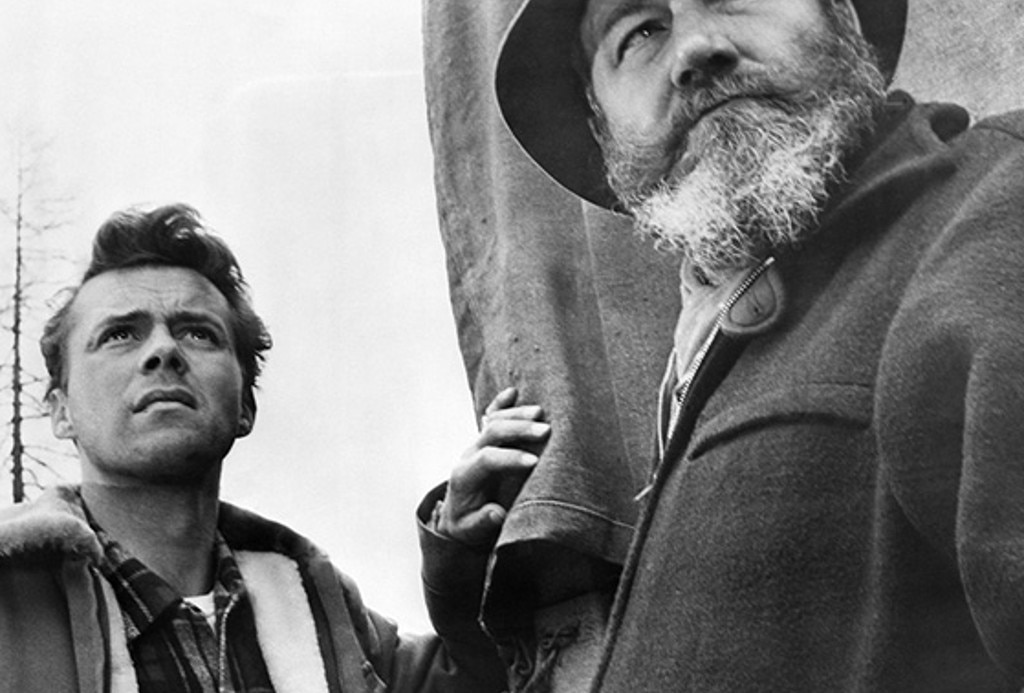
Director Ralph Thomas made a rare foray into the Western genre with Campbell's Kingdom, a 1957 box-office hit in England. Starring Dirk Bogarde, a matinee idol often dubbed the British Rock Hudson, the picture dazzled audiences by combining stunning
location shooting in the Canadian Rockies with an action-packed narrative.
Bogarde stars as a young man who inherits his grandfather's Wild West
spread just as an unscrupulous contractor (Stanley Baker) is about to flood
the area to make a fortune in hydroelectric power. Bogarde, meanwhile, engineers a plot to sabotage the dam project until he can find a way to make his inheritance support him and the area's longtime inhabitants.
Box-office success was nothing new to Thomas, particularly when teamed with
producer Betty E. Box, with whom he would make 32 films between 1950 and
1979. With an unerring eye for talent and good stories, Box had earned
the nickname "Betty Box Office," particularly in 1954 when she stumbled
across a comic novel about a young doctor and cast rising star Dirk Bogarde
in the leading role. The result, 1954's Doctor in the House, was a
box-office triumph that would lead to decades of sequels, three of them
featuring Bogarde in the role that made him England's top box-office
star.
Campbell's Kingdom was part of a master plan to build Bogarde's popularity with movie audiences. Thomas, Box and Bogarde all worked for the J. Arthur Rank studios, where
Chief Accountant John Davis had decided to personally supervise Bogarde's
career. After the actor's success in the first three "Doctor" films and a
series of dramas and comedies, Davis wanted him to expand into action roles
and prestige projects like a remake of A Tale of Two Cities (1958). For
starters, Bogarde would travel to Canada to star in his first
Western.
Action stardom was hardly a natural choice for Bogarde. Although, like
Hudson, he had a devoted female following who never suspected he was gay,
he did not share Hudson's athletic prowess. Even though the studio gave
him barbells and ordered him to work out, he remained, in his own words,
"scrawny as a plucked chicken." He got around that by wearing two sweaters
under his costumes for Campbell's Kingdom to create the illusion that
he had a more developed torso.
Davis' plans proved successful, and Bogarde continued as England's reigning
male star for ten years. But over time, his success in popular fare like
Campbell's Kingdom proved a straitjacket. Box, Thomas and the studio
were so committed to providing little more than entertainment that they
turned down most of Bogarde's more ambitious ideas. Despite his urgings,
they would pass on the film version of John Osborne's searing play Look
Back in Anger, which would go to Richard Burton, and Alan Sillitoe's
working-class novel Saturday Night and Sunday Morning, which helped
make Albert Finney a star. To make matters worse, even though the studio
was usually accommodating to Bogarde's requests to do plays between films,
his rising popularity made theatre work impossible. Mobs of adoring fans
disrupted performances by screaming at his every entrance and, at one
point, pushed their way through locked doors to stampede backstage.
Ultimately, Bogarde's dissatisfaction with his artistic prospects at Rank
would lead him to leave the studio in pursuit of more ambitious roles.
With his departure, Box and Thomas would promote one of his Campbell's Kingdom co-stars, Michael Craig, to the leading role in the "Doctor"
series.
Producer: Betty E. Box
Director: Ralph Thomas
Screenplay: Robin Estridge
Based on the novel by Hammond Innes
Cinematography: Ernest Steward
Art Direction: Maurice Carter
Music: Clifton Parker
Cast: Dirk Bogarde (Bruce Campbell), Stanley Baker (Owen Morgan),
Michael Craig (Boy Bladen), Barbara Murray (Jean Lucas), James Robertson
Justice (James MacDonald), Athene Seyler (Miss Abigail), Finlay Currie (Old
Man).
C-102m.
by Frank Miller
Campbell's Kingdom
by Frank Miller | January 05, 2011
SIGN UP FOR OUR NEWSLETTERS

CONNECT WITH TCM