"I'm as happy as the average man could hope to be"
Robert Young's opening narration in H.M. Pulham, Esq.
The poet laureate of the working class, director King Vidor raised his
sights socially for H.M. Pulham, Esq., his 1941 adaptation of J.P Marquand's novel about a
Boston blue blood tempted to leave his wife as he looks back on the choices
that have made him society's idea of a success. Still haunted by
memories of the working-class woman he would have married had his father
not interfered, he attempts a reunion that could change his life forever.
Vidor brought to the story the same trenchant social commentary that had
marked such classics of his as The Crowd (1928) and Our Daily
Bread (1934), while also demonstrating a rare grace in penetrating his
leading character's smug exterior.
Vidor had scored a big hit with his adaptation of the historical epic
Northwest Passage (1940) when he and wife Elizabeth Hill took on
this adaptation of Marquand's novel. He was attracted by the idea of man
trying to re-capture a lost love, something he had once attempted himself.
The book had been a best seller, a successful serial in McCall's
Magazine and a Reader's Digest condensed book; MGM estimated that
more than 5 million people had read it. Nonetheless, Vidor had trouble
casting the male lead. Both Gary Cooper and James Stewart turned him down,
leading him to offer the role to Robert Young, a solid professional but
hardly a star. To make the picture's marquee more attractive, studio
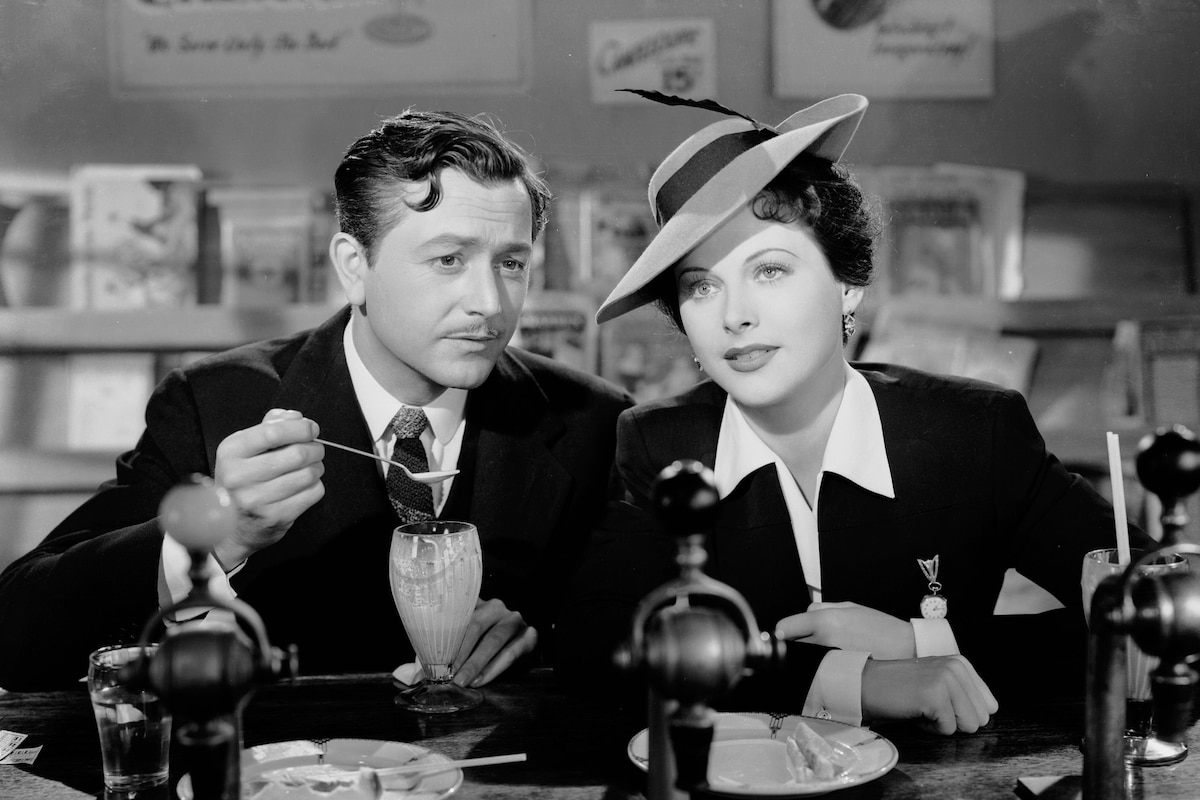
executives insisted he cast Viennese sexpot Hedy Lamarr as Marvin Myles,
the Iowa farm girl Young loves and leaves so he can marry within his class.
Since Lamarr's accent was far from Iowa, Vidor inserted a line in which
she explains that her family had emigrated from Europe to the Midwest.
Vidor would later state that he should have cast an American actress in the
role. His dream choice in retrospect would have been Shirley MacLaine,
although she was still more than a decade away from film stardom when he
made the picture.
Marquand came to Hollywood to advise Vidor and Hill on the screenplay,
delighting them with his dry wit and keen observation of class
distinctions. One day Vidor took him to lunch in the MGM commissary where
a studio executive interrupted them to ask, "What is this H.M.S.
Pulham about, an over-age destroyer?" Nonplussed, Marquand simply
replied, "Yes, by God, it is."
Vidor's inventiveness with the camera was already legendary when he made
H.M. Pulham, Esq.. For a scene establishing Young's daily routine,
he shot a series of close-ups of hands, feet -- everything but the actor's
face. Although the script called for the sequence to play against a
clock's ticking, he actually used a metronome to keep the beat perfectly.
The film is also the first to present a phone conversation as it would be
heard in real life and use undistorted voice-overs while one character is
reading another's letter. Previously sound editors had used distortion in
both cases.
For Young and Lamarr's failed reunion Vidor drew on the experience that had
sparked his initial interest in the story. While he had been writing the
script for his silent classic The Big Parade (1925), he looked up a
woman he had almost married during his youth in Texas. Years later, she
seemed like a different person -- rough, crude and common; nothing like the girl he once knew. In the film, Young and Lamarr's
reunion is proceeding well until she reveals a side of herself that shows how much the years have hardened her.
H.M. Pulham, Esq. brought Vidor some of his best reviews since his
silent classics. It also won praise for Young and Charles Coburn, who
played his father, with both named among the best actors of the year by the
National Board of Review. Lamarr's notices were more mixed. Although some
critics hailed the performance as her most energetic in years, others
complained that she was woefully miscast. In later years, she would cite
Marvin as her favorite among all her characters. Co-star Ruth Hussey, who
played Young's wife, received strong reviews, though some critics thought she was too attractive in the part and
that Lamarr, one of the screen's most glamorous stars, could not pose a
believable threat to her marriage.
Producer-Director: King Vidor
Screenplay: Vidor & Elizabeth Hill
Based on the Novel by John P. Marquand
Cinematography: Ray June
Art Direction: Cedric Gibbons, Malcolm Brown
Music: Bronislau Kaper
Cast: Hedy Lamarr (Marvin Myles), Robert Young (Harry Pulham),
Ruth Hussey (Kay Motford), Charles Coburn (Mr. Pulham, Sr.), Van Heflin
(Bill King), Fay Holden (Mrs. Pulham), Bonita Granville (Mary Pulham), Leif
Erickson (Rodney "Bo-Jo" Brown), Sara Haden (Miss Rollo), Connie Gilchrist
(Tillie), Frank Faylen (Sergeant), Anne Revere (Miss Redfern), John Raitt
(Soldier), Ava Gardner (Girl).
BW-120m. Closed captioning.
by Frank Miller
H. M. Pulham, Esq.
by Frank Miller | June 27, 2006
SIGN UP FOR OUR NEWSLETTERS

CONNECT WITH TCM