Stand Up and Fight (1939) could almost have been a memo from
studio heads to Robert Taylor about the direction of his career. Since his film
debut in 1934, Taylor had been MGM's pretty boy leading man, most popular with female audiences in such romances as The Gorgeous Hussy (1936) with
Joan Crawford, Camille (1936) opposite Greta Garbo, Personal
Property (1937) with Jean Harlow, and This Is My Affair
(1937), which also starred his soon-to-be wife, Barbara Stanwyck. In 1938, however,
the studio put him into a boxing film, The Crowd Roars, and it
proved to be a boost for the new virile image they wanted for him. To keep the
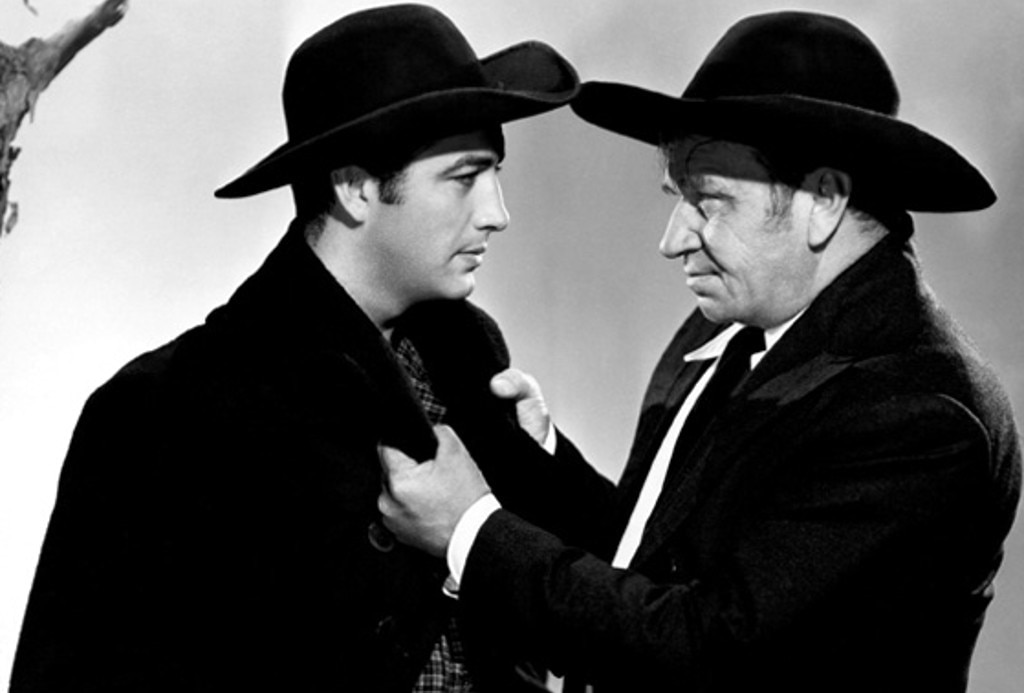
momentum going, they next cast Taylor opposite rough, gruff Wallace Beery in this
Western about the railroad-versus-stagecoach conflict, with some slave trading thrown
in to give the battling leads something to unite against. The plot, however, is
merely an excuse for several knock-down-drag-out brawls that show Taylor in great
fighting shape.
The action scenes were so realistic in fact that female fans became alarmed. They
could not understand how Taylor managed to take so many blows and not damage his
handsome face. The studio, of course, reassured them that everything was carefully
choreographed so that no punch ever actually landed. Taylor told friends the skill
to pull punches just a fraction from someone's nose was even greater than that needed
for being a successful boxer, and he was very grateful Beery and others learned
their lessons well.
This was Taylor and Beery's second film together. When they appeared in West
Point of the Air (1935), Taylor was little more than a bit player. In
Stand Up and Fight, Beery still got top billing, but Taylor was
every bit his box office equal and very soon eclipsed his co-star. Although Beery
continued to work until his death in 1949, he slowly slipped from leading actor
to supporting player, while Taylor remained one of MGM's top male stars well into
the 1950s.
The large cast features a number of well-known character actors, including Helen
Broderick, best known for comic roles, among them a couple of appearances in Fred
Astaire-Ginger Rogers movies. She was the mother of Broderick Crawford, the Academy Award-winning Best Actor for All the King's Men (1949).
The screenplay came from a couple of unlikely sources. Co-author Jane Murfin penned
several Katharine Hepburn films, including the screen adaptation of Booth Tarkington's
novel Alice Adams (1935). She also adapted Clare Boothe Luce's
all-female play, The Women (1939). James M. Cain, on the other
hand, was best known for gritty urban crime thrillers. His novels adapted for the
screen include Double Indemnity (1944), Mildred Pierce
(1945) and The Postman Always Rings Twice (1946).
Director: W.S. Van Dyke
Producer: Mervyn LeRoy
Screenplay: James M. Cain, Jane Murfin, Harvey Fergusson
Cinematography: Leonard Smith
Editing: Frank Sullivan
Art Direction: Cedric Gibbons
Original Music: William Axt
Cast: Robert Taylor (Blake Cantrell), Wallace Beery (Captain Boss Strakey), Florence
Rice (Susan Griffith), Helen Broderick (Aunt Mandy Griffith), Charles Bickford (Mr.
Arnold), Barton MacLane (Mr. Crowder).
BW-97m. Closed captioning.
by Rob Nixon
Stand Up and Fight
by Rob Nixon | August 25, 2004
SIGN UP FOR OUR NEWSLETTERS

CONNECT WITH TCM