During the 1940's and '50's, Barbara Stanwyck created a vivid gallery of vicious,
cold-blooded, sociopathic film noir dames: Phyllis Dietrichson in Double
Indemnity (1944), perhaps her finest performance; Martha Ivers (The
Strange Love of Martha Ivers, 1946); Thelma Jordon (The File
on Thelma Jordon, 1950); and Mae Doyle (Clash by Night,
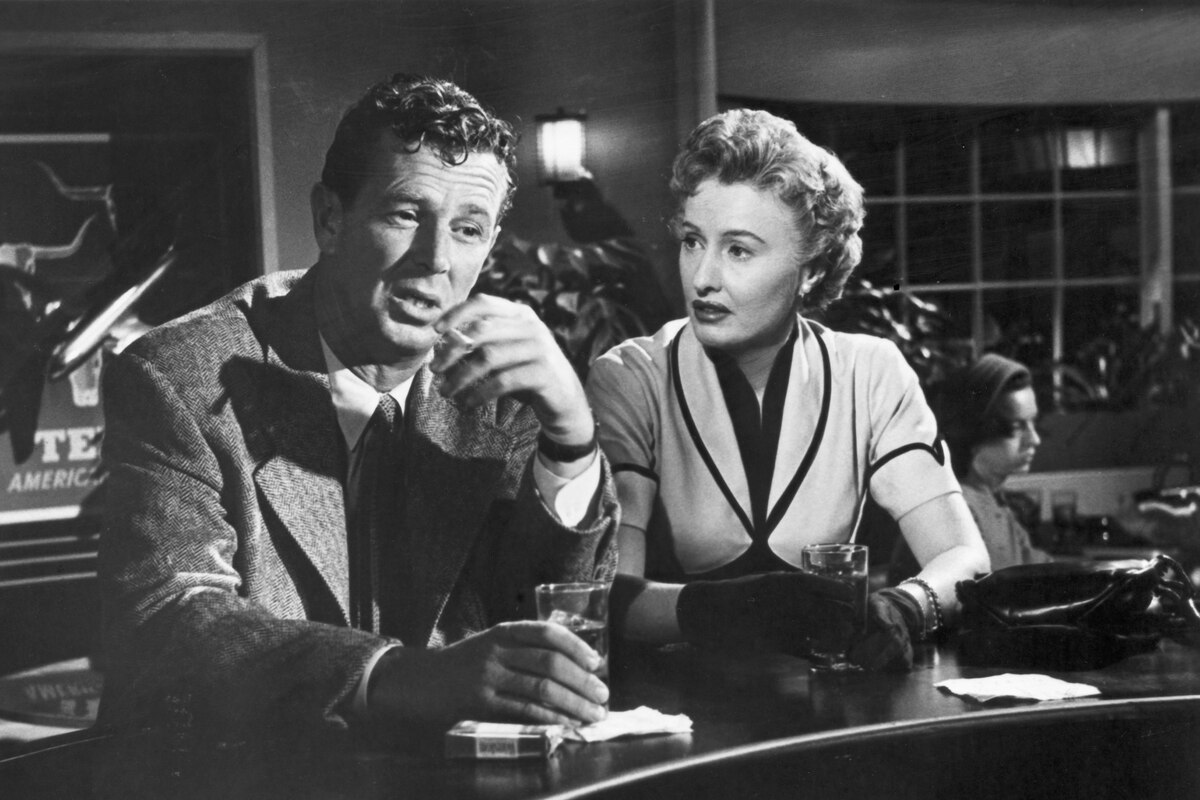
1952). The final portrait in that gallery was Kathy Ferguson Doyle in Crime
of Passion (1957).
When the film begins, Kathy is a San Francisco newspaper advice columnist, a "sob
sister," in the jargon of the era. In short order, Kathy convinces a murderess
to give herself up, falls in love with the policeman working on the case, played
by Sterling Hayden, and abandons her career to marry him and become a suburban Los
Angeles housewife. But she soon grows bored with that life, and channels the ruthless
ambition she had previously used to advance her career to try to advance her husband's.
She does so by scheming, lying, betraying her husband's colleague, and having an
affair with the husband's boss. Finally, Kathy's perfidy escalates to an even worse
crime.
Besides Stanwyck, Crime of Passion had several participants with
superb noir credentials. It was written by Jo Eisinger, who also wrote two of the
most psychologically complex film noirs, Gilda (1946), and Night
and the City (1950). Director Gerd Oswald had recently directed his first
feature film, which would become a noir classic, A Kiss Before Dying
(1956). Co-star Sterling Hayden's credits included The Asphalt Jungle
(1950) and a noir Western, Johnny Guitar (1954). And Raymond
Burr had been a stellar villain in Alfred Hitchcock's Rear Window
(1954). The same year that Crime of Passion was released, Burr
began his long stint as TV's Perry Mason, and Oswald would direct some episodes
of the series.
Dismissed as a routine crime melodrama when it opened in early 1957, Crime
of Passion resonates much more deeply nearly fifty years later. From
a post-feminist perspective, it seems to be a strikingly modern commentary about
how women were driven mad by the limitations imposed on them in the postwar period.
It's also interesting to look at how the film noir style had evolved from the 1940's
to the 1950's. The light-and-shadow look of 40's noir had given way to what's been
called "darkness in daylight," and in Crime of Passion,
the bright, harsh light of southern California was particularly effective, almost
suffocating in its brightness. The bland suburban atmosphere becomes as menacing
as the urban shadows of the previous decade.
Stanwyck was nearly fifty when she made Crime of Passion, and
though she was still slim and elegant, she made no effort to hide her age. The
unflattering hairdos and makeup of the period didn't do her any favors either, so
the specter of being an aging career woman at a time of cozy domesticity added another
layer of desperation to her characterization. But ultimately, it's Stanwyck's characteristic
fierceness and intensity that propels her character, and the film, and makes Crime
of Passion a worthy farewell to film noir from Stanwyck.
Director: Gerd Oswald
Producer: Herman Cohen
Screenplay: Jo Eisinger
Cinematography: Joseph LaShelle
Editor: Francis J. Scheid
Costume Design: Grace Houston
Art Direction: Leslie Thomas
Music: Paul Dunlap
Cast: Barbara Stanwyck (Kathy Ferguson Doyle), Sterling Hayden (Bill Doyle), Raymond
Burr (Tony Pope), Fay Wray (Alice Pope), Virginia Grey (Sara Alidos), Royal Dano
(Charlie Alidos), Stuart Whitman (Laboratory Technician).
BW-86m. Letterboxed.
by Margarita Landazuri
Crime of Passion
by Margarita Landazuri | August 27, 2004
SIGN UP FOR OUR NEWSLETTERS

CONNECT WITH TCM