Cult director Michael Powell returned to the military milieu of such
earlier triumphs of his as 49th Parallel (1941) and One of Our
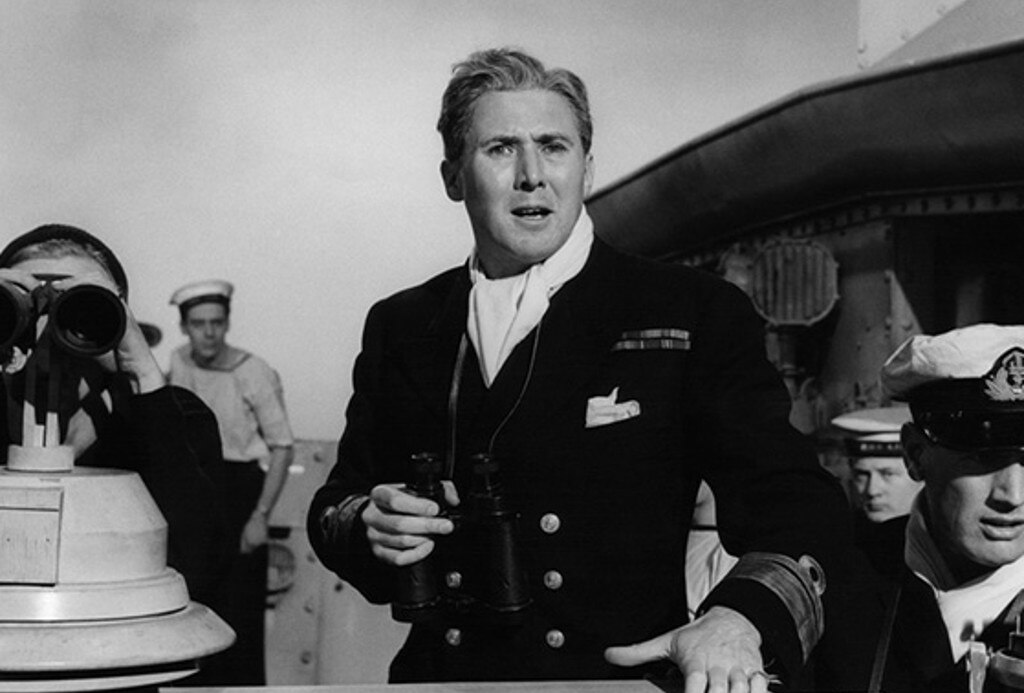
Aircraft Is Missing (1942) for Pursuit of the Graf Spee (1956), an epic war drama about the naval battle that marked the "twilight of the gods" for the German fleet. Like all of
his films, it combined a startling use of color with Powell's trademark
ability to tell a story through visual details. And after a string of
failures with his producing, writing and directing partner, Emeric
Pressburger, his deft combination of thrilling battle scenes and the human
side of war marked a return to box-office glory.
The British Powell and the Hungarian-born Pressburger had first worked
together in 1939 as co-directors of The Spy in Black. They would
continue their partnership through 15 films on which they shared producing,
writing and directing credits (Powell did most of the directing;
Pressburger most of the writing), forming their own production company, The
Archers, in 1942. But after such international hits as Black
Narcissus (1947) and The Red Shoes (1948), they fell on hard
times. When they were invited to attend an Argentinean film festival in
1954, they decided they couldn't take time from trying to resuscitate their
careers unless they made it a working vacation. Pressburger did some
research and suggested that they use the trip to gather background on the
defeat of the German light battleship Admiral Graf Spee in 1942 off
the shores of Uruguay. The legendary naval battle, in which three smaller
British cruisers -- the Exeter, the Ajax and the
Achilles -- outmaneuvered, outclassed and ultimately out-negotiated
the impressive German ship, was considered by many historians to be a major
turning point in the war.
Early in the planning stages, the team was hard-pressed to find a human
angle to the story. They didn't want to do just a pseudo-documentary about
ships at sea. Then, while interviewing one of the surviving British naval
officers, Pressburger was given a copy of I Was a Prisoner on the Graf
Spee, a memoir by Captain Patrick Dove, a merchant seaman whose ship
was sunk by the Germans. During his time on the Graf Spee, he had
become close to the German Capt. Lansgdorff and developed a grudging
respect for him. Their relationship became the story's human
focus.
To shoot the naval battles, Powell worked out an arrangement with the
British Navy to film maneuvers in the Mediterranean. He even got shots of
the Ajax and the Achilles, which had been part of the
original battle. Since the British had nothing close to the size of the
Graf Spee, they had to use a U.S. ship, the USS Salem, though
that led to complications when the U.S. Navy refused to let them put any
Nazi insignia on the ship. So they shot around any possible German
markings while filming the American ship, then used a British ship for
close-ups.
For the climactic scene, in which the German captain scuttles his ship
rather than hand it over to the British, technicians constructed a
six-foot-deep tank at Pinewood Studios with wave machines, wind machines
and a 23-foot-long model complete in every detail, but only on the side
they needed to shoot. After blowing up the model several times, editor
Reginald Mills intercut different shots so that the explosion would build
to a stunning climax over the course of several minutes, much longer than
it had taken the real Graf Spee to go up. All of this was combined
with studio scenes of such British luminaries as Anthony Quayle and Peter
Finch playing officers on opposite sides of the battle and location footage of
the port of Montevideo, where thousands of locals served as extras for the
Graf Spee's arrival and departure.
When Powell and Pressburger finally screened the film for their backers at
the J. Arthur Rank Studios, the results were so impressive they decided to
hold back release for a year. The Royal Command Performance for 1955 had
already been chosen, and they knew Pursuit of the Graf Spee (or as
it was called in England, The Battle of the River Plate) was a
natural for that honor. Indeed, not only was the film chosen for the 1956
Command Performance, but it became a big winner at the British box office,
marking the last great success for The Archers before Powell and
Pressburger decided to dissolve their history-making partnership.
Producers, Directors & Screenplay: Michael Powell, Emeric Pressburger
Cinematography: Christopher Challis
Art Direction: Arthur Lawson, Hein Heckroth
Music: Brian Easdale
Principal Cast: John Gregson (Capt. F.S. Bell, Exeter), Anthony
Quayle (Cmdr. Henry Harwood, Ajax), Peter Finch (Capt. Hans
Langsdorff, Admiral Graf Spee), Ian Hunter (Capt. Woodhouse,
Ajax), Jack Gwillim (Capt. Parry, Achilles), Bernard Lee
(Capt. Patrick Dove, Africa Shell), Patrick Macnee (Lt. Cmdr.
Medley, Cmdr. Harwood's Aide), Christopher Lee (Manolo, Cantina Manager),
Anthony Newley (Ralph, Merchant Seaman), David Farrar (Narrator).
C-115m.
by Frank Miller.
Pursuit of the Graf Spree - Pursuit of the Graf Spee
by Frank Miller | August 25, 2004
SIGN UP FOR OUR NEWSLETTERS

CONNECT WITH TCM