There may not be a more difficult filmmaking task than translating a classic
novel to the big screen. The verdict from viewers who love the source
material is almost always that the book was better. But if you stop to
think about it, that makes perfect sense.
If you've read the book, you've already seen the "best" version of the
film. Your imagination cast the actors, designed the sets, and stationed the
camera right where you felt it should be. The most a director can hope for
in such a situation is to somehow suggest the guiding emotions that intrigued and
fascinated readers of the book in the first place.
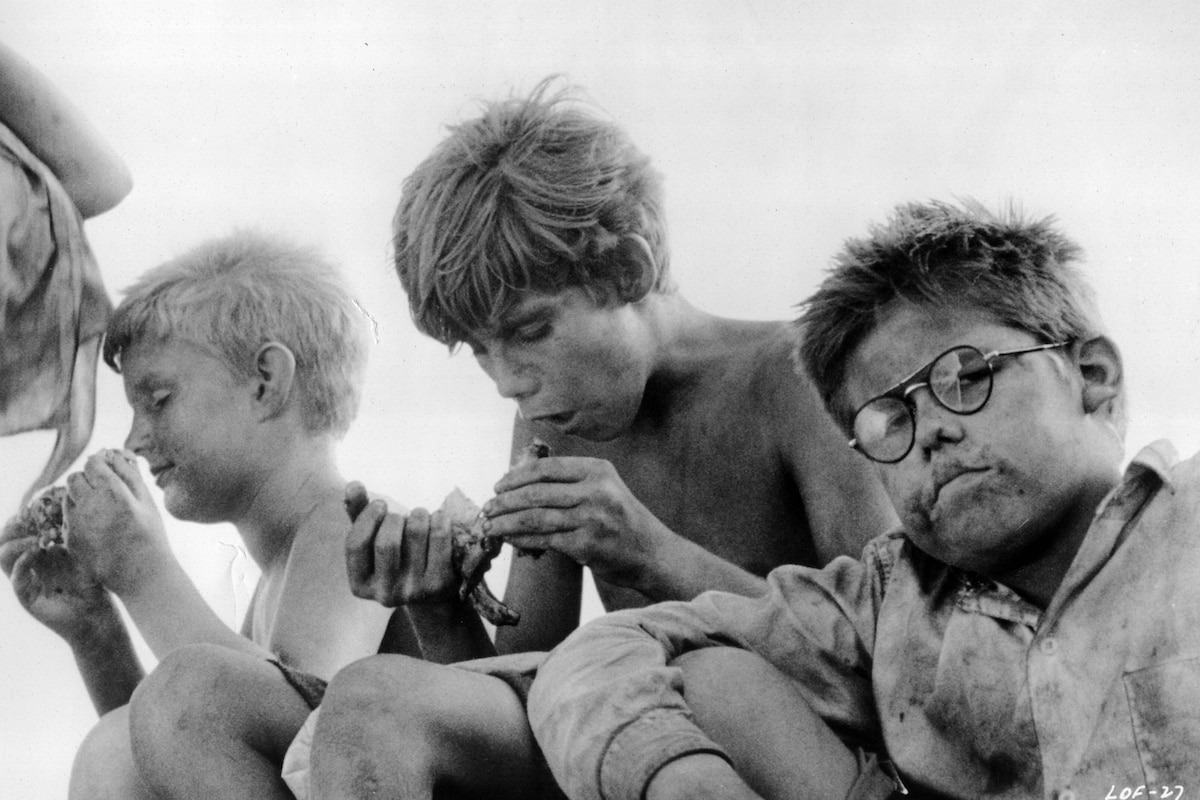
Though Peter Brook's Lord of the Flies (1963) is an expectedly
problematic adaptation of William Golding's cult novel, Brook showed characteristic
chutzpa in how he decided to interpret the material, and it's still more compelling
than the 1990 color remake. In a nutshell, Brook and his actors just made it
up as they went along. It would be hard to imagine another director,
outside of maybe Robert Altman, heading to Puerto Rico to film this picture
with a bare-bones crew and a cast full of amateur actors...with nothing but
a worn copy of the book to guide them!
Even without that kind of risk-taking, Brook may have had the deck stacked
against him from the start. Golding's narrative is arguably too on-the-nose
for proper filmic representation. In it, a group of British schoolboys
survive a horrible plane crash, then wash ashore on a remote, unpopulated
island. All the adults on the plane have been killed, so the kids elect a
benevolent leader named Ralph (played by James Aubrey in the movie), who does
the best he can to establish a makeshift, civilized society.
Unfortunately, Jack (Tom Chapin), the lead hunter of the group, has other
plans for their little community. Jack and his followers form a separate
faction and become savages, complete with war makeup. They take it upon
themselves to brutalize an overweight, much weaker boy nicknamed Piggy (Hugh
Edwards), and are soon creating myths about a monster that supposedly lives
in the jungle and requires a sacrifice. (You can hear Joseph Campbell
saying, "I told you so!")
This is powerful stuff, especially when you consider that these savages were previously
a prim group of British schoolchildren. But Golding seems to think it's the unavoidable
outcome of the situation, never mind his carefully calculated social
metaphor. In the movie, the children's retreat to their murderous instincts
is fairly frightening, but comes too quickly, and seems too obvious. The
book's dreamlike horror is blunted in the process.
Still, the picture is often fascinating. Brook, who was already a legendary
theater director at the time that he made Lord of the Flies,
placed the children in the proper setting, then fed them the basic storyline and
dialogue until they began to inhabit their characters. "British
films are financed and planned and controlled in such a way," he once said,
"that everything goes into the crippling concept of screenplay. And a
breakthrough can only come about thoroughly and satisfactorily if the
working conditions can be freed, so that smaller crews and lower budgets
give people the opportunity to take more time, and go back on their tracks,
if necessary, without anyone worrying them."
This Godardian conception of filmmaking might have worked better had Brook
hired trained performers. If anything, he seemed to have put too much faith
in Golding's ideas. You could argue that Lord of the Flies,
as Brook designed it, would have worked from beginning to end only if the kids had
actually turned into murderous brutes.
Expecting the worst, however, was often a part of Brook's MO as a
director. Kenneth Tynan once wrote that Brook's stage work suggested "that
people stripped of social conventions are rotten to the core." This
picture, then, is a fully appropriate mating of director and material, and
the results are just as fittingly reckless.
Director: Peter Brook
Screenplay: Peter Brook, based on the novel by William Golding
Editors: Peter Brook and Gerald Feil
Producer: Lewis M. Allen
Music: Raymond Leppard
Principal Cast: James Aubrey (Ralph), Tom Chapin (Jack), Hugh Edwards
(Piggy), Roger Elwin (Roger), Tom Gaman (Simon).
B&W-90m. Letterboxed.
by Paul Tatara
Lord of the Flies (1963)
by Paul Tatara | August 25, 2004
SIGN UP FOR OUR NEWSLETTERS

CONNECT WITH TCM