Southern California has often served as a whipping boy for satirists, with the emerging
counter-culture of the sixties being one of the most obvious targets. Evelyn Waugh
provided a wickedly funny critique of it - from pet cemetaries to the movie industry
- in his novel, The Loved One, which director Tony Richardson
transformed into a flamboyant, over-the-top black comedy in 1965. Other attempts
to capture the region's cultural quirkiness and eccentricities on film include
Lord Love a Duck (1966), Bob and Carol and Ted and Alice
(1969) and Serial (1980), based on Cyra McFadden's column and
best-selling book. Less well known than the above but an entertaining time capsule
of its era nonetheless is Don't Make Waves, which looks better
now than when it was first released in 1967.
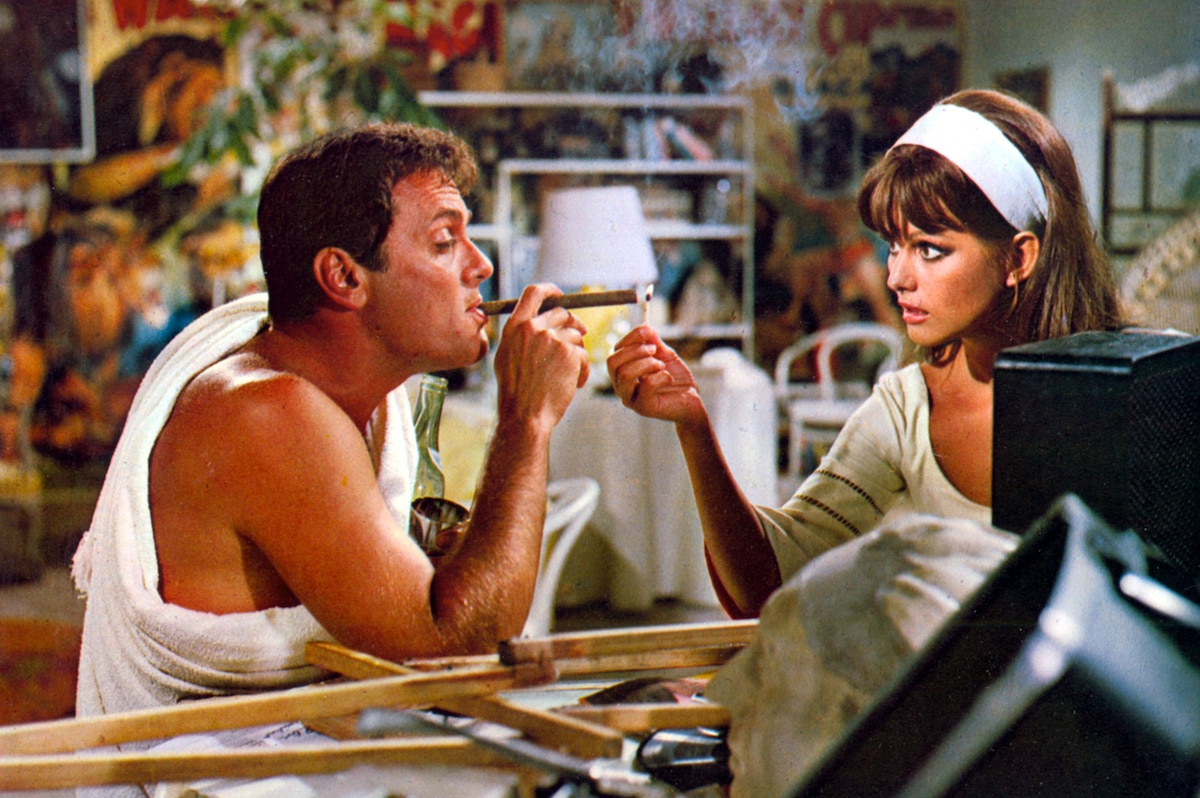
Based on the Ira Wallach novel, Muscle Beach, which poked fun
at health and fitness fanatics, the film focuses on Carlo Cofield (Tony Curtis),
a drifter who loses his car and all of his possessions in a freak accident within
minutes of arriving at the coast. (In the book, Carlo is a recently fired college
professor). In short order, he moves in with the woman (Claudia Cardinale) who caused
the accident, the Italian mistress of a married businessman (Robert Webber), and
bluffs his way into a job with her lover as a swimming pool salesman in Los Angeles.
Along the way he encounters a variety of California "characters" including
assorted bodybuilders and a female skydiver named Malibu (Sharon Tate). Carlo's
lucky streak ends with the acquisition of a scenic hillside home overlooking the
Pacific, a situation which has a comic payoff in the film's climactic mud slide.
Producer Martin Ransohoff recruited British director Alexander Mackendrick for Don't
Make Waves which might seem like an unlikely choice at first glance. But
Mackendrick had already proven himself a sharp and witty observer of human foibles
in such screen comedies as Whiskey Galore! (aka Tight
Little Island, 1949), The Man in the White Suit (for
which he received an Oscar® nomination in 1952), and The Ladykillers
(1955). It also helped that he had worked well with Tony Curtis, the film's star,
in a previous film, the highly acclaimed noir drama, Sweet Smell of Success
(1957). The actual truth is that Mackendrick was tricked into making Don't
Make Waves. As he revealed in Lethal Innocence: The Cinema of
Alexander Mackendrick by Philip Kemp (Methuen), "That whole operation
was Hollywood at its worst. I had an agent at that time - he's dead now - who was
a buddy of Ransohoff's. The pair of them went to Tony [Curtis] and told him, "Sandy
has this subject he's dying to make, and he got on very well with you - so he wants
to know if you would do it, because it's something that's very dear to his heart."
And then they came to me and said, "Tony Curtis has this subject that's very
dear to his heart," and so on. We later found out both of us thought the material
was absolute rubbish."
From the very beginning, making the film proved to be an ordeal for Mackendrick.
Ira Wallach, who based the screenplay on his novel, was forced to revise his script
three times before leaving the project in frustration. The producers then brought
in another writer, George Kirgo, who did not get along with the director. Mackendrick
even tried to get taken off the project but was threatened with a lawsuit if he
quit so he stayed and tried to make the best of a bad situation. Tony Curtis, in
his autobiography co-written with Barry Paris, recalled that "Erich von Stroheim,
Jr. was the assistant director on Don't Make Waves. He and Mackendrick
hated each other...I think that experience with Erich junior was one of the things
that soured Mackendrick on the business." Introducing another chaotic element
into the mix was co-producer John Calley who brought in author and satirist Terry
Southern (Candy, 1968) to provide additional dialogue during the final
stages of production. According to Kemp's book on Mackendrick, it was common knowledge that Calley and Southern got high and sat up all night "writing funny, outrageous lines of dialogue. All the funniest stuff in the film, such as it was, was ad-libbed by Calley and Southern."
Despite Mackendrick's own harsh assessment of Don't Make Waves,
the film is often surprisingly funny and full of incidental pleasures. For one thing,
Curtis is perfectly cast as the shyster pool salesman; his Carlo Cofield could be
a distant cousin of Sweet Smell of Success's Sidney Falco, albeit
a more benign and ineffective version. Philip Lathrop's bright, sun-kissed cinematography perfectly captures the Malibu vibe and Ms. Tate, in one of her final films (despite a screen credit that reads "Introducing Sharon Tate"), is both enigmatic
and vacuous as Carlo's sexual fantasy; her trampoline scene is a voyeuristic high
point. There are also amusing cameo appearances by Jim Backus (playing himself as
a potential customer of Carlo's), comedian Mort Sahl, and, strangest of all, ventriloquist
Edgar Bergen as "Madame Lavinia," a syndicated newspaper astrologist.
The sight gags are also occasionally inspired, especially one involving Carlo's
cliffside house which at the film's end is about to slide into the sea. Mackendrick
admits that the scene was a steal from Chaplin's The Gold Rush (1925)
but it works beautifully in conveying the fragile, quixotic nature of life in Southern
California. The skydiving sequence is also memorable though the parachute jump required 35 attempts before they got a perfect take and in a tragic turn of events, one of
the stuntmen, Bob Buquor, drowned off the Malibu coast while shooting this sequence.
Don't Make Waves opened to mostly mixed reviews but Andrew Sarris
of the Village Voice called it "one of the most underrated
comedies of the season" and another reviewer called it "the one gem out
of nine million bad Tony Curtis comedy vehicles." The jury is still out on
whether the film will ever attract a cult following but this much is certain - it
marked the end of Mackendrick's film career. After completing it, he tried - and
failed - to raise financing for two long-cherished personal projects - Rhinoceros
and Mary Queen of Scots - which eventually were made without
his involvement. Instead, Mackendrick retired from filmmaking and began a teaching
career at the California Institute of the Arts.
Producer: Julian Bercovici, John Calley, Martin Ransohoff
Director: Alexander Mackendrick
Screenplay: George Kirgo, Maurice Richlin, Terry Southern, Ira Wallach (novel)
Cinematography: Philip H. Lathrop
Film Editing: Rita Roland, Thomas Stanford
Art Direction: Edward C. Carfagno, George W. Davis
Music: Chris Hillman, Jim McGuinn, Vic Mizzy
Cast: Tony Curtis (Carlo Cofield), Claudia Cardinale (Laura Califatti), Robert Webber
(Rod Prescott), Joanna Barnes (Diane Prescott), Sharon Tate (Malibu), David Draper
(Harry Hollard).
C-97m. Letterboxed. Closed captioning.
by Jeff Stafford
Don't Make Waves
by Jeff Stafford | August 25, 2004
SIGN UP FOR OUR NEWSLETTERS

CONNECT WITH TCM