The story of a young boy who loses his soul to the ravages of warfare,
Germany, Year Zero (1947) examines the struggle to reinvent meaning in a
physically and morally devastated society. It's the final picture in
Roberto Rossellini's hard-hitting "war trilogy," the prior installments
being Rome, Open City (1946) and Paisan (1946). These films
are landmarks in the evolution of Italian neo-realist cinema, a deeply
compelling technique that infuses fictional storylines with semi-documentary
renderings of time and place.
Germany, Year Zero couldn't have been further removed from the
escapist pictures that were coming out of America at the time. As the story
opens, World War II has ended. Berliners are trying to regroup, then
rebuild their Allied-occupied city. The main character, twelve year-old
Edmund Koeler (Edmund Moeschke), is forced to grow up quickly amidst the
ruins, especially since his father (Ernst Pittschau) is too ill to earn a
living.
Everyone in Edmund's family suffers. His mother has been killed. His older
brother, Karl (Franz Kruger), is a former Nazi soldier who's terrified that
he'll be jailed as a war criminal; he can't register with the authorities,
so finding work is impossible. Edmund's adult sister, Eva (Ingetraud
Hinze), resists the unfortunately obvious route of becoming a prostitute.
These desperate circumstances will lead Edmund to commit what can only be
called a brutal act of compassion, one that shatters the remaining vestiges
of his pre-war existence.
Early in his life, Rossellini (who fathered actress Isabella Rossellini
while married to Ingrid Bergman) would have seemed an unlikely candidate to
direct such a film. The product of a wealthy Roman family, he found himself
working for Benito Mussolini's Fascist-controlled motion picture unit while
still in his 30's; he even wrote screenplays with the leader's son, Vittorio
Mussolini. But Rossellini asserted a new viewpoint when he shot Rome,
Open City, and continued to do so with the other pictures in his
trilogy.
His seemingly haphazard approach to shooting invests Germany, Year
Zero with an indisputable raw energy. This experimentation was even
extended to the casting decisions and script development. Knowing only that
he wanted to make a film about post-war Germany, Rossellini visited the
country looking for inspiration. His sojourn posed many questions: "The
Germans were human beings like us," he once said. "What could have lead
them to this disaster? False morality, the very essence of Nazism?
Abandonment of humility for the cult of heroism? Exaltation for force,
rather than weakness? Pride rather than sympathy?" He would seek the
answers while improvising a film.
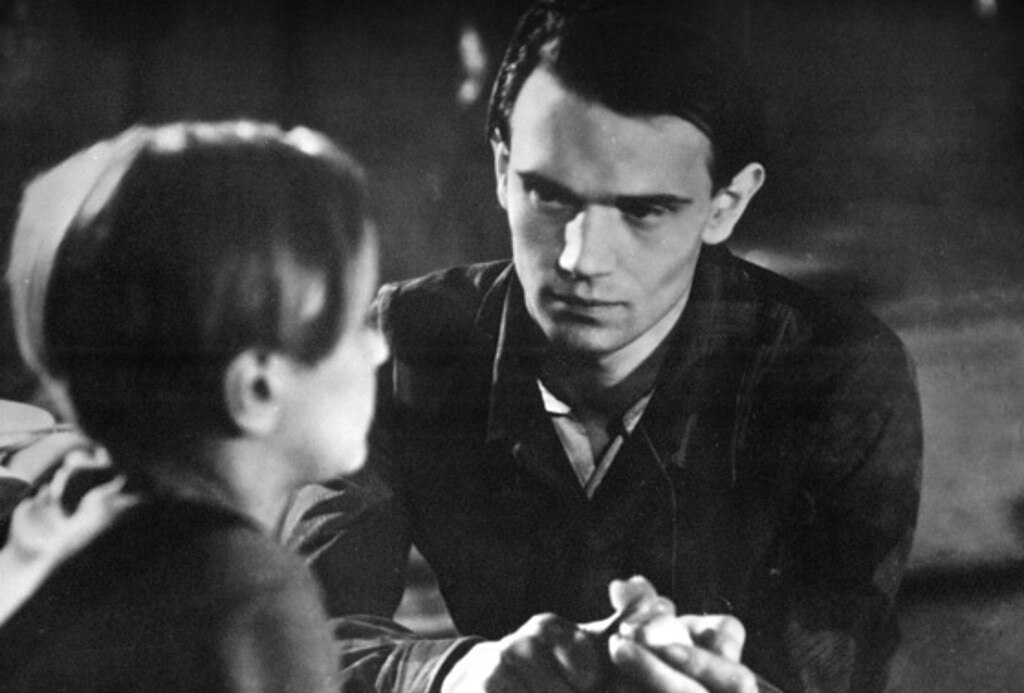
The cast of Germany, Year Zero was chosen from non-performers who were
discovered in bombed-out Berlin. Pittschau (who, it turned out, had acted
in a few silent pictures) was living in a public home for the aged. The
"resigned despair" on Hinze's face struck Rossellini when he saw her waiting
in line for food. Kruger came from a family of scholars, and, along with his
father, had been jailed by the Gestapo. And Moeschke was a circus hand who
Rossellini noticed when he was actually more interested in checking out some
performing elephants. The boy's resemblance to Rossellini's late son sealed
the deal. "Anyone can act," the director said, "provided he is in familiar
surroundings and given lines that are natural."
He wasn't kidding, either. The process of creating Germany, Year
Zero's dialogue is best illustrated by an exchange Rossellini had with
Moeschke during one of their first meetings: "You must be very rich,"
Moeschke said. "Only very rich people can have a tablecloth in Germany."
"You'll say that in my film," Rossellini replied.
Director: Roberto Rossellini
Producers: Roberto Rossellini and Alfredo Guarini
Screenplay: Roberto Rossellini and Max Kolpe
Cinematography: Robert Juillard
Editing: Eraldo Da Roma
Sound: Kurt Doubrowsky
Art Direction: Piero Filippone
Principal Cast: Edmund Moeschke (Edmund), Ernst Pittschau (Herr Koeler), Ingetraud Hinze (Eva), Franz Kruger (Karl), Erich Guhne (Herr Enning).
BW-71m.
by Paul Tatara
Germany Year Zero
by Paul Tatara | August 27, 2004
SIGN UP FOR OUR NEWSLETTERS

CONNECT WITH TCM